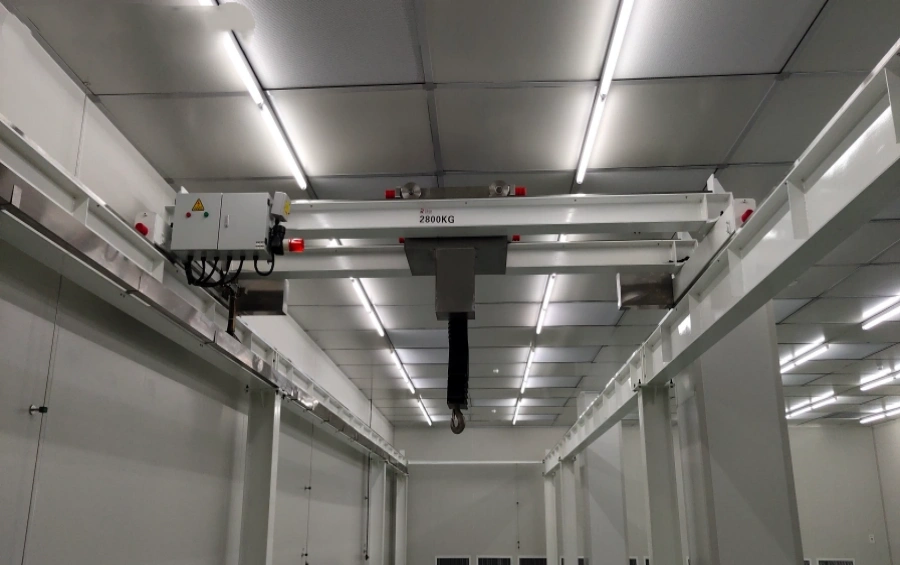
1. What Is a Clean-room Crane?
Not every overhead crane can operate in a clean-room. Clean-room environments demand strict control over hygiene, dust, bacteria, and safety standards. Standard industrial cranes simply don’t make the cut because they introduce risks like particulate shedding, oil leaks, noise, and bacterial growth—all of which compromise product integrity and worker safety.
Moreover, maintenance in a clean-room is far more complex. It’s not just about keeping the crane running; it’s about ensuring that every service intervention doesn’t contaminate the production line.
Weihua’s Clean-room Cranes are engineered specifically to solve these challenges. They meet rigorous international standards—including ISO 14644, GMP, FDA, and CE—ensuring your facility remains compliant while maintaining high operational efficiency.
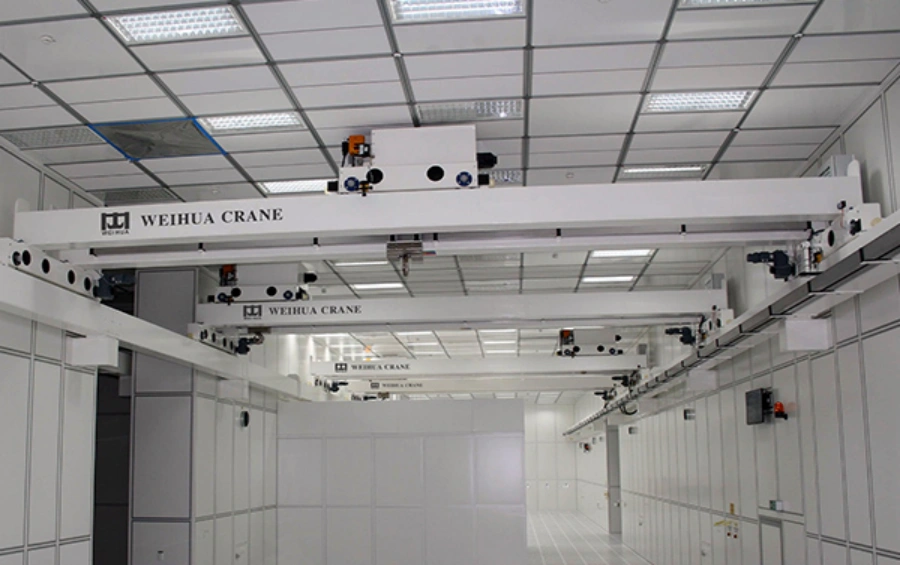
2. Why Do You Need a Clean-room Crane?
Using a standard crane in a controlled environment is a risk you shouldn’t take. Here’s why specialized equipment is non-negotiable:
Contamination Control: Standard cranes leak oil, shed rust or paint particles, and harbor microbes. In a clean-room, even a microscopic drop of lubricant or a single particle can ruin an entire batch of pharmaceuticals or semiconductors.
Regulatory Compliance: Industries like healthcare and microelectronics are governed by strict regulations (FDA, EU CE, GMP, ISO 14644). These mandates explicitly require equipment designed to prevent contamination. Using non-compliant machinery can lead to failed audits and costly shutdowns.
Space Constraints: Clean-rooms often have limited headroom and tight layouts. Standard cranes are bulky and difficult to integrate. Clean-room-specific designs are compact and optimized for these constrained spaces.
Precision & Stability: Whether you’re handling delicate wafers, sterile vials, or optical instruments, you need millimeter-perfect positioning. Standard cranes lack the fine control required for these high-precision tasks.
3. Core Features & Technical Advantages
Weihua clean-room cranes are built from the ground up for controlled environments:
(1)Zero-Contamination Design
Sealed Components: Motors and gearboxes are fully enclosed to prevent internal particulates from escaping and external contaminants from entering.
Specialized Surface Finishes: We use stainless steel or anodized aluminum to eliminate rust and corrosion. These materials are non-porous, making them easy to sterilize and resistant to chemical cleaning agents.
(2)Clean Lubrication Systems: Choose between maintenance-free (dry) systems or food-grade lubricants (H1 certified) for applications in food processing or pharma, ensuring zero risk of toxic contamination.
(3)High Precision & Low Vibration
Advanced VFD Control: Our Variable Frequency Drives ensure smooth acceleration and deceleration, eliminating load swing. This is critical for handling fragile items like silicon wafers or glass substrates.
(4)Anti-Sway Technology: Integrated algorithms actively counteract pendulum effects, allowing for precise placement without manual correction.
(5)Easy Cleaning & Low Maintenance
Modular Design: Components are designed for quick removal and cleaning without disassembling the entire structure. Smooth surfaces prevent dust accumulation, reducing cleaning time and labor costs.
(6)Smart Monitoring: IoT-enabled sensors track load weight, height limits, and travel boundaries. This reduces the need for manual inspections (minimizing human presence in the cleanroom) and prevents accidents before they happen.
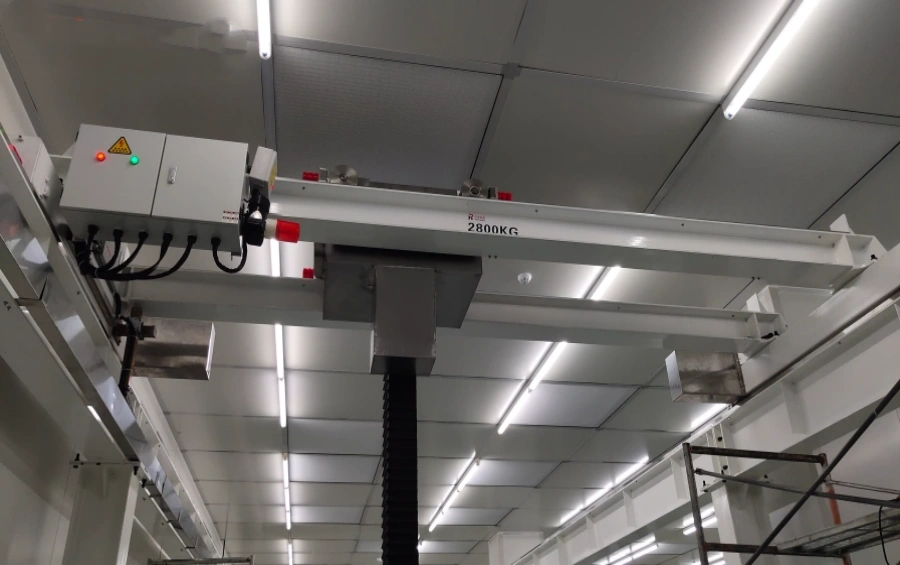
4. Key Application Scenarios
(1) Semiconductor Manufacturing: Ideal for wafer handling, lithography machine maintenance, and clean-room logistics where particle counts must remain near zero.
(2)Pharmaceuticals & Biotech: Perfect for sterile raw material handling, filling lines, and packaging areas requiring GMP compliance.
(3)Aerospace & Optics: Supports the assembly of sensitive instruments and aircraft components where dimensional accuracy is critical.
(4)Food Processing: Ensures hygiene standards are met during production, preventing cross-contamination in ready-to-eat food lines.
5. How to Choose the Right Clean-room Crane
Selecting the right crane isn’t just about lifting capacity. Consider these five factors:
1. Define Your Clean-room Class
Your ISO class (e.g., ISO 5, ISO 7) dictates the crane’s design requirements. Higher cleanliness levels demand stricter sealing and material choices. Reference standards like FEM (M1–M8) or CMAA to determine duty cycles. Unsure? Contact our sales team—we’ll provide a tailored recommendation within 24 hours.
2. Load Capacity & Span
Balance your lifting needs with the span length. A shorter span under the same load extends the crane’s lifespan and reduces structural stress. Provide us with your exact layout, and we’ll optimize the design for longevity.
3. Material Selection: Stainless Steel vs. Coated Steel
Stainless Steel (304/316L): Best for high-corrosion environments, higher ISO classes, and facilities using aggressive cleaning chemicals. Higher upfront cost, but lower long-term risk.
Coated Steel (Epoxy Powder Coat): A cost-effective solution for less aggressive environments. Ensure the coating is high-quality, chip-resistant, and certified for clean-room use.
4. Certifications & Compliance
Never skip this step. Valid certifications (CE, ISO, FDA compliance docs) are your passport to global markets and audit success. They prove the equipment meets safety and hygiene standards, reducing liability and import hurdles.
5. Supplier Capability & After-Sales Support
A crane is only as good as the support behind it. Look for suppliers who offer:
Factory audits (virtual or in-person).
Responsive technical support.
Spare parts availability.
Total Cost of Ownership (TCO): Don’t just look at the purchase price. Consider maintenance frequency, downtime risks, and energy efficiency. A slightly higher initial investment often pays for itself in reduced operational risks.
Frequently Asked Questions
1.What’s the real difference between a clean-room crane and a standard crane?
It’s all about contamination control. Standard cranes shed particles, leak oil, and are hard to clean. Clean-room cranes are sealed, use special materials, and are designed to be wiped down or sterilized without degrading.
2.My facility is FEM M7. Should I choose stainless steel or coated steel?
If your process doesn’t involve corrosive chemicals and budget is a concern, high-quality epoxy powder-coated steel is a solid choice. However, if you need maximum rigidity, corrosion resistance, or are operating in a higher ISO class, 304/316L Stainless Steel is the safer, long-term investment.
3.How can I verify that a crane truly meets my clean-room class requirements?Ask for proof. Reputable suppliers will provide:
Material Certificates: Spectral analysis for stainless steel; adhesion and chemical resistance tests for coatings.
Test Reports: Independent verification of particle emission levels.
IQ/OQ/PQ Support: Documentation to help you complete Installation, Operational, and Performance Qualifications—essential for pharmaceutical and semiconductor audits.