English
 Español
 Русский
 العربية
 Français
 Deutsch
 Português
 Tiếng Việt
 Thai
Thai
 Bahasa Indonesia
 Türkçe
 Italiano

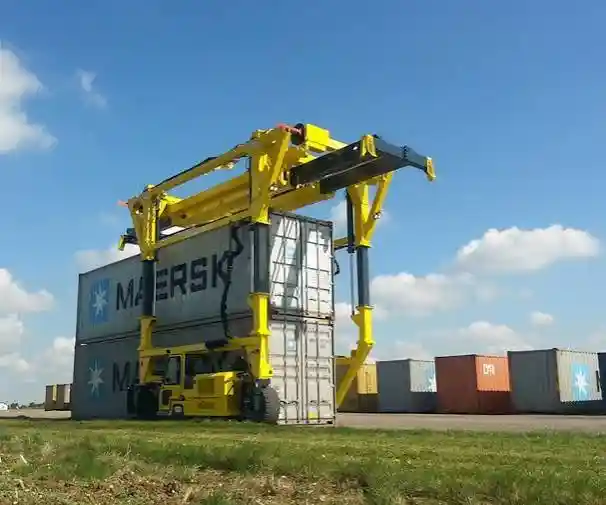
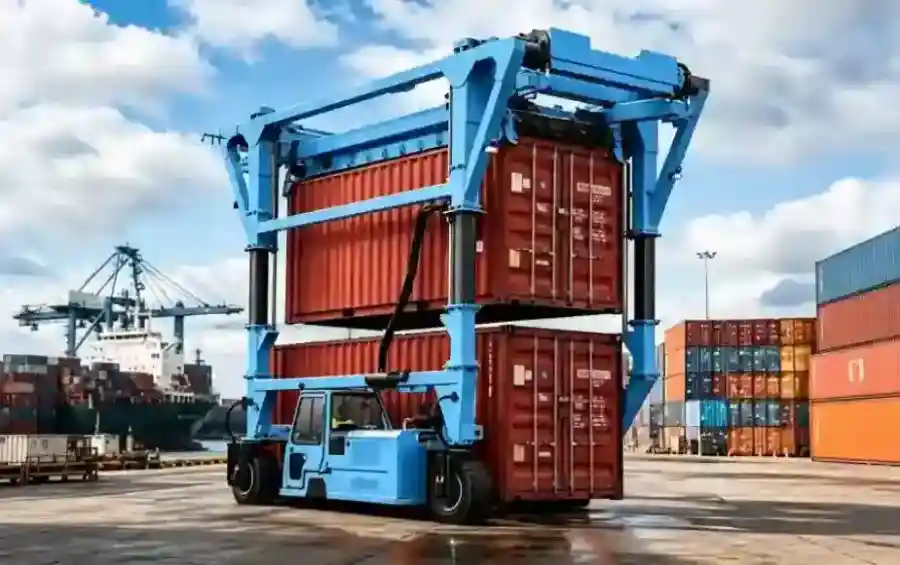
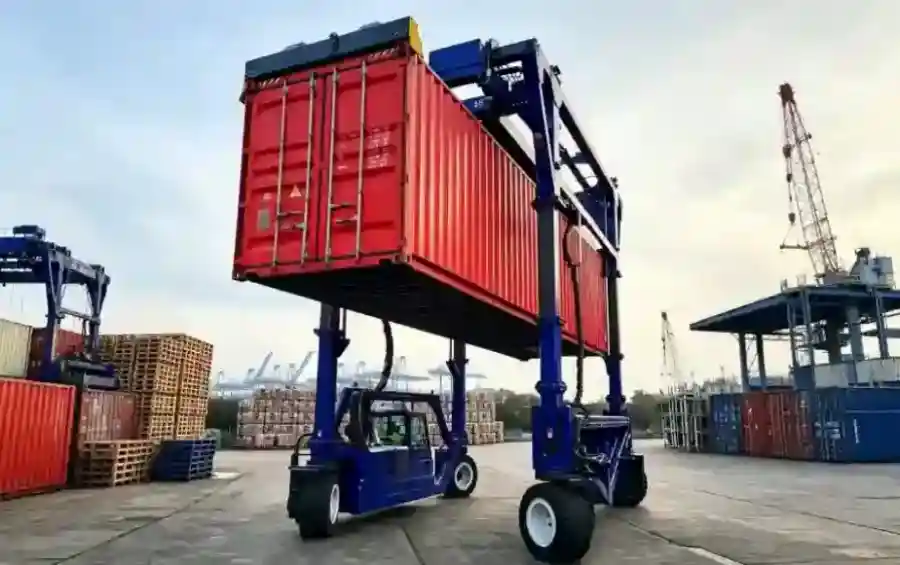
A container straddle carrier crane is a self-propelled, U-frame machine that lifts and transports ISO containers and oversized structural components within its own chassis. Unlike a gantry crane that runs on fixed rails or an RTG that moves along predetermined rows, a straddle carrier crane travels freely on solid rubber tires, picks up a load from any position in the yard, and delivers it directly without requiring a trailer or truck.
This article covers the three tonnage classes — 35T, 60T, and 80T — the engineering features that set the straddle carrier crane apart from other container handling equipment, and the practical questions an overseas buyer should answer before issuing an RFQ.
Tonnage Classes and Their Real-World Use Cases
The 35-ton, 60-ton, and 80-ton models are not scaled versions of one design. Each is engineered around a specific set of operational constraints.
Four Engineering Features Unique to Straddle Carrier Cranes
These four features are specific to the straddle carrier crane design. None of them apply to gantry cranes, reach stackers, or forklifts.
Rigid Telescopic Frame with Adjustable Wear Pads
The lifting frame consists of an outer guide sleeve and an inner guide column. High-wear material pads fill the gap between them and absorb the lateral stress generated during high-speed travel and sharp turns. When the pads wear, the gap can be adjusted incrementally instead of replacing the entire assembly. This reduces maintenance downtime by up to 50%.
Fail-Safe Hydraulics with ±200 mm Side-Shift
Each lifting cylinder is fitted with a one-way counterbalance valve. If a hydraulic line ruptures or loses pressure, the valve locks mechanically and instantly — no free-fall. The spreader also supports ±200 mm of lateral side-shift, allowing the operator to align the container with the target slot without repositioning the machine. Cycle time is reduced by roughly 15%.
Wet Multi-Disc Brakes and Six Steering Modes
The travel drive uses full-hydraulic hub motors with spring-applied, hydraulically-released wet multi-disc brakes. The brakes are normally closed: no hydraulic pressure means the brakes remain locked. If the engine stalls on a slope, the machine stops and holds position automatically.
The steering system provides six modes — straight, diagonal, crab, and pivot steering among them. In pivot mode, the machine rotates around its own center point, which is a practical advantage when maneuvering in tight yard corners. Yard space utilization improves by an estimated 30% compared to equipment with limited steering options.
Dual Control Redundancy with Active Obstacle Detection
The control system runs on a PLC-based logic controller and supports two operating modes: cabin control and wireless remote. The remote allows the operator to stand on the ground and control the machine from a safe distance during high-risk lifts or when cabin visibility is blocked. An optional 360° camera system with ultrasonic obstacle detection provides audible warnings and automatic speed reduction when personnel or objects are detected within 4 meters.
Power Options — Which One Makes Sense for Your Yard
The choice of power system affects both the purchase price and the operating cost over the next decade.
Diesel — Lowest upfront cost. No charging infrastructure required. Works for yards without grid access. The trade-off is higher long-term fuel and engine maintenance costs, plus emissions restrictions in markets like the EU.
Diesel-Electric Hybrid — The generator runs at optimal RPM while the electric drive manages acceleration and deceleration. During hoisting and frequent start-stop cycles, the battery or capacitor bank assists, cutting fuel consumption by 20–30%. The system is more complex and requires higher maintenance skill.
Pure Electric (Battery) — Lowest per-hour operating cost. Electricity is cheaper than diesel, and there is no engine to maintain. Zero emissions, low noise. The initial equipment cost is higher, and the yard needs charging stations. Shift scheduling must account for charging downtime.
Grid-Connected Electric — Cable reel or sliding contact system for continuous power. Only feasible in fixed-yard layouts where the machine operates within a defined area.
Five Questions to Answer Before You Send an RFQ
These five questions are taken from a manufacturer’s sales checklist. They determine whether the quoted straddle carrier crane will actually work in your yard.
1. What are you lifting?
Standard ISO containers require an automatic telescopic spreader with twist locks. Non-standard steel structures or oversized machinery need a lifting beam with slings and wire ropes. The two configurations are not interchangeable without modification.
2. What is the narrowest passage in your yard?
The 35-ton model needs a 3,200 mm clear passage. The 60-ton and 80-ton models need 3,700 mm. Turning radii are 7,000 mm, 10,000 mm, and 12,000 mm respectively. Measure the actual turning space, not just the straight-path width.
3. Is your yard floor reinforced?
A fully loaded straddle carrier crane generates significant wheel load. If the yard surface is gravel or unpaved soil, the tire contact area and ground bearing capacity must be recalculated. The machine can sink or become stuck on unprepared ground.
4. How will the machine be shipped?
A straddle carrier crane does not fit inside a standard container. It must be shipped via flat rack (FR), roll-on/roll-off (Ro-Ro), or breakbulk vessel. Shipping costs vary significantly by method, so involve a freight forwarder early in the quotation process.
5. Can you source spare parts locally?
Solid tires, hydraulic components, and wear pads are consumables that typically need replacement within 2–3 years. If there is no local distributor in your country, ordering a 2-year consumables kit bundled with the initial purchase is a practical safeguard against downtime.
Standard Safety Systems
The following safety features are built into the standard configuration:
•Wind siren and anemometer — Alerts the operator when wind speed exceeds the safe operating limit.
•Break-proof shaft — Prevents the drive shaft from separating under mechanical failure.
•Overturn prevention — Structural stability control reduces tipping risk during turning or uneven terrain operation.
•Anti-sway system — Minimizes container swing during lifting and travel.
•CMS intelligent monitoring — Displays real-time load weight, engine parameters, and fault diagnosis.
Before shipment, the fully assembled machine undergoes a 120% overload test. Buyers can arrange third-party inspection (SGS, TUV, or similar) during the factory acceptance test, either on-site or via live video.
Frequently Asked Questions
Q1: What is the difference between a container straddle carrier crane and an RTG crane?
A straddle carrier crane is self-propelled and carries the container within its own frame. It can change direction freely and requires no fixed infrastructure. An RTG runs on rubber tires but operates within a fixed row of containers, moving along a predetermined path. Straddle carriers are better suited for flexible yard layouts that require frequent reconfiguration.
Q2: Can a straddle carrier crane handle 45-foot containers?
Yes. The telescopic spreader on the 35-ton and higher models is designed to handle 20-foot, 40-foot, and 45-foot standard ISO containers.
Q3: What is the minimum turning radius?
35-ton: 7,000 mm. 60-ton: 10,000 mm. 80-ton: 12,000 mm.
Q4: What is the typical service life?
10–15 years with proper maintenance. Total cost of ownership is influenced by the quality of the initial configuration and the availability of spare parts for solid tires and wear pads.
Q5: Can I inspect the machine before shipment?
Yes. Most manufacturers accept on-site or live video inspection by the buyer or a third-party agency such as SGS or TUV. A 120% overload test is performed in the factory before shipment.