English
 Español
 Русский
 العربية
 Français
 Deutsch
 Português
 Tiếng Việt
 Thai
Thai
 Bahasa Indonesia
 Türkçe
 Italiano

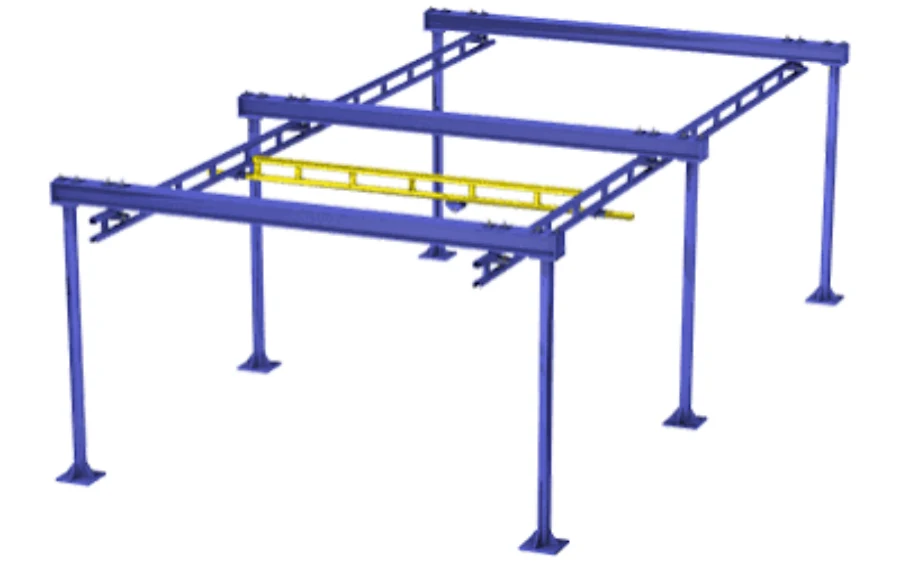
A workstation bridge crane is a modular, self-supporting light-duty lifting system designed for repetitive material handling tasks in workshops, assembly lines, and warehouses. Unlike traditional overhead cranes that depend on building roof structures for load-bearing support, workstation bridge cranes feature a freestanding rigid frame that eliminates the need for factory modifications.
Weihua, a leading crane manufacturer with products exported to over 120 countries, offers a comprehensive range of workstation bridge crane systems tailored to diverse industrial applications.
Key Specifications
Weihua workstation bridge cranes are engineered to deliver precise lifting performance across a wide range of working conditions. The following table outlines the core technical parameters:
Lifting Capacity: 0.25 - 5 ton
Span: 1 - 12.5 m
Lifting Height: 3.7 - 13.5 m
Power Supply: 380V, 50Hz, 3-Phase
Lifting Equipment: Chain Hoist or Wire Rope Hoist
Control Method: Remote Control
Travelling Type: Manual or Electric
Duty Class: A2 - A3
Operating Temperature: -20 ℃ to +60 ℃
Types of Workstation Bridge Cranes
Weihua offers five primary configurations to match different operational requirements:
Single-girder workstation bridge crane: Features a lightweight single main girder, ideal for loads up to 2 tons in assembly and packaging areas.
Double-girder workstation bridge crane: Utilizes a dual-girder structure for stronger load-bearing capacity and larger spans, handling loads from 125 kg to 3 tons.
Rigid workstation bridge crane: Built on a rigid steel frame with minimal deflection and strong anti-sway capability, supporting 125 kg to 2 tons (up to 5 tons in reinforced models).
Flexible workstation bridge crane: Constructed from lightweight modular components with bolt-together assembly, suited for flexible handling environments under 2 tons.
Aluminum alloy workstation bridge crane: Made from high-strength aluminum for corrosion resistance and cleanliness, ideal for food, pharmaceutical, and electronics applications (up to 2 tons).
Core Advantages
The self-supporting design is the defining advantage of the workstation bridge crane — no roof reinforcement or structural modifications are required, which significantly reduces installation time and cost. The modular rail system supports straight, curved, closed-loop, and multi-layer track configurations, allowing the crane to adapt to virtually any workshop layout.
Each component — rail system, bridge beam, moving trolley, lifting mechanism, and electrical control system — is standardized for compatibility and quick replacement. This modular approach keeps maintenance costs low while ensuring long-term operational stability. The system also supports manual, electric, or fully automatic operation, making it easy to integrate into intelligent production lines.
Applications
Workstation bridge cranes serve a wide range of industries where precision lifting and repetitive handling are essential:
Automotive manufacturing: Component transport, assembly line support, and quality inspection stations
Electronics manufacturing: Precision handling of sensitive components with accurate positioning
Food processing: Hygiene-compliant material handling using clean-material construction
Pharmaceutical manufacturing: Transport and packaging of raw materials and finished products
Warehouse logistics: Loading, unloading, sorting, and storage operations
Selection Guide
Choosing the right workstation bridge crane requires a clear understanding of your operational parameters. Start by determining the maximum load weight you need to lift on a regular basis — avoid over-specifying, as higher capacity increases cost unnecessarily. Next, measure the available workshop floor space and ceiling height to confirm that the span and lifting height fall within the standard range.
For environments with strict cleanliness requirements such as food processing or pharmaceuticals, the aluminum alloy model is the recommended choice. For heavier or more frequent lifting cycles, the double-girder or rigid configuration provides greater stability and load-bearing capacity.
Weihua's engineering team can provide customized designs based on your specific handling routes and spatial constraints.
Frequently Asked Questions
Q1: What is the maximum lifting capacity of a Weihua workstation bridge crane?
A: Up to 5 tons, with standard models typically ranging from 250 kg to 3.2 tons depending on the configuration.
Q2: Does a workstation bridge crane require roof reinforcement?
A: No. The self-supporting rigid frame carries all loads independently, eliminating any structural dependency on the factory roof.
Q3: Can the rail system be reconfigured after installation?
A: Yes. The modular rail design supports straight, curved, and closed-loop layouts, and can be expanded or reconfigured as operational needs change.
About Weihua
Weihua Group is one of China's largest crane manufacturers, with bridge and gantry crane output ranking first in China for ten consecutive years. The company holds over 500 honorary titles, operates a 600-person R&D team, and exports to more than 120 countries worldwide. Weihua's workstation bridge crane systems are designed in accordance with FEM and DIN standards, ensuring international quality and reliability.