


 English
 Español
 Русский
 العربية
 Français
 Deutsch
 Português
 Tiếng Việt
 Thai
Thai
 Bahasa Indonesia
 Türkçe
 Italiano

What a Free-Standing Jib Crane Is, and What Makes It Different?
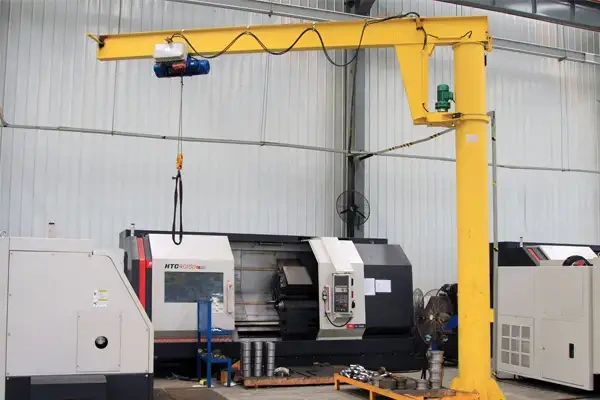
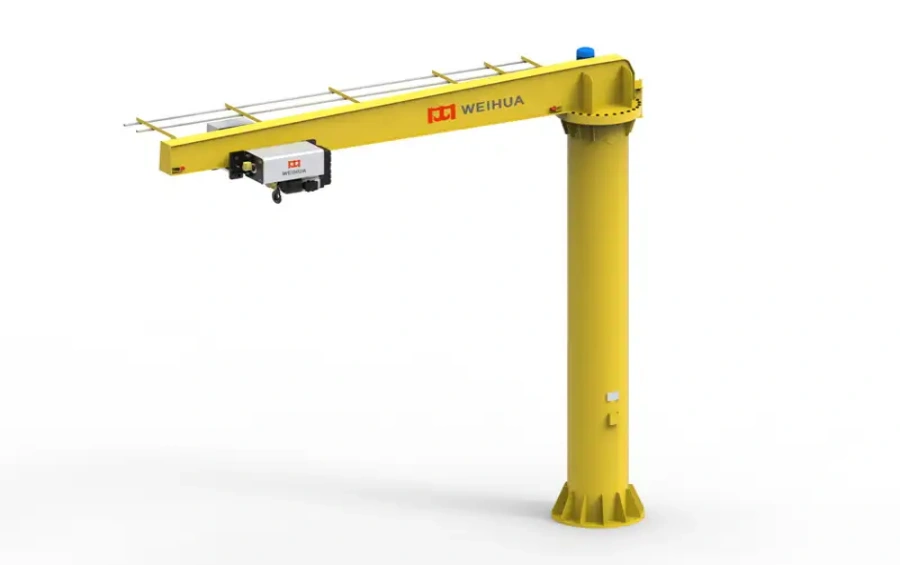
A free-standing jib crane — also referred to as a pillar jib or self-supporting jib — is a rotating crane where the entire overturning moment is resisted by a single reinforced concrete foundation block. A vertical mast rises from that block, a horizontal jib (boom) pivots at the top of the mast, and a hoist runs along the underside of the boom. That description sounds similar to a wall-mounted jib, but the difference is structural, not cosmetic: a wall-mounted jib ties its back end into a reinforced column in your building, and a mast-type jib braces its top to the ceiling with tie-rods. On a free-standing jib, the foundation is the only thing keeping the crane upright. That single fact is why a free-standing unit can sit outdoors, against a leased building, or in the middle of an open yard — and why every other jib type needs a building to lean on.
The mechanical consequence is that the foundation block under a free-standing jib is unusually deep and heavily reinforced compared to the foundation under a wall bracket. The mast reaction includes a vertical dead load, a horizontal slewing shear, and a bending moment at the base. For light indoor units the block may be 1.2–1.5 m square; for outdoor 5–10 t units with a 6 m boom, 2 m × 2 m × 2.5 m is a typical starting point that the supplier's reference drawing assumes. The final dimensions cannot be picked without your soil report — see the foundation section below.
Weihua supplies free-standing jib cranes from light workshop duty (≈0.25 t) up to heavy fabrication duty (≈10 t). The component list is the same regardless of capacity: base plate, anchor bolt cage, mast, head assembly with bearing, boom, hoist, and electrical collector. What changes with capacity is the mast wall thickness, the slew bearing type, and the foundation block — not the engineering principle.
Why the Foundation Block Is the Structural Member, Not Just a Footing?
For a free-standing jib, the foundation block is not a footing — it is a structural member of the crane itself. Get this wrong and the crane either cracks the slab it sits on, leans over time, or fails in a wind gust. Get it right and the supplier can ship a complete kit that includes the anchor bolt cage (a pre-welded steel cage of bolts and rebar that is set in the wet concrete so the mast base plate bolts down to a known pattern).
A few items apply only to free-standing designs and rarely get discussed until installation day:
-Anchor bolt pattern. Most light-duty units use 4 bolts in a square pattern (for example M24 × 4 on a 600 mm bolt circle); heavier units move to 6 or 8 bolts at M30–M36. The pattern is fixed by the mast base plate — ask for it on the foundation drawing, not just a generic "anchor bolts included" line.
-Foundation template. A good supplier ships a steel foundation template — a flat plate with bolt holes welded on — that is set in the formwork before the pour. Without it, anchor bolts drift during the pour and the mast base plate does not line up. This is the single most common installation delay.
-Concrete strength and curing. C25/30 is a common minimum for indoor duty; outdoor or cold-weather sites often need C30/37 with an admixture. The mast should not be erected until the concrete has cured — typically 7 days minimum before standing the mast, 28 days before full SWL loading. The supplier's installation manual will state the exact numbers.
-Soil bearing capacity. A 1–3 t unit on competent soil (≥100–150 kPa allowable bearing) is straightforward. On weak or fill ground, the block may need to be enlarged or a pile added. The supplier's reference drawing assumes a soil class; your civil engineer must adapt it to the actual soil at the site.
The Slew Bearing: King-Post vs Slew Ring
This is the part that lets the boom rotate, and it is the part that decides whether the crane is cheap to buy or expensive to live with. There are two constructions, and the difference is mechanical, not cosmetic.
-King-post (pin) bearing. A short cylindrical pin sits in a bronze or polymer bushing at the top of the mast, and the boom rotates around the pin. Simple, cheap, and adequate for light-duty indoor jibs up to about 2 t with short booms. The bushing wears and must be greased; replacement means removing the boom head.
-Slew ring (roller) bearing. A large ring gear with internal or external teeth is bolted between the mast head and the boom. A small gearmotor with a pinion drives the ring, and the boom rotates on rolling elements (balls or rollers). Used on virtually every free-standing jib above 2 t, and on lighter units that need precise slewing control or motorized rotation.
The mechanical difference drives three practical consequences:
1.Slewing control. A king-post jib is almost always hand-rotated. A slew-ring jib can be hand-rotated or motorized. For loads above 1 t or booms above 4 m, motorized slewing with VFD control is the difference between a usable crane and an arm workout for the operator.
2.Maintenance access. King-post bushings are greased from the side of the mast head; slew rings are greased from the outside of the ring. Ask where the grease fittings are before the boom goes up — once the crane is commissioned, you do not want to be disassembling anything to grease it.
3.Continuous rotation and electrical feed. For 360° rotation with a powered hoist, the hoist power must cross the rotating interface. A slip ring (also called a collector ring) is mounted inside or on top of the slew bearing, with enough conductors for hoist power, control, and any pendant or radio receiver. Confirm the slip ring IP class matches the environment (IP54 indoor, IP65 outdoor is a sensible minimum).
Hoist, Trolley, and the Power-Feed Path Across the Slew Bearing
On a free-standing jib, the hoist is almost always mounted on a trolley that runs along the underside of the boom. The trolley may be hand-pushed (cheap, suitable for occasional lifts) or motorized (necessary above about 1 t or for precise placement). The choice of hoist, and the choice of how power reaches that hoist across the slewing interface, both deserve attention because they vary a lot between indoor and outdoor units.
-Hoist type. Electric chain hoists are common up to 5 t for indoor duty; wire-rope hoists dominate above 5 t, for outdoor duty, or for higher utilization. Pneumatic hoists appear in explosion-risk or wash-down environments such as paint shops and pharmaceutical lines.
-Power feed to the hoist. The hoist must get power across the slewing interface and along the length of the boom. Three common arrangements:
-Festoon system. A flat or round cable is suspended on rollers or in a loop below the boom. Cheap and robust, but limited to about 180° slewing — the cable will twist on itself if the boom keeps rotating in the same direction.
-Conductor bar (power rail, busbar). A rigid rail along the boom feeds the trolley via a sliding contact. More expensive, but tolerates 360° slewing, and is the standard for outdoor jibs in monsoon or freeze-thaw regions where festoon cables degrade fast.
-Cable reel (spring-loaded drum). A drum on the mast head feeds cable out and back as the boom rotates. Common on outdoor yard jibs that swing 360° intermittently.
-Hoist and trolley speeds. Single-speed saves on the quotation; dual-speed or VFD earns the cost back on the first precision placement or the first fragile load.
Outdoor and Wind
A free-standing jib outdoors is a vertical sail with a horizontal sail bolted to its top. Most manufacturers publish a maximum in-service wind speed (commonly 20 m/s, or about 72 km/h, for the crane to be operating) and a maximum out-of-service wind speed (often 36 m/s or higher) above which the crane must be parked and tied down. Two practical provisions make this safe:
1.A lock-pin at the slew bearing. When the crane is not in use, the pin locks the boom in a fixed azimuth — usually pointing into the prevailing wind or into a leeward wall. The pin is mandatory for any outdoor unit in a cyclone, hurricane, or typhoon region.
2.A tie-down or storm anchor. A separate set of ground anchors engaged only when the crane is parked. This is distinct from the operating anchor bolts and is what the supplier should quote as a separate line item.
Surface finish is part of the spec. Indoor units get primer plus topcoat. Outdoor units need hot-dip galvanizing to ISO 1461 (or zinc-rich primer plus marine-grade topcoat for coastal or chemical sites). State the finish standard and the environment in the same line of the RFQ, or the factory default will arrive.
Frequently Asked Questions
What is the difference between a king-post bearing and a slew ring on a free-standing jib?
A king-post (pin) bearing uses a short cylindrical pin in a bushing at the mast head — simple, hand-rotated, common on light indoor units up to about 2 t. A slew ring is a large geared ring with rolling elements that supports heavier loads and allows motorized slewing. Free-standing jibs above 2 t, or any outdoor jib with motorized slewing, almost always use a slew ring.
How deep does the foundation block need to be?
It depends on the mast reaction and your soil bearing capacity. A 1–3 t free-standing jib on competent soil typically needs a block about 1.5 m × 1.5 m × 2 m deep, with the anchor bolt cage set before the pour. The supplier should issue a foundation drawing sized to your specific model and your soil report; treat any quote that does not include one as incomplete.
Can a free-standing jib crane be installed outdoors?
Yes, but specify outdoor duty from the start: hot-dip galvanized finish (or zinc-rich primer plus marine topcoat), IP65 enclosure and hoist, a declared in-service and out-of-service wind speed, a lock-pin for parking the boom, and a separate set of tie-down anchors for storm conditions. Confirm each item in the quotation.
