


 English
 Español
 Русский
 العربية
 Français
 Deutsch
 Português
 Tiếng Việt
 Thai
Thai
 Bahasa Indonesia
 Türkçe
 Italiano

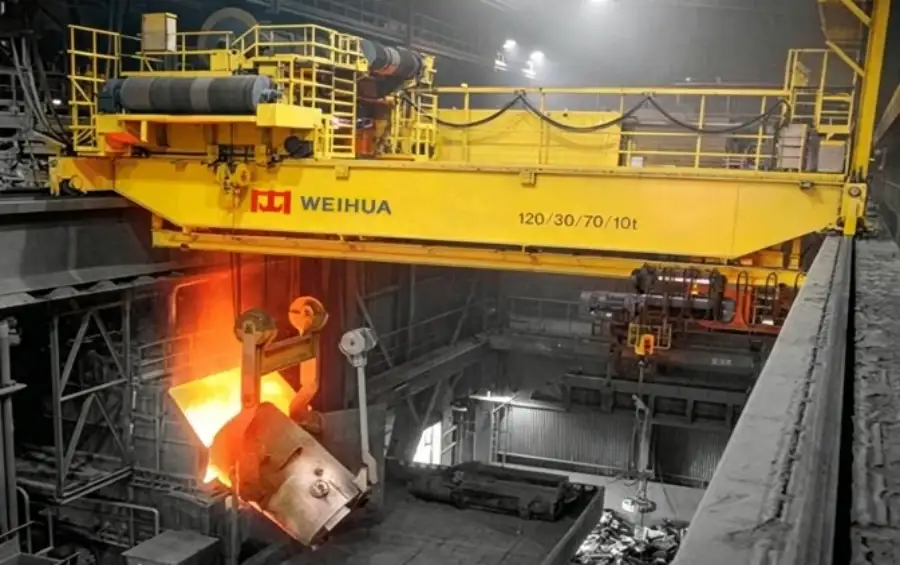
A metallurgy overhead crane operates alongside molten steel, scale dust, radiant heat from ladles, and shock loads during tapping. These conditions, not capacity alone, define the equipment. The cranes belong in the same engineering family as ladle transfer cars and torpedo ladle cars.
The family splits by application. Ladle cranes move molten steel at 1500–1650 °C between converter, ladle furnace, and continuous caster. Scrap chargers feed EAF and BOF furnaces. Slab, billet, and bloom cranes handle semi-finished steel between caster and rolling mill. Coil cranes run finishing lines. Foundry cranes move molds and pouring ladles. Capacity runs from roughly 40 t coil cranes to 450 t and beyond for ladle transfer; tonnage is the least interesting line on the data sheet.
Ladle Cranes as Safety-Critical Systems
A ladle crane carries molten steel in 100–400 t ladles on hooks that rarely center themselves. The load sloshes, the ladle flexes on its trunnions, and the path between vessel and caster crosses heat zones.
Three design decisions follow from this:
-Brakes are redundant and rated for emergency-stop from full hoisting speed with a full ladle. A primary brake failure drops molten steel if the secondary fails.
-Anti-sway is part of the safety case. Pouring into a narrow tundish or ingot mold requires ±50 mm repeatability, which manual control cannot deliver.
-Tandem hoisting is designed in. Many mills lift ladles with main and tail hoists; speed, position, and load share are synchronized by the control system.
What Heat and Dust Do to a Crane?
Ambient air around casting platforms reaches 60 °C, with radiant heat pushing local temperatures higher on the crane. Components fail in predictable ways:
-PVC-insulated cabling embrittles within months; silicone- or mineral-insulated conductors are the rule.
-Conductor bars collect conductive dust and develop tracking faults; cable reel or festoon systems with heat-resistant cable are common in hot zones.
-Wheel bearings, gearboxes, and motor housings need dust protection rated for the specific dust — iron oxide, sinter dust, scale — rather than generic IP ratings.
-Runway rails expand measurably; joints, anchors, and buffers are matched to the mill's thermal expansion model.
Standards a Buyer Should Cite in the RFQ
Most metallurgy cranes are specified against one or more of the following:
-ISO 4301 for duty classification (A6–A8 for metallurgy work).
-FEM 1.001 / 9.341 / 9.511 for the European tradition.
-EN 15011 for European crane safety, including ladle-specific clauses.
-CMAA 70 / 74 for North American specifications.
-GB/T 3811 for Chinese-built equipment, often relevant for export documentation.
A quotation that does not name the standards it cites has to be translated twice — once into English, once into engineering.
Selection Logic Tied to the Steelmaking Process
Standard crane selection asks capacity, span, and height. Metallurgy crane selection starts with the process:
1.Process rhythm drives the FEM group. Tap-to-tap cycle time, heats per day, and rolling sequence set the duty class. A 200 t BOF ladle crane runs a different cycle than a 200 t EAF ladle crane, and from a continuous casting transfer crane on a fixed caster rhythm.
2.Heat zone mapping precedes layout. Where the crane travels sets the cooling, shielding, and component ratings. Ask for a heat zone diagram before quoting.
3.Tandem hoisting locks the design early. Once two hoists are mechanically and electrically tied together, changing the configuration later means a redesign.
4.Spare parts lead time is contractual. Heat-resistant cables, brake coils, and brake pads run 8–14 weeks from European or Japanese suppliers — order spares with the crane, not after the first failure.
Cab, Power Supply, and Mill Integration
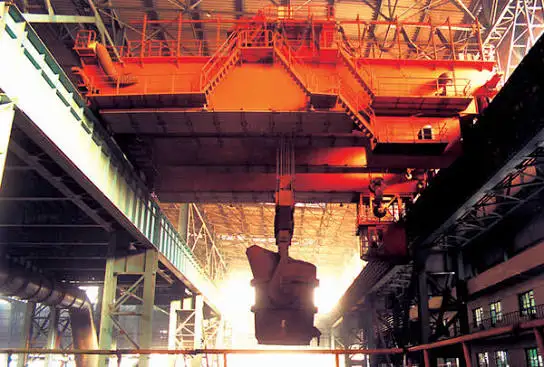
Ladle cranes in continuous casting bays need a sealed, air-conditioned cab facing the pour zone, plus radio control for low-heat work. Conductor bar is the lowest-cost power supply in cold bays; cable reel or festoon with heat-resistant cable is more reliable near furnaces.
Modern cranes also integrate with the mill's Level 2 / Level 3 systems for ladle tracking and dispatch — a capability general industrial crane suppliers typically lack.
Installation, FAT, SAT, and Commissioning
Most metallurgy cranes go in during a planned mill shutdown, typically a 10–14 day window. The supplier integrates with the mill's schedule; rail alignment, conductor system, power supply, and automation network are the critical items.
Commissioning uses water bags, never a real ladle on first lift. A documented Factory Acceptance Test (FAT) at the workshop and a Site Acceptance Test (SAT) after erection cover anti-sway, tandem synchronization, and brake performance under partial load. Mill-side witnesses at the FAT help avoid post-commissioning disputes.
Maintenance Pattern
Brake inspections on ladle cranes run monthly; heat damage checks on cabling near furnaces follow a documented checklist. Rope retirement criteria are tighter because the failure consequences are catastrophic.
Most steel mills keep metallurgy cranes on the supplier's maintenance contract for the first years; the supplier holds the component-hour and heat-exposure data inspection planning depends on.
Procurement Pointers
Three documents separate serious metallurgy crane suppliers from catalog resellers:
-A process-specific FEM / ISO 4301 classification statement with the standards cited.
-A documented heat zone analysis for your mill, not ambient temperature ratings.
-A spare parts lead-time commitment with named part numbers.
Delivery runs 6–10 months from contract to commissioning, depending on capacity, hoist count, and shutdown window. Send us your mill layout, tap-to-tap data, and heat zone map; we will propose a configuration matched to your process.
Frequently Asked Questions
1. Why does a ladle crane need redundant brakes when a standard overhead crane usually has one or two?
Molten steel at 1500 °C cannot be safely lowered under power if the hoist motor or primary brake fails. The secondary brake has to hold the full ladle from full speed without relying on the first. Standard crane brakes are sized for normal stop duty, not ladle emergency duty.
2. What duty class should a 200 t ladle crane be specified to?
It depends on tap-to-tap cycle time and heats per day, not just on capacity. Most BOF and EAF mills land at ISO 4301 A7. Continuous casting ladle transfer cranes often run at A8 because the caster dictates the cycle.
3. Can a metallurgy crane use conductor bar power supply in hot zones?
It can, but conductive dust — iron oxide, scale, sinter dust — builds up on the bars and causes tracking faults. Cable reel or festoon systems with heat-resistant cable are more reliable near furnaces and casters, even at higher cost.
