



What Is an L Type Single Girder Gantry Crane?
An L Type Single Girder Gantry Crane is a rail-mounted lifting system designed for efficient material handling in factories, warehouses, construction yards, precast concrete plants, steel stockyards, and other industrial environments.
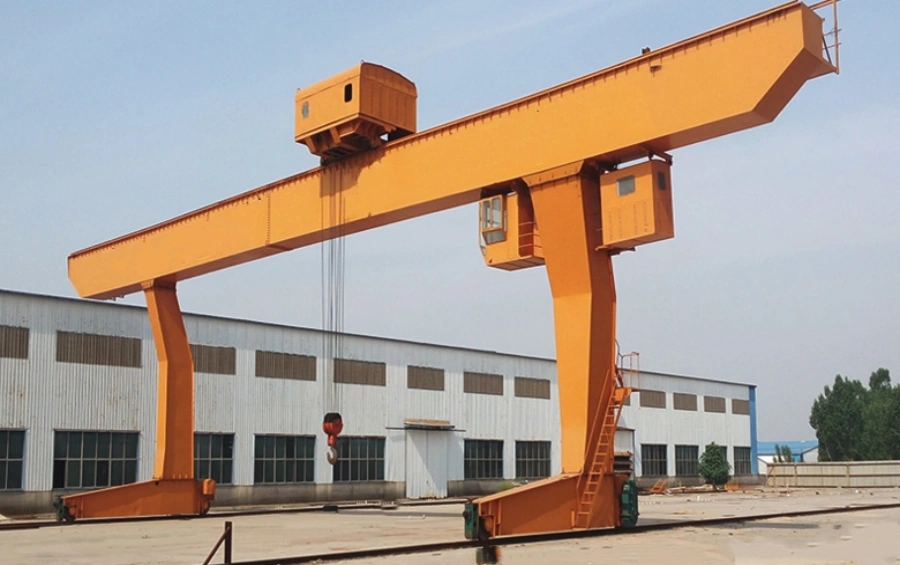
Unlike a conventional A-frame gantry crane, the L-shaped leg structure provides additional space on one side of the crane. This design makes it easier to handle long materials, bulky components, steel pipes, concrete beams, and other oversized loads.
The crane normally consists of a single main girder, L-shaped supporting legs, end carriages, an electric hoist or lifting trolley, a crane travel mechanism, an electrical control system, and safety protection devices.
Because of its relatively simple structure, low dead weight, and efficient operating performance, the L Type Single Girder Gantry Crane is a practical solution for medium-duty lifting applications.
Main Advantages of an L Type Gantry Crane
1. More Space for Long and Bulky Loads
The open L-shaped leg design reduces interference during side loading and unloading. Long work pieces can pass closer to the crane leg, making the crane especially suitable for handling steel pipes, concrete products, beams, plates, and structural components.
2. Lightweight Single Girder Structure
Compared with a double girder gantry crane, the single girder structure normally requires less steel and has a lower overall self-weight. This may reduce wheel loads, rail foundation requirements, transportation costs, and installation work.
3. Efficient Outdoor Material Handling
L Type Single Girder Gantry Cranes are widely used in outdoor storage yards and production areas. With suitable motors, electrical enclosures, coatings, and weather protection, the crane can operate reliably in demanding industrial environments.
4. Flexible Configuration
The crane can be customized according to the required lifting capacity, span, lifting height, working duty, travel speed, control method, power supply, and operating environment.
5. Convenient Operation
The crane can be operated by pendant control, wireless remote control, or operator cabin. Variable-frequency drives can also be used to provide smoother starting, stopping, lifting, and traveling.
Typical Applications
The L Type Single Girder Gantry Crane is suitable for many material-handling tasks, including:
-Steel plate, steel pipe, and structural steel handling
-Precast concrete beam and component lifting
-Machinery and equipment assembly
-Outdoor warehouse loading and unloading
-Construction material handling
-Manufacturing plant logistics
-Maintenance and repair operations
-Long workpiece transportation
-Mold and production component handling
The crane is especially valuable where side clearance is important or where long loads must move through the gantry structure.
Main Components
Main Girder
The main girder supports the lifting mechanism and transfers the load to the crane legs. It is generally manufactured from welded steel sections and designed according to the required capacity, span, and working class.
L-Shaped Legs
The L-shaped legs are the key structural feature of this crane. They support the main girder while providing improved clearance for long or oversized loads.
Electric Hoist or Lifting Trolley
Depending on the required capacity and duty class, the crane can be equipped with a wire rope electric hoist, low-headroom hoist, or customized lifting trolley.
Crane Travel Mechanism
The crane travels along ground-mounted rails through motor-driven end carriages. Smooth travel helps improve positioning accuracy and reduce load swing.
Electrical Control System
The electrical system controls lifting, cross travel, and long travel. Common options include contactor control, variable-frequency control, overload protection, phase protection, emergency stop, and limit switches.
Safety Devices
A properly designed L Type Single Girder Gantry Crane may include:
Lifting overload limiter
Upper and lower lifting limit switches
Crane travel limit switches
Emergency stop system
Rail clamps or anchoring devices
Audible and visual warning devices
Anti-collision protection
Wind alarm and storm protection for outdoor cranes
Buffer devices
Electrical phase-sequence protection
The final safety configuration should be selected according to local regulations and the actual working environment.
L Type Single Girder Gantry Crane vs. A Type Gantry Crane
Both L Type and A Type gantry cranes are widely used for industrial lifting, but their structures serve different working requirements.
An A Type gantry crane normally has inclined legs on both sides, offering good structural stability. However, the inclined leg arrangement may reduce side clearance when handling long materials.
An L Type Single Girder Gantry Crane has an open leg arrangement that provides more usable space on one side. It is often preferred when long workpieces need to pass through or close to the crane leg.
The right design depends on the load dimensions, operating area, rail layout, lifting frequency, and available clearance.
How to Select the Right L Type Gantry Crane
Rated Lifting Capacity
The crane capacity should cover the maximum load, including lifting attachments such as hooks, spreader beams, grabs, magnets, or slings.
Crane Span
The span is the horizontal distance between the crane travel rail centerlines. It should be determined according to the working area and facility layout.
Lifting Height
The lifting height is measured according to the required vertical hook travel. Building height, rail elevation, load size, and operating clearance must all be considered.
Working Duty
A crane used occasionally for maintenance has different design requirements from a crane operating continuously in a production line. Working frequency, load spectrum, daily operating hours, and expected service life should be evaluated carefully.
Operating Environment
Important environmental factors include indoor or outdoor installation, ambient temperature, humidity, dust, rain, wind, corrosion, hazardous areas, and altitude.
Control Method
Wireless remote control is convenient for many outdoor applications, while cabin control may be more suitable for frequent operation or long travel distances.
Why Choose a Customized L Type Single Girder Gantry Crane?
Every lifting project has different requirements. A customized crane can be designed around the customer’s actual building layout, rail system, load dimensions, production process, electrical standard, and operating conditions.
Customization options may include:
Non-standard span and lifting height
Low-headroom lifting mechanism
Dual lifting speeds
Variable-frequency travel control
Wireless remote control
Operator cabin
Outdoor rain covers
Anti-corrosion paint systems
High-temperature protection
Special hooks or lifting attachments
Rail clamps and windproof devices
Local voltage and frequency
Customized color and branding
A properly matched crane improves efficiency, safety, maintenance convenience, and long-term operating reliability.
Manufacturing and Quality Control
A reliable L Type Single Girder Gantry Crane should be manufactured under controlled production procedures. Important quality-control stages include material inspection, welding inspection, dimensional checking, structural assembly, electrical testing, mechanism testing, painting inspection, and pre-delivery trial operation.
Before shipment, the crane components should be clearly marked and packed according to transportation requirements. Installation drawings, electrical diagrams, operation manuals, and maintenance documents should also be supplied.
Installation and Maintenance
Correct installation is essential for safe crane operation. The runway rails must be aligned and installed according to the project drawings. The crane structure, travel mechanisms, electrical system, limit switches, and safety devices should be checked before commissioning.
Routine maintenance normally includes:
Checking wire ropes, hooks, brakes, and pulleys
Inspecting wheels, rails, and end carriages
Tightening bolts and electrical terminals
Lubricating moving parts
Testing limit switches and overload protection
Inspecting structural welds and paint condition
Checking motors, reducers, and brakes
Cleaning electrical panels
Recording operating and maintenance history
Preventive maintenance helps reduce unexpected downtime and extend crane service life.
Frequently Asked Questions
1.What is the main advantage of an L Type Single Girder Gantry Crane?
Its L-shaped leg structure provides better side clearance, making it easier to handle long and oversized materials.
2.Can the crane be used outdoors?
Yes. Outdoor versions can be supplied with weather-resistant electrical components, protective covers, anti-corrosion coatings, rail clamps, wind alarms, and anchoring devices.
3.Can the crane specifications be customized?
Yes. Capacity, span, lifting height, speed, duty class, control method, voltage, rail type, and safety configuration can be designed according to the project.
4.What information is required for a quotation?
Please provide the lifting capacity, span, lifting height, rail length, application, daily working hours, power supply, control method, and installation environment.
5.Is remote control available?
Yes. Pendant control, wireless remote control, and operator cabin control are available.
6.Can you supply installation support?
Installation guidance, drawings, manuals, remote technical support, and on-site services may be arranged according to the project and destination.
