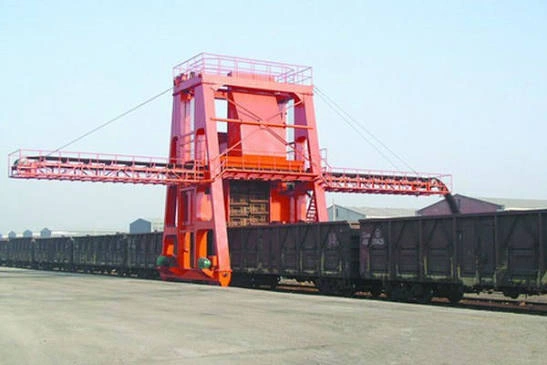
A chain bucket unloader crane is an overhead crane with the hook replaced by a chain bucket stripping head. T-shaped buckets run along the wagon floor, sweep the material out in one continuous pass and drop it onto an onboard belt conveyor. Weihua builds the machine for granular bulk: coal, gypsum, shale and iron ore. It is rated at 500 t/h, sized to order rather than sold at one fixed capacity, and listed for truck unloading as well as rail wagon duty.
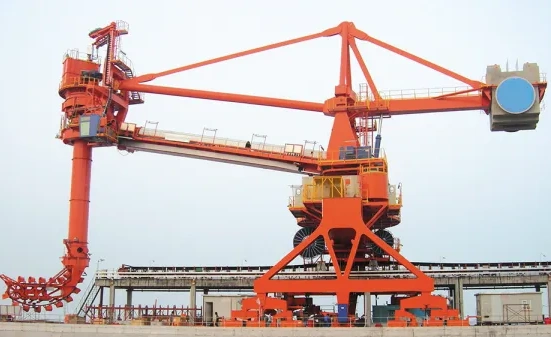
It is not a chain bucket ship unloader. That machine is a quay-mounted portal unit reclaiming from ship holds. This one works above a rail spur or truck lane and discharges to a ground conveyor or hopper through a sealed telescopic chute.
Bridge or Gantry — an Existing Runway Usually Decides
A bridge version runs on an elevated runway over the unloading line. It suits a bay that already has runway columns, because the space between the rails stays clear for wagons to be spotted underneath. A gantry version carries its own legs on ground rails, the practical choice in an open yard where the line sits in a pit or at grade. Settle span and clear height against the wagon spotting envelope early; both are fixed in the general arrangement drawing.
Why the Head Travels, and Why the Buckets Are T-Shaped?
Both features answer a site constraint, not a catalogue preference.
The tipping bucket mechanism moves along the bridge. One crane can work several parallel unloading lines instead of being tied to one track. In a yard with two or three lines, that is the difference between buying one machine and buying two.
The chain carries T-shaped buckets in both directions. The head can start at either end of a wagon without the crane being repositioned, which matters when the rake is already spotted nose-to-tail and cannot be shuffled freely.
Weihua publishes residual material below 1% after unloading for this series, which is the figure that decides how much manual floor cleaning your crew does between wagons.
Read Your Material Before You Read the Datasheet
| Material | Max lump size | Size fraction | Moisture |
| Coal, gypsum | ≤ 300 mm | ≥ 85% below 100 mm | ≤ 13% |
| Shale | ≤ 150 mm | ≥ 85% below 80 mm | — |
| Iron ore | ≤ 80 mm | ≥ 85% below 50 mm | — |
The size fraction governs output and it is the column buyers skip. A few oversized lumps ride in front of the chain and stall the sweep until someone breaks them loose by hand. The moisture limit exists for a different reason: coal above roughly 13% packs into the buckets and the belt transfer points instead of flowing off them. Shale and iron ore carry tighter size bands because the material is harder and heavier per lump.
Send measured data, not "typical" data. If your size distribution or moisture sits outside this envelope, bucket geometry and chain speed can be adjusted, provided the real numbers reach the supplier before the design is frozen.
When a Chain Bucket Unloader Crane Is the Wrong Buy?
Wagons with bottom discharge doors. They empty by gravity into a pit. A bottom-discharge system is cheaper, faster and needs no stripping head.
A rotary dumper is already on site. Tipping the wagon as a unit moves more material per wagon with less labor.
Sticky, frozen or contaminated material. The buckets depend on material flowing off them, and debris such as rebar or timber passes through a grab far more tolerantly than through a bucket chain.
A grab looks equivalent on price but not on rate. A grab works in cycles, needs a clear swing path over the wagon, and loses output as the wagon empties. A stripping head sweeps continuously and holds its rate to the last layer.
The fit is fixed-floor gondola wagons or trucks, granular material inside the envelope, a steady daily volume, and a site that wants the material path closed against dust.
What Actually Limits the Hourly Rate?
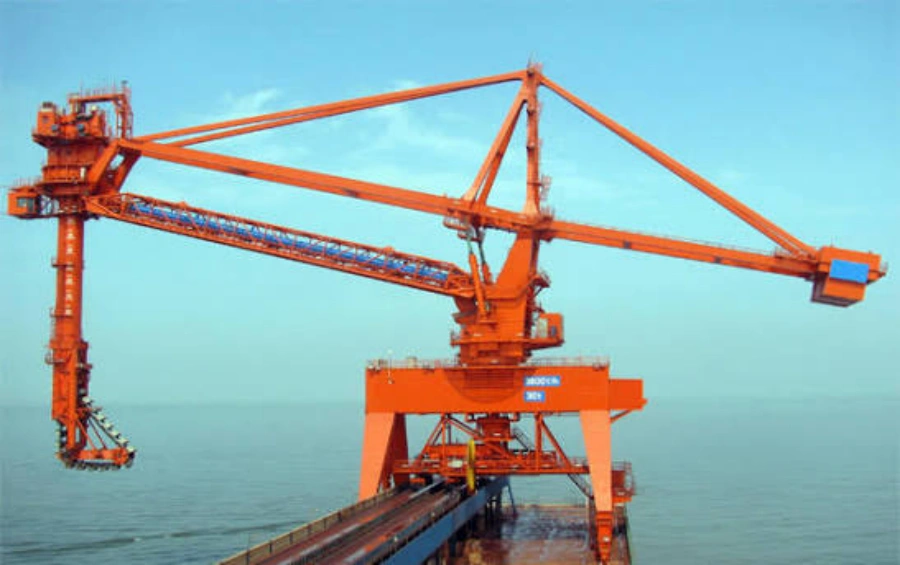
The crane is rarely the bottleneck.
-Receiving conveyor capacity. A ground conveyor rated below the unloader's output throttles the whole installation.
-Wagon cycle time. Repositioning between wagons is dead time; slow spotting or a long rake cuts the effective rate below the rated figure.
-Material condition. Moisture and oversize lumps move throughput from shift to shift more than any drive setting.
-Line count. Every extra line one crane serves spends part of the hour traveling instead of stripping.
Before You Ask for a Price
The standard configuration includes an overload limiter, lifting height limiter, trolley buffer, travel stroke limiters, guards over the chain drive, and the sealed telescopic chute that keeps the material path closed at the discharge. Ask for the traveling reducers and the chain to be specified explicitly: this machine inches along a wagon for hours under cutting load, so those two components decide service life. Variable frequency drive is listed across this series, which matters on a machine that starts and stops this often.
Send six things with the inquiry:
1.Material type, measured size distribution and moisture content.
2.Wagon or truck type and floor dimensions, and whether gravity discharge or tipping already exists on site.
3.Required rate in t/h, wagons per day and operating hours per shift.
4.Number of unloading lines and their layout, plus span and clear height if the bridge type is intended.
5.Receiving conveyor capacity, supply voltage, and feed mode (cable drum or safety conductor bar).
6.Dust limits at the discharge and transfer points.
Wagon spotting stays with you. A chain bucket unloader crane strips a wagon where it stands; moving the rake is a separate shunting arrangement, and that is why the forward and reverse bucket run is worth asking about.
Frequently Asked Questions
Q1: Is this the same machine as a chain bucket ship unloader?
No. The ship unloader is a quay machine reclaiming from ship holds; this crane runs above a rail spur or truck lane and feeds a ground conveyor. They share the bucket chain principle and little else.
Q2: Can you supply more than 500 t/h?
The 500 t/h figure applies to the standard wagon-duty machine. Capacity is designed to order, and Weihua publishes a larger variant of the same series at up to 600 t/h for harder duty. Give the target rate with your material data and the head is sized to it.
Q3: The page quotes 500 t/h and five 60 t wagons per hour. Which figure do I size the conveyor to?
They describe different conditions. 500 t/h is the rated unloading capacity; the wagon figure reflects a complete wagon cycle including spotting. Size the receiving conveyor at or above the rated capacity, and ask for a guaranteed rate against your own wagon weight and material.
Q4: My coal is wetter or coarser than the table. Can the machine still be used?
Usually yes, with adjustments to bucket geometry and chain speed, and with an honest statement of the resulting rate. What cannot be designed away is the flow behavior of sticky material or the jamming risk of oversize lumps, so raise both in the inquiry.
Q5: Can one machine handle both rail wagons and road trucks?
Yes. Because the bucket mechanism travels along the bridge, the head can be positioned over several lanes, including truck positions alongside the rail line.