



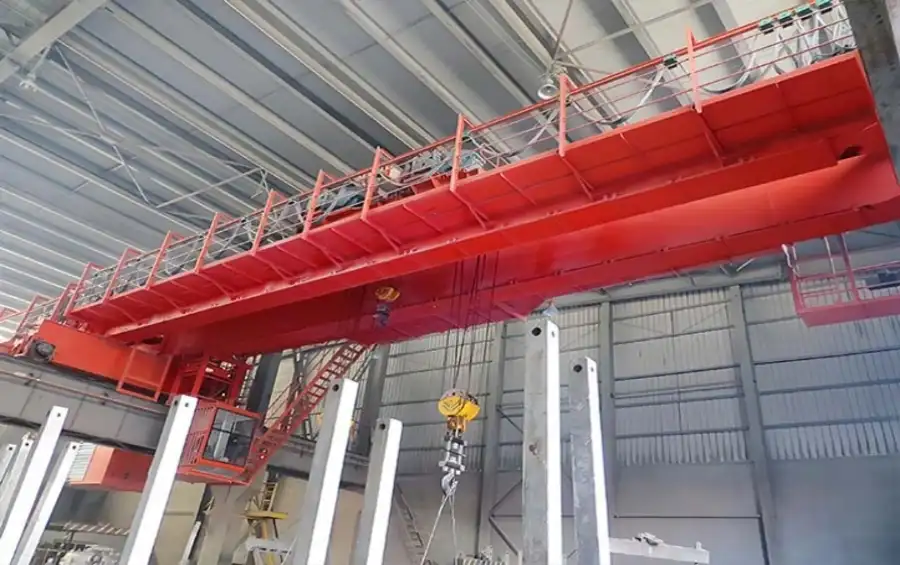
An insulation overhead crane is a double-girder crane whose hoisting system is electrically isolated from its own structure. In an electrolytic plant the lifted load is not neutral: anode assemblies, cathode plates and metal ladles come out of the cells at pot potential. On an ordinary crane that path runs from the load through the hook, rope, drum, trolley frame, bridge and end carriages into the runway rail and the building — so the structure becomes part of the circuit, and so does anyone leaning on it. Weihua builds the insulating version on a 5–50 t double-girder platform, 10.5–31.5 m span, A5/A6 duty.
Where the Conducting Path Is Broken?
The first break sits above the hook: an epoxy-phenolic laminated glass-cloth bushing between hook and pulley block, tested to withstand up to 35 kV. One element is not enough, because the rope is steel: it runs over the sheaves to the drum, and the drum, reducer and motor all ride on the trolley. An insulated hook above a bonded hoisting mechanism only moves the problem one stage upward.
Three Points, Not One
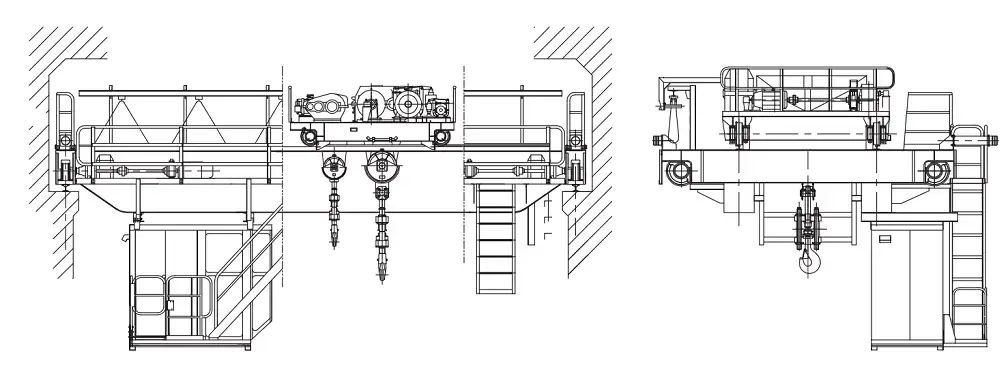
On the Weihua insulation overhead crane the same principle is repeated at three or more interfaces:
-Hook to pulley block — the bushing above.
-Hoisting mechanism to trolley frame — an integral insulating base plate and insulating bearing housings, closing the path through the drum shaft and the reducer feet.
-Trolley frame to crane structure — the last interface before the bridge and the runway.
Each is a mechanical part before it is an electrical one: it carries load, absorbs the impact of every hook-in and is handled during maintenance. Damage one and the potential returns to the structure. Three independent breaks are used for that reason — no single defect restores the circuit.
The 1 MΩ and the 35 kV Are Two Different Tests
Two figures appear in the specification and they are not interchangeable. Insulation resistance — not less than 1 MΩ at each insulated point, at 20–25 °C and relative humidity ≤ 85 % — is a low-voltage measurement of leakage across the element. The 35 kV figure is a high-voltage test of the same element's dielectric strength. A crane can satisfy the first and still leave a creepage path that is marginal in service.
The condition line matters as much as the value: readings are quoted at fixed air conditions precisely because insulation resistance tracks moisture and surface contamination, so one taken on a dry afternoon says little about the same crane on a humid one.
Measure Each Point, Not the Chain
A single reading from hook to structure confirms the chain is intact, but not where it is weak. Test each interface separately against the structure, and record the values so later readings have a baseline. The factory record is not the delivery record: insulating elements are exposed during transport, lifting and erection, so re-test on site before the crane is commissioned.
Where the Failure Usually Starts
Insulating elements seldom fail on their own. Dust and fume settle on upper faces and on surfaces that are awkward to wipe, and a deposit bridging an element is a path around it — something a resistance test in a clean bay will not find. Put the insulated interfaces on the inspection route as physical items, not as meter readings.
Insulation Does Not Replace Earthing
These do different jobs. Insulation keeps the load's potential away from the crane; earthing holds the structure at a known potential and gives fault current somewhere to go, so protection operates. The easiest way to defeat a correctly insulated crane is to improve it: a bonding jumper fitted across an insulated joint during a repair reinstates exactly the path the designer removed. Earthing conductors added on site have to be routed around the insulated interfaces — and so does the trolley's own power and control feed, which crosses one of them.
Brake failure is the other half of that safety case: dual brakes are fitted to the main hoisting mechanism precisely because the load being held is often live, not merely heavy.
Duty Class, Trolley-Level Heat and Fume
This product line is rated A5/A6, but the rating is a starting point rather than the answer. What shortens an insulation overhead crane's life is heat at trolley level — higher than the bay average maintenance plans are written around — plus the fume that comes with it. Ask for the insulating elements' temperature rating and compare it with a measurement taken there, not at floor level.
If the job is wider than lifting — tending cells in an aggressive fluoride atmosphere, running continuously across shifts, working near pot temperature and magnetic fields — it belongs to a different machine. Weihua's multi-function crane for electrolytic aluminum is engineered for that duty at M7–M8, combining heat, magnetic-field and corrosion resistance with insulation. A duty cycle measured in shifts rather than lifts signals the wrong crane.
What to Send for an Insulation Overhead Crane Quotation?
Insulation is selected from your plant's electrical data, not from a catalogue:
-DC voltage at a single cell and across the series, plus the maximum the crane could ever see
-Capacity at worst radius, span and lifting height, plus ambient temperature, humidity and chemical exposure at trolley level
-Shifts per day and lifts per hour, so the A5/A6 rating is checked rather than assumed
-Rail section already in place (43 kg/m, QU70, QU80 or 90/100 square steel) and supply — 3-phase 380 V/50 Hz standard, other supplies on request
-Accepted insulation resistance and the documentation you expect: per-point records rather than one aggregate certificate, plus the compliance file — GB/T 3811, based on ISO 4301; CE can be supplied for European projects
-What a replacement insulation set contains, so a damaged element is a planned stop and not a shutdown
Ask for the insulation points to be marked on the general arrangement drawing. Marked joints get respected; unmarked ones get bridged.
If you are specifying an insulation overhead crane for an electrolysis or high-voltage lifting application, send your cell voltage, capacity, span and working environment — you will get a configuration recommendation, the insulation points identified on the drawing, and a quotation.
Frequently Asked Questions
Q: How do I know whether I need an insulation overhead crane or a standard one?
A: The test is whether the load can be live relative to the crane. Lifting anode assemblies or cathode plates out of electrolytic cells, handling material in electrowinning or electrorefining, or lifting components inside a high-voltage test circuit all qualify. If nothing in the lift is electrically live, an insulating overhead crane is unnecessary and a standard one costs less.
Q: How often should insulation resistance be tested?
A: Commissioning sets the baseline. After that, test at an interval that matches your planned maintenance stops, and always after a shock load, a collision or an electrical fault in the plant. Compare readings taken under similar conditions rather than in isolation: the specified value is ≥ 1 MΩ at 20–25 °C and RH ≤ 85 %, and a slow fall at one point is the earliest warning available.
Q: Can it be used in a corrosive chemical environment?
A: The standard insulation overhead crane is built for electrolytic smelting atmospheres. For concentrated corrosive gases, such as chlorine in a chlor-alkali plant, state this at inquiry stage: anti-corrosion treatment on structural components, coatings and sealed electrical enclosures are added to the configuration. Where environment and duty exceed that, the multi-function crane for electrolytic aluminum is the appropriate machine.
