


 English
 Español
 Русский
 العربية
 Français
 Deutsch
 Português
 Tiếng Việt
 Thai
Thai
 Bahasa Indonesia
 Türkçe
 Italiano

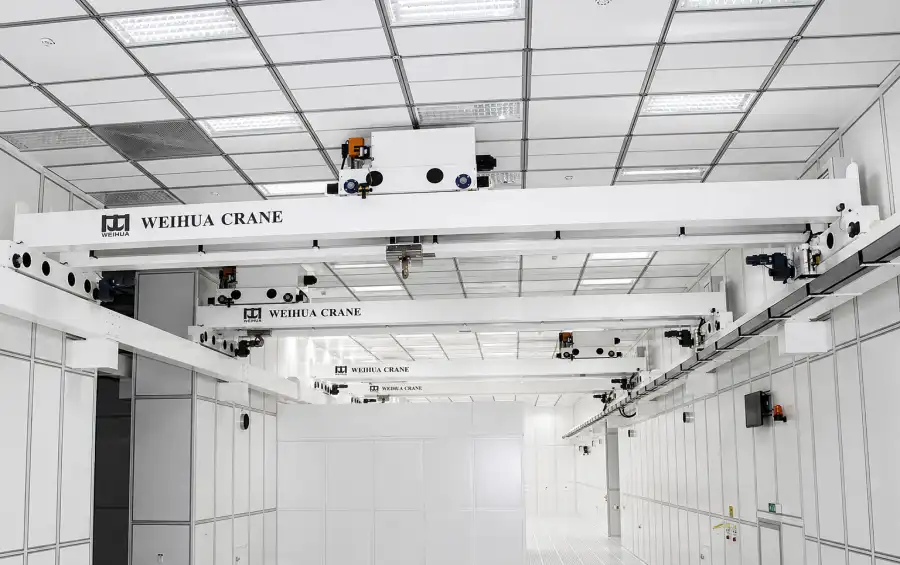
What Is a Cleanroom Overhead Crane?
A cleanroom overhead crane is an overhead lifting system designed for workshops with strict requirements for dust, particles, lubrication, surface cleanliness, and equipment hygiene.
Unlike a standard industrial crane, the design focuses not only on lifting capacity and operating safety, but also on controlling possible contamination sources.
Typical cleanroom crane designs may include:
-Smooth and easy-to-clean structural surfaces
-Enclosed or protected drive components
-Low-particle-emission traveling mechanisms
-Special surface coating or stainless steel components
-Controlled lubrication systems
-Enclosed power supply systems
-Variable frequency drives for smooth acceleration and braking
-Wireless remote or automated operation
These features help reduce dust accumulation, lubricant leakage, paint shedding, and particles generated by mechanical friction.
Why Standard Overhead Cranes Are Not Always Suitable for Cleanrooms?
A normal overhead crane works well in general manufacturing plants, warehouses, steel workshops, and assembly facilities. However, several components can become contamination sources in a cleanroom.
For example, exposed wheels, lubricated wire ropes, electrical cables, painted structural surfaces, and open transmission components may release particles during long-term operation.
For this reason, cleanroom lifting equipment requires additional attention to several areas.
Particle Control
Mechanical friction between moving components should be minimized wherever possible.
Drive systems, wheels, power supply devices, and lifting mechanisms can therefore be enclosed or specially designed to reduce particle generation.
Lubrication Control
Oil leakage is particularly undesirable in pharmaceutical, semiconductor, electronics, and other clean production areas.
Cleanroom cranes may use controlled lubrication, dry lubricants, sealed reducers, or other solutions depending on the lifting mechanism and cleanliness requirement.
Easy-to-Clean Surfaces
Complex structures with inaccessible corners can collect dust.
A simplified crane structure with fewer exposed components and smooth surfaces makes routine cleaning and inspection easier.
Special paint systems, powder coatings, stainless steel covers, or stainless steel components can also be selected according to the working environment.
Smooth Movement
Sudden starts and stops can create vibration, load swing, and additional wear.
Variable frequency control allows the crane bridge, trolley, and hoisting mechanism to accelerate and decelerate gradually, improving both handling accuracy and operating stability.
Where Are Cleanroom Overhead Cranes Used?
Cleanroom cranes are suitable for industries where production processes require controlled levels of airborne contamination.
Semiconductor Manufacturing
Semiconductor manufacturing equipment is often large, expensive, and highly sensitive.
Cleanroom overhead cranes can be used for:
-Installing production equipment
-Handling precision machinery
-Moving process modules
-Equipment maintenance
-Production line adjustment
Precise positioning and smooth movement are particularly important when handling sensitive semiconductor equipment.
Pharmaceutical and Biotechnology Facilities
Pharmaceutical production places strong emphasis on equipment cleanliness and contamination control.
Cleanroom lifting systems can assist with:
-Production equipment installation
-Maintenance handling
-Material transfer
-Reactor or vessel maintenance
-Clean manufacturing line construction
Depending on the production area, the crane can be customized with corrosion-resistant and easy-to-clean materials.
Electronics Manufacturing
Precision electronics, display panels, optical products, and electronic components can be affected by airborne particles.
A cleanroom overhead crane allows heavy equipment and materials to be moved above the production area while reducing floor-level obstruction.
Medical Equipment Manufacturing
Clean manufacturing environments are common in medical device production.
Overhead cranes can help move molds, equipment, fixtures, and production components while maintaining efficient use of workshop space.
New Energy and Precision Manufacturing
Battery production, precision assembly, laboratories, optics, and other advanced manufacturing sectors may also require low-particle material handling systems.
Important Design Features of a Cleanroom Overhead Crane
The correct configuration depends on the cleanliness requirement, lifting load, production process, workshop dimensions, and frequency of operation.
Rather than selecting a crane only by capacity, buyers should consider the complete operating environment.
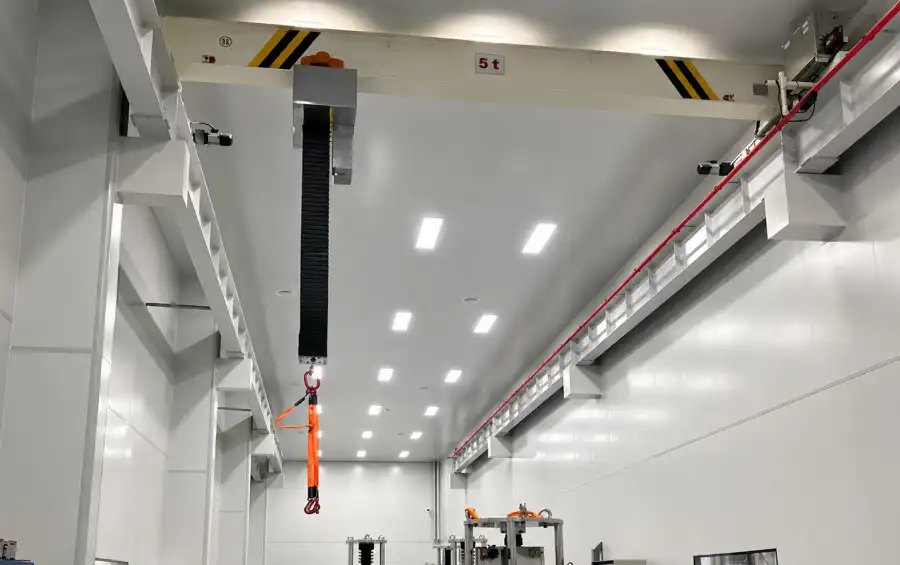
Enclosed Lifting Mechanism
Where possible, the hoisting mechanism can be covered or enclosed to reduce direct exposure of moving components to the clean production area.
Protective covers also make external cleaning easier.
Clean Power Supply System
Traditional exposed conductor systems may not be ideal for some controlled environments.
Depending on the project, the crane may use:
-Enclosed conductor systems
-Cable festoon systems
-Energy chains
-Protected electrical cables
The purpose is to reduce mechanical wear and limit particle escape from moving electrical components.
Special Surface Treatment
Structural components can be treated with clean-compatible coatings or manufactured with stainless steel where required.
The appropriate solution depends on environmental conditions such as humidity, chemical exposure, cleaning procedures, and cleanliness level.
Low-Noise Drive System
Low-noise motors, reducers, wheels, and frequency-controlled drives improve the working environment and reduce mechanical impact.
This can be important in laboratories and facilities containing sensitive precision equipment.
Remote Operation
Wireless remote control is commonly suitable for cleanroom lifting applications because the operator does not need to remain directly beside the crane control station.
It can also reduce unnecessary personnel movement around the load-handling area.
Precision Positioning
For equipment installation and precision assembly, simple lifting is often not enough.
Optional systems may include:
-Variable-speed control
-Anti-sway control
-Fine positioning
-Synchronized movement
-Automatic positioning
-PLC-based control
These functions allow the crane to handle valuable or sensitive loads more accurately.
How to Select a Cleanroom Overhead Crane?
Before requesting a quotation, it is useful to prepare the main technical information.
1. Required Lifting Capacity
Determine the maximum weight of the equipment or material to be lifted.
The crane capacity should be selected according to the real load conditions rather than estimating from average operating weight.
2. Crane Span
The span is normally determined by the distance between crane runway rails.
Providing workshop drawings can significantly improve the accuracy of the crane design.
3. Lifting Height
The required lifting height should consider:
-Building height
-Runway elevation
-Crane structural depth
-Hook approach
-Height of the lifted equipment
Low-headroom designs may be considered when vertical space is limited.
4. Cleanroom Requirement
The supplier should understand the required cleanliness level and the production process inside the workshop.
Different facilities may require different materials, covers, coatings, lubrication methods, or electrical protection.
5. Operating Frequency
A crane used occasionally for equipment maintenance has different requirements from one operating continuously on a production line.
The expected number of operating hours and lifting cycles should therefore be provided.
6. Required Positioning Accuracy
If the crane is only transporting materials from one area to another, standard variable-speed operation may be sufficient.
For semiconductor equipment installation, molds, precision machinery, or automated production, more accurate positioning may be required.
7. Workshop Environment
Also provide information about:
-Temperature
-Humidity
-Corrosive substances
-Cleaning chemicals
-Wash-down requirements
-Restricted installation space
These conditions influence the selection of materials and electrical components.
Cleanroom Overhead Crane FAQ
1.What is the difference between a cleanroom crane and a normal overhead crane?
The main difference is contamination control.
A cleanroom crane is designed to reduce particle generation, lubricant leakage, dust accumulation, and other contamination risks. It may use enclosed mechanisms, special coatings, stainless steel components, controlled lubrication, and clean-compatible electrical systems.
2.Can a cleanroom overhead crane be customized?
Yes.
Lifting capacity, span, lifting height, crane structure, operating speed, surface material, control method, and electrical system can all be designed according to the workshop and production process.
3.Does the entire crane need to be stainless steel?
Not necessarily.
The material configuration depends on the required cleanliness level, corrosion conditions, cleaning procedures, and project budget.
In some projects, selected parts use stainless steel while structural components use specially treated or coated steel.
4.Can cleanroom cranes use variable frequency control?
Yes.
Variable frequency drives are commonly used to provide smooth starting, stopping, and speed adjustment. They can reduce load swing and improve positioning during equipment handling.
5.Can the crane be operated by remote control?
Yes.
Wireless remote operation is suitable for many cleanroom applications and allows the operator to choose a safer viewing position while handling the load.
6.Can a cleanroom crane be designed for limited headroom?
Yes.
Low-headroom designs can help increase available hook height in workshops where the distance between the runway and ceiling is limited.
