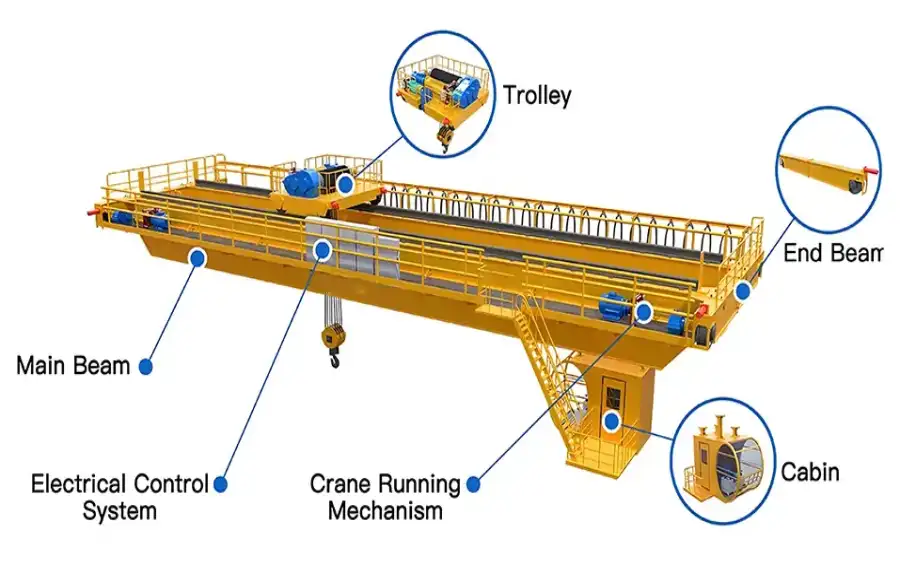
An explosion-proof bridge crane is an overhead lifting system built to work safely where flammable gases, vapors, or combustible dust are present. In a chemical plant, oil refinery, gas storage yard, or paint workshop, a single spark from a standard crane's motor, brake, or electrical switch can be enough to trigger a catastrophic explosion.
Weihua's explosion-proof bridge crane is engineered to remove that risk, so you can keep lifting in classified areas while protecting your people, your plant, and your production schedule.
What is an explosion-proof bridge crane?
An explosion-proof bridge crane works on the same bridge-and-trolley principle as a standard overhead crane, but every part that could produce a spark, arc, or hot surface is replaced with an explosion-proof version. The motors, control cabinets, limit switches, and the hoist itself are housed in flameproof or increased-safety enclosures, and exposed components are made from spark-resistant materials.
The logic is simple: even if an ignition source occurs inside the equipment, the enclosure contains it, so no spark or high temperature ever reaches the surrounding atmosphere. Depending on your site, the crane can be built for gas groups IIA, IIB, or IIC and temperature classes up to T4, which covers most Zone 1 and Zone 2 classified work areas.
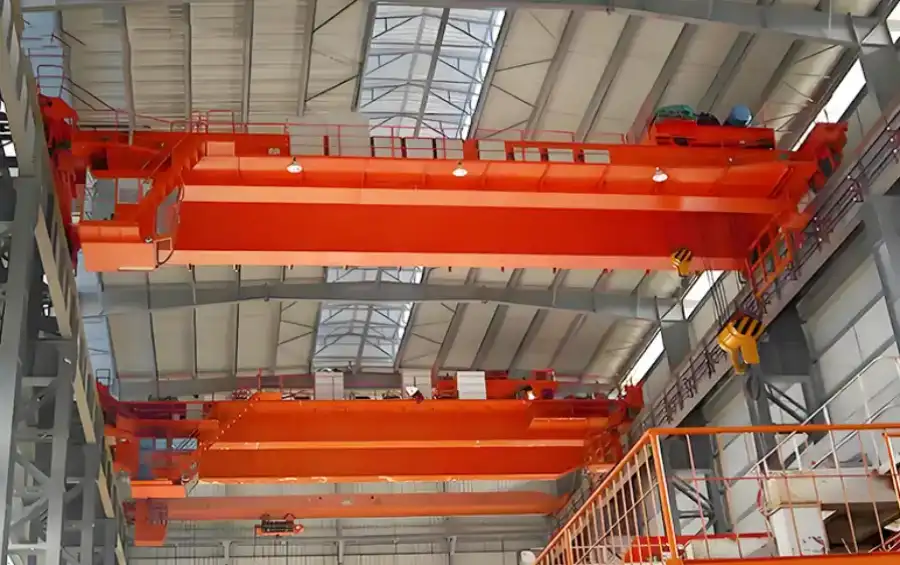
Key specifications of Weihua's explosion-proof bridge crane
Model: QB explosion-proof bridge crane
Lifting capacity: 5–75 t
Span: 10.5–31.5 m
Work duty: A4
Ambient temperature: −20 °C to 40 °C
Lifting speed: 1.9–5 m/min
Control mode: Remote control, ground pendant, or cabin
Power supply: 380 V / 50 Hz / 3-phase, customized
Beyond this standard range, Weihua can customize the capacity, span, and lifting height to match your workshop dimensions and the loads you handle every day.
Why should you choose Weihua's explosion-proof bridge crane?
A proven manufacturer with global experience. Weihua is one of the largest crane manufacturers in China, with more than 30 years of history and customers in over 100 countries. Weihua has delivered cranes to chemical, petrochemical, and other hazardous-area projects worldwide, so we understand the compliance requirements of different markets before we quote.
Certified quality. Weihua cranes are engineered to ISO, FEM, and DIN standards, and CE certification is available for the European market. Every crane is fully load-tested in the factory before shipment, so the machine you receive has already proven its capacity.
Safer daily operation. Remote control keeps the operator out of the hazardous zone during lifting, and intelligent monitoring with fault alerts helps your maintenance team spot problems early — without sending people into a restricted area for routine checks.
After-sales support you can rely on. Weihua provides installation supervision, operator training, and spare parts support through overseas service centers and partners. Fast response matters most when your crane runs in a classified area, where access is restricted and every hour of downtime is expensive.
Tips on how to choose the right explosion-proof bridge crane
Know your hazard classification first. Before requesting a quotation, confirm your area's zone classification, gas group, and temperature class. These determine the explosion-proof grade of every electrical component on the crane, and they are the first thing our engineers will ask for.
Match the work duty to your real production. A crane in a refinery that runs frequent cycles needs a higher duty class than one in a paint shop used a few times per shift. A crane rated below its real workload in a hazardous area is a long-term safety risk, so always share your lifting frequency and typical loads.
Look at total cost of ownership, not just the purchase price. An explosion-proof crane costs more upfront than a standard crane, but the right choice saves money later through fewer failures, lower maintenance, and less downtime. Ask about spare-parts availability and delivery time before you sign the contract.
Send complete site information. Provide your span, lifting height, runway condition, and power supply, and we will confirm the right design from the start — including whether your existing runway can carry the new crane.
Frequently Asked Questions
Q1: In which environments is an explosion-proof bridge crane required?
Anywhere flammable gases, vapors, or combustible dust may be present — chemical plants, oil refineries, gas storage areas, and paint, flour, or wood-dust workshops. If your work area is classified as Zone 1 or Zone 2, a standard crane is simply not allowed.
Q2: How does the Weihua explosion-proof bridge crane prevent ignition?
All electrical parts — motors, control cabinets, limit switches, and the hoist — use flameproof or increased-safety enclosures and spark-resistant materials, with surface temperatures kept below the ignition point of the surrounding atmosphere.
Q3: Can my existing standard crane be upgraded to explosion-proof?
No. Explosion protection must be designed in from the beginning, because the hoist, electrical system, and many structural details differ from a standard crane. If your process now involves hazardous materials, the safe option is a purpose-built explosion-proof bridge crane.