English
 Español
 Русский
 العربية
 Français
 Deutsch
 Português
 Tiếng Việt
 Thai
Thai
 Bahasa Indonesia
 Türkçe
 Italiano

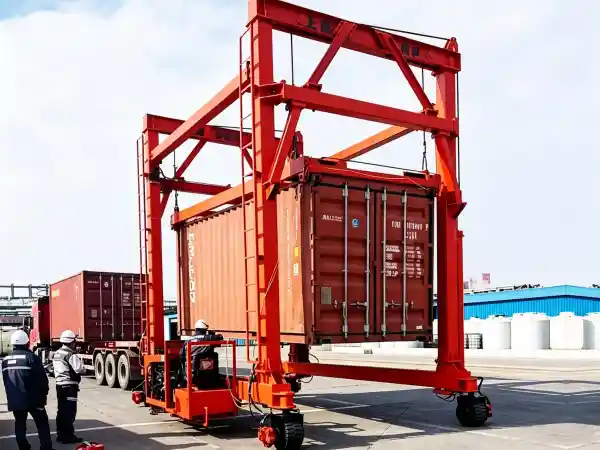
Efficient container handling is essential for ports, logistics terminals, intermodal yards and industrial storage areas. When containers need to be moved frequently over short distances without relying on fixed crane rails, a Container Straddle Carrier Crane provides a flexible and efficient solution.
A straddle carrier can travel directly over a container, lift it within its own frame and transport it to another position. This combination of lifting and travelling functions makes the equipment particularly useful for container transfer, stacking and yard relocation.
What Is a Container Straddle Carrier Crane?
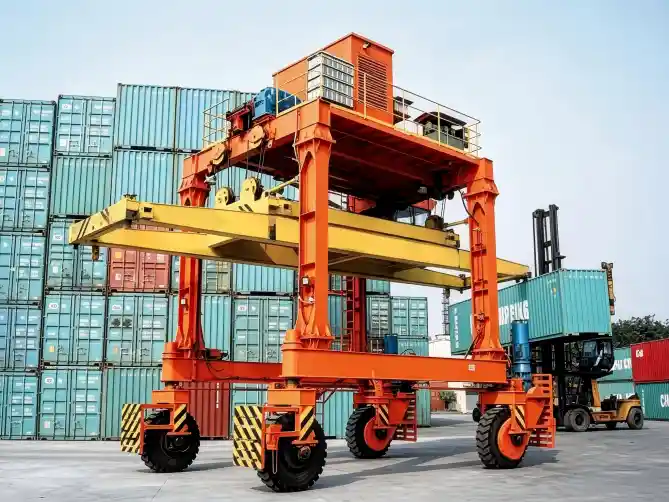
A Container Straddle Carrier, sometimes called a straddle crane or container transporter gantry crane, is a mobile lifting machine with a high portal-shaped frame.
The machine drives over the container so that the load is positioned between its wheels. A lifting mechanism then raises the container from the ground, trailer or storage position.
The main components generally include:
-Main frame
-Container lifting mechanism
-Wheels and tyres
-Operator cab
-Hydraulic or electric drive system
-Power unit
-Control and safety systems
The lifting mechanism may use hydraulic or electric systems depending on the equipment configuration, while the power source can be diesel, electric or hybrid.
How Does a Container Straddle Carrier Work?
The operating principle is relatively straightforward.
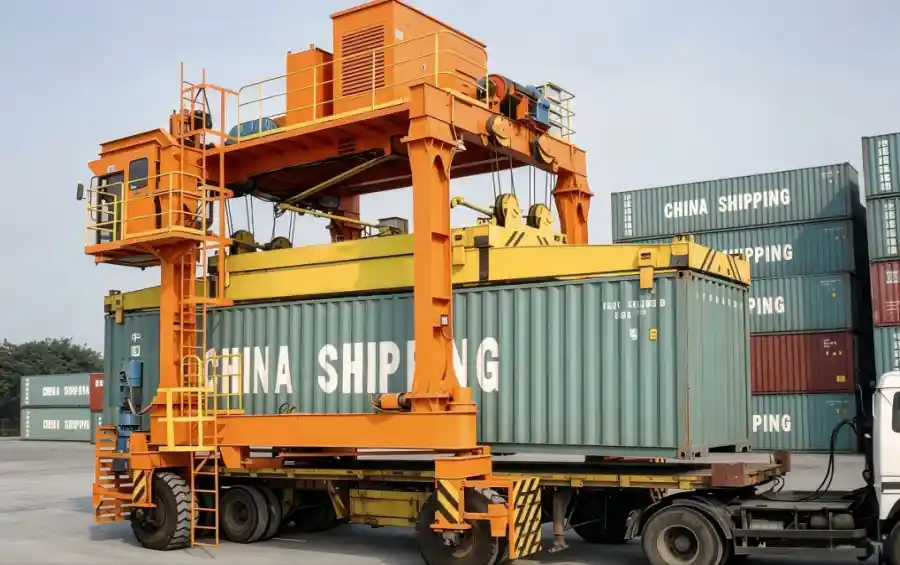
The carrier approaches and straddles the container. Once correctly positioned, the lifting system connects to the container through the spreader or lifting arrangement. The container is then raised within the frame so that the machine can travel with the load.
At the destination, the operator positions the carrier above the required location and lowers the container.
This allows one machine to perform several operations:
-Pick up containers
-Transport containers
-Position containers
-Load or unload trailers
-Relocate containers within a yard
-Support container stacking operations
Compared with equipment that depends on fixed rails, a straddle carrier can move directly between different working areas.
How Does a Container Straddle Carrier Work?
The operating principle is relatively straightforward.
The carrier approaches and straddles the container. Once correctly positioned, the lifting system connects to the container through the spreader or lifting arrangement. The container is then raised within the frame so that the machine can travel with the load.
At the destination, the operator positions the carrier above the required location and lowers the container.
This allows one machine to perform several operations:
-Pick up containers
-Transport containers
-Position containers
-Load or unload trailers
-Relocate containers within a yard
-Support container stacking operations
Compared with equipment that depends on fixed rails, a straddle carrier can move directly between different working areas.
Where Are Container Straddle Carriers Used?
Container straddle carriers are mainly designed for short-distance container transportation and handling.
Typical applications include:
Ports and Container Terminals
Straddle carriers can move containers between storage areas, loading zones and transport vehicles.
They are particularly useful when the yard requires flexible routing rather than fixed crane movement.
Inland Container Depots
At inland container terminals, straddle carriers can support container storage, repositioning and truck loading operations.
Logistics Centers
Large logistics facilities may use straddle carriers to transfer containers between different sections of the yard.
Railway Container Yards
The equipment can assist with moving containers between rail-related handling areas and storage positions.
Industrial Container Storage Areas
Manufacturing companies and industrial operators that frequently handle ISO containers can also use straddle carriers for internal logistics.
WEIHUA describes its straddle crane as equipment primarily used for transferring containers from one yard area to another, while configurations can also be adapted for large structures and other heavy loads.
Main Advantages of a Container Straddle Carrier Crane
Flexible Mobility
Mobility is one of the main reasons for choosing a straddle carrier.
Unlike rail-mounted cranes, the machine does not need a dedicated crane runway. Its wheeled chassis allows it to travel through different areas of a terminal or logistics yard.
Some configurations can provide highly flexible steering. WEIHUA's straddle crane design, for example, can rotate around the machine center, while its battery-powered model is designed for all-direction steering.
This flexibility can be particularly useful in yards where operating routes change frequently.
Integrated Lifting and Transportation
A straddle carrier combines lifting and travelling within one machine.
This means that after picking up a container, the same equipment can transport it directly to the required location.
For some operations, this can reduce the need for separate lifting cranes and terminal transport vehicles.
Suitable for Short-Distance Container Transfer
Straddle carriers are especially effective for repeated container movement over relatively short distances.
Typical movements include:
-Storage area to truck lane
-Truck lane to stacking area
-One yard block to another
-Container inspection area to storage area
-Workshop to logistics yard
This makes them particularly suitable for flexible container logistics.
Precise Lifting Control
Modern straddle carriers can incorporate synchronized lifting and stepless speed control.
For example, WEIHUA's battery-powered straddle carrier uses sensing and monitoring systems for container identification, positioning, movement and loading or unloading, while also providing synchronized lifting control.
Precise control is important because containers must often be positioned accurately onto trailers or storage locations.
Multiple Power Options
Depending on the operating environment, straddle carriers may use different power systems.
Typical options include:
Diesel engine
Electric drive
Battery power
Hybrid systems
Battery-powered equipment is becoming attractive for yards where lower local emissions and quieter operation are important.
WEIHUA's WHKYC40 model uses a lithium battery and electric motor with a fully hydraulic drive system.
Battery-Powered Container Straddle Carrier
Electric container handling is becoming increasingly important as ports and logistics facilities seek to reduce local emissions and improve energy efficiency.
A battery-powered straddle carrier replaces the conventional diesel engine with an electric power system.
Potential advantages include:
-No direct exhaust emissions during operation
-Lower operating noise
-Smooth acceleration
-Reduced engine-related maintenance
-Suitable operation in environmentally sensitive areas
WEIHUA's current WHKYC40 battery-powered straddle carrier has a rated capacity of 40 tons and uses lithium battery power. The manufacturer also states that the machine can climb a 10% grade under full load, compared with the approximately 3% grade referenced for traditional tyre-mounted cranes in its product description.
For a container terminal with uneven terrain or ramps, gradeability can therefore become an important selection parameter.
Container Straddle Carrier vs. RTG Crane
Although both machines operate on rubber tyres and handle containers, a Container Straddle Carrier and a Rubber Tyred Gantry Crane (RTG) serve different yard functions.
An RTG is generally a larger gantry crane used to stack multiple rows of containers within a defined yard block.
A straddle carrier is more mobile and normally carries the container inside its own frame while travelling.
In practical terms:
Choose a straddle carrier when:
-Containers need to move frequently between locations
-Flexible routing is important
-Short-distance transportation is a major requirement
-The yard does not require a large fixed stacking block
Choose an RTG when:
-High-density container stacking is the priority
-Multiple container rows need to be covered
-The crane mainly operates within a defined storage block
WEIHUA's RTG range is designed around container-yard stacking and can use dedicated spreaders for standard 20GP, 40GP and 45HQ containers.
The correct equipment therefore depends more on the yard operating process than on lifting capacity alone.
Frequently Asked Questions
1.What is a container straddle carrier?
A container straddle carrier is a mobile lifting and transporting machine that drives over a container, lifts it within its frame and carries it to another position.
2.What is a straddle carrier mainly used for?
It is mainly used for short-distance container transfer, repositioning, loading, unloading and storage operations in ports, container yards and logistics facilities.
3.Can a straddle carrier lift a fully loaded container?
Yes, provided the carrier's rated lifting capacity is greater than the total container load and the machine is configured for that container type.
4.Can a straddle carrier move without rails?
Yes. Straddle carriers travel on tyres and do not require fixed crane rails.
5.What is the difference between a straddle carrier and an RTG crane?
A straddle carrier combines container lifting and transportation in one mobile machine. An RTG is generally used mainly for high-density stacking within container yard blocks.
6.Are electric straddle carriers available?
Yes. Battery-powered straddle carriers are available. WEIHUA, for example, offers a 40-ton lithium-battery-powered model for container handling.