


 English
 Español
 Русский
 العربية
 Français
 Deutsch
 Português
 Tiếng Việt
 Thai
Thai
 Bahasa Indonesia
 Türkçe
 Italiano

Modern shipbuilding requires the handling of extremely large and heavy structures. Hull blocks, ship sections and large prefabricated modules must often be lifted, transported, turned and accurately positioned before final assembly.
A Shipbuilding Gantry Crane, also known as a shipyard gantry crane or Goliath gantry crane, is specially designed for these demanding lifting operations. Its large span, high lifting capacity and multiple lifting mechanisms make it one of the most important pieces of equipment in a modern shipyard.
Shipbuilding gantry cranes are commonly used for lifting, turning and joining large ship sections during vessel construction. Weihua has supplied shipbuilding gantry cranes in capacities ranging from several hundred tons to several thousand tons for large-scale shipyard applications.
What Is a Shipbuilding Gantry Crane?
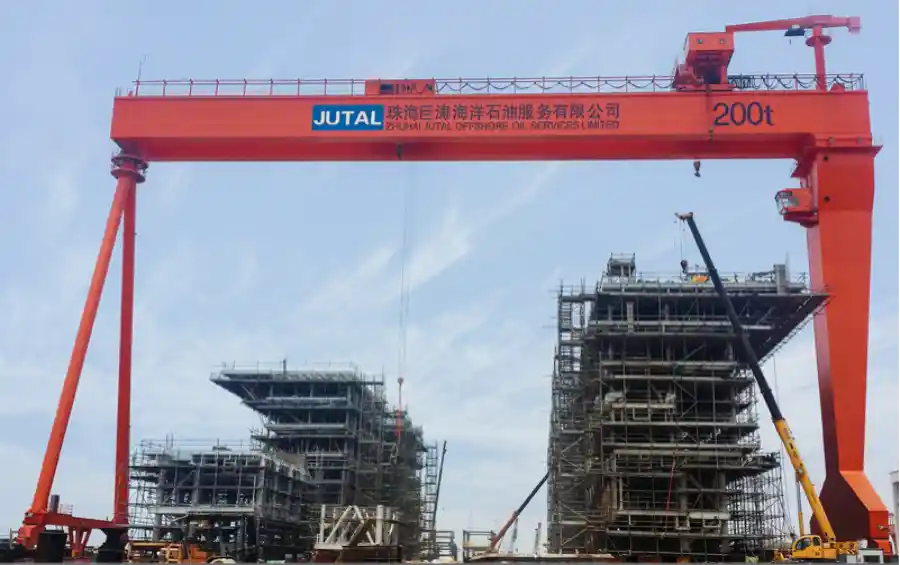
A shipbuilding gantry crane is a large rail-mounted gantry crane installed over a shipbuilding dock, assembly area or outdoor fabrication yard.
Unlike ordinary workshop cranes, shipbuilding cranes must handle loads that may be hundreds or even thousands of tons while maintaining accurate positioning over very large spans.
A typical system consists of:
-Main girder structure
-Rigid and flexible legs
-Main lifting trolley
-Auxiliary lifting mechanisms
-Crane travelling system
-Electrical and control system
-Operator cabin
-Safety and monitoring devices
Depending on the shipyard layout and production process, the crane can be customized with multiple hooks or lifting trolleys so that very large ship blocks can be handled safely.
How Is a Shipbuilding Gantry Crane Used?
The biggest difference between a shipbuilding gantry crane and a conventional industrial gantry crane is the complexity of the lifting process.
Modern ships are normally constructed from large prefabricated blocks. These blocks are manufactured separately and then transported to the dock for final assembly.
The gantry crane performs several important operations during this process.
Ship Block Lifting
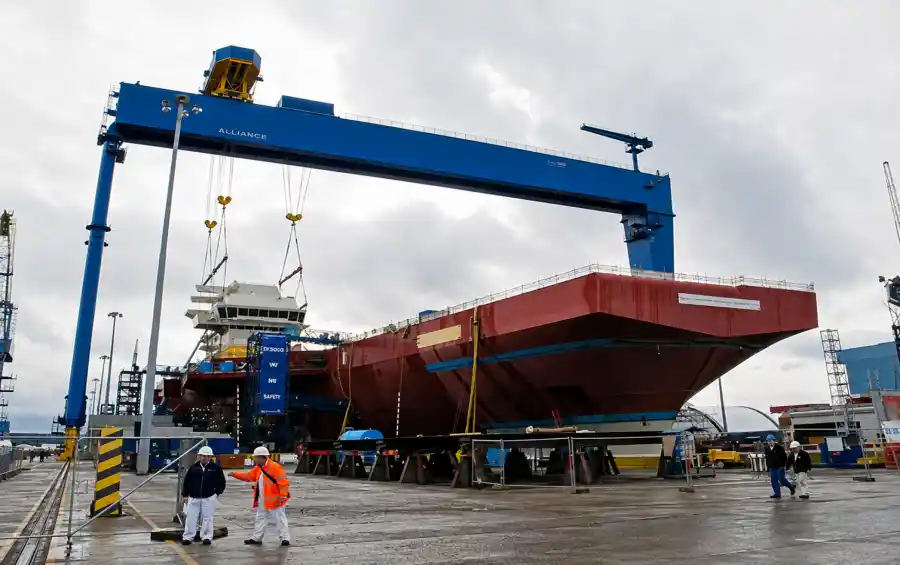
Large hull sections can be lifted from the fabrication area and transferred to the assembly position.
Because these sections can weigh hundreds of tons, the crane must provide sufficient structural rigidity and synchronized lifting capability.
Block Turning
Some ship sections need to be rotated or turned before welding and assembly.
Using coordinated main and auxiliary lifting mechanisms, a shipbuilding gantry crane can assist with large block turning operations.
This is one of the most demanding operations in shipbuilding because the load center changes during rotation.
Hull Assembly
After lifting, ship blocks must be positioned accurately so that different sections can be joined together.
Fine-speed control allows operators to make small positioning adjustments before welding and final connection.
Large Module Handling
In addition to conventional vessels, these cranes can also be used for offshore structures, marine engineering modules and other large fabricated components.
Weihua describes shipbuilding gantry cranes specifically as equipment used in the hoisting, flipping and joining of ship sections, which reflects the main operational requirements of this crane category.
Why Are Shipbuilding Gantry Cranes So Large?
Shipbuilding has moved increasingly toward modular construction.
Instead of assembling a ship piece by piece directly in the dock, large sections can be fabricated in advance and then combined into larger blocks.
The heavier the prefabricated modules that can be lifted, the fewer separate assembly operations may be required.
This creates demand for cranes with:
-Extremely high lifting capacities
-Very large spans
-High lifting heights
-Multi-hook synchronization
-Precise low-speed positioning
For example, Weihua has participated in a 2,000 t × 200 m shipbuilding gantry crane project for the expansion of Wison Offshore's Nantong production base. The crane uses multiple trolley and hook combinations for large-module handling.
Such equipment illustrates why shipbuilding gantry cranes belong to a very different class from ordinary factory gantry cranes.
Main Advantages of a Shipbuilding Gantry Crane
Ultra-Heavy Lifting Capacity
Shipbuilding cranes are designed specifically for very large loads.
Depending on the shipyard and vessel construction process, lifting capacity may range from several hundred tons to several thousand tons.
Weihua's published shipyard crane portfolio includes large gantry cranes with rated capacities such as 380 t, 450 t, 500 t, 1,000 t, 1,200 t, 2,000 t, 2,500 t, 3,000 t and 3,600 t.
The correct capacity should always be selected according to the maximum ship block weight and lifting arrangement rather than simply choosing the highest available capacity.
Large Span for Shipyard Coverage
A shipbuilding crane must often span an entire construction dock or large fabrication area.
This requires a much larger structural span than typical industrial gantry cranes.
The large span allows:
-Complete hull sections to pass underneath
-Large assembly areas to remain accessible
-Multiple work zones to operate beneath the crane
-Large marine structures to be assembled within the crane envelope
Synchronized Multi-Hook Lifting
Large ship blocks are often too long or irregular to be safely handled by a single lifting point.
Shipbuilding cranes can therefore use multiple hooks or lifting mechanisms operating together.
Synchronization is important because uneven lifting can cause:
-Load tilting
-Structural stress
-Difficult positioning
-Increased operational risk
For particularly large shipbuilding cranes, several trolley or hook combinations may be used to accommodate different lifting tasks. Weihua's 2,000-ton project, for example, incorporates multiple trolley and hook configurations for large-scale lifting operations.
Precise Positioning
Large lifting capacity alone is not enough.
When two ship blocks are being joined, even a very heavy component must be moved slowly and accurately into position.
Variable-speed drives and coordinated control systems can provide precise movement during:
-Lifting
-Lowering
-Trolley travelling
-Crane travelling
-Load positioning
This makes the crane suitable for both heavy lifting and accurate ship assembly.
Designed for Outdoor Marine Environments
Shipbuilding gantry cranes usually operate outdoors near coastal areas.
Their structure and electrical systems therefore need to consider environmental factors such as:
-Wind
-Rain
-High humidity
-Salt-containing marine air
-Temperature variation
-Long-term outdoor exposure
Wind resistance and storm protection are especially important because of the crane's large structural dimensions.
Safety Features for Shipbuilding Gantry Cranes
Because both the crane and the lifted structures are extremely large, safety systems are particularly important.
Depending on the project, a shipbuilding crane may incorporate:
-Overload protection
-Hoisting limit protection
-Travel limit switches
-Anti-collision systems
-Wind speed monitoring
-Rail clamps
-Storm anchoring devices
-Emergency braking
-Electrical interlocking
-Synchronized lifting control
-Equipment condition monitoring
For very large cranes, redundant monitoring and control functions may also be incorporated according to the project requirements.
Frequently Asked Questions
1.What is a shipbuilding gantry crane?
A shipbuilding gantry crane is a large gantry lifting system designed to handle ship blocks and marine structures during vessel construction. It is mainly used for lifting, turning, transporting and positioning prefabricated ship sections.
2.How much can a shipbuilding gantry crane lift?
The capacity depends on the shipyard. Large shipbuilding cranes can range from several hundred tons to several thousand tons. Weihua's published shipyard crane references include units from 380 tons up to 3,600 tons.
3.Why do shipbuilding gantry cranes use multiple hooks?
Large hull blocks may have long dimensions and uneven weight distribution. Multiple lifting points make it possible to control the attitude of the block and perform synchronized lifting or turning operations.
4.Can a shipbuilding gantry crane turn a ship block?
Yes. Properly configured shipbuilding gantry cranes can perform block turning or flipping using coordinated lifting mechanisms. This is one of their key applications during ship construction.
5.What is the difference between a shipbuilding gantry crane and a Goliath crane?
The terms are often used for similar very large shipyard gantry cranes. “Goliath crane” commonly emphasizes the exceptionally large size and lifting capacity of the structure, while “shipbuilding gantry crane” describes its application.
6.Can the crane be customized for a specific shipyard?
Yes. Lifting capacity, span, height, trolley arrangement, number of hooks, travelling distance and control system can be designed according to the shipyard layout and construction process.
7.What information is required for a quotation?
The most useful information is the maximum lifting weight, load dimensions, span, lifting height, runway length, lifting points, working frequency and local environmental conditions. A shipyard layout drawing is especially helpful.
