English
 Español
 Русский
 العربية
 Français
 Deutsch
 Português
 Tiếng Việt
 Thai
Thai
 Bahasa Indonesia
 Türkçe
 Italiano

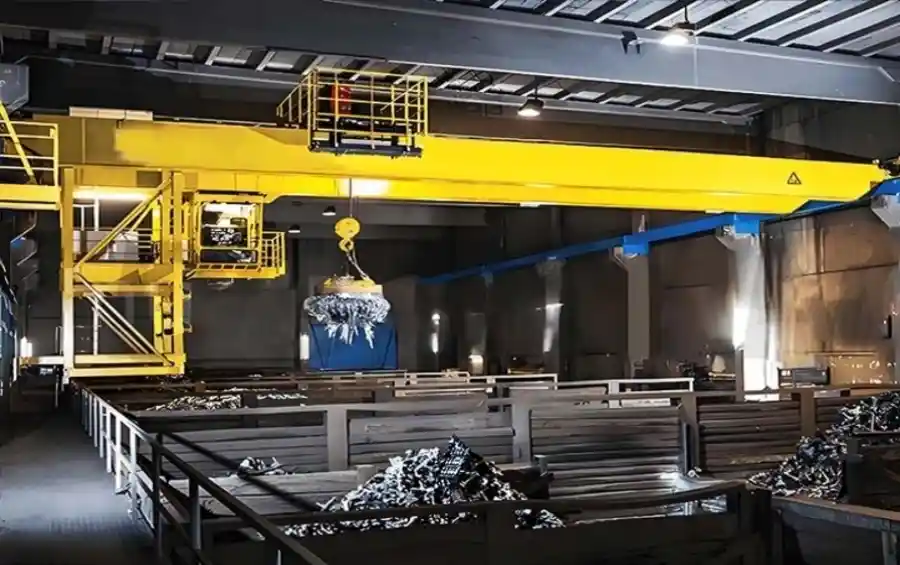
An electromagnetic bridge crane is a double-girder overhead crane that carries a DC-powered lifting magnet suspended from its hook instead of slings or clamps. The magnet holds ferrous steel by magnetic force alone and lets go the moment the current is cut — no rigging crew, no clamp marks, nothing to snag.
Weihua builds this machine as its QC electromagnetic bridge crane: a double-girder, double-rail unit with a single trolley and separate main and auxiliary hoists, supplied with the crane, magnet and control system engineered as one package and sized to your bay.
How the lift happens?
Two systems do the work — the magnet holds, the bridge carries.
The magnet runs on direct current. An excitation controller rectifies the site AC supply and feeds steady DC down a cable reel on the trolley to the magnet coil. Because the load is held only while that coil is live, release is deliberate: the controller de-energises the magnet and applies a short reverse pulse to clear residual magnetism, so thin sheet and small offcuts do not cling to the face after the load drops.
The hoist is arranged for turning. Main and auxiliary hoists share one trolley with independent drives, running separately for routine lifts or in tandem to flip billets and sections. Variable-frequency drive with a control brake and a holding brake keeps starts and stops smooth, which lets the operator set the magnet down accurately onto a stack.
What it moves, and where it earns its keep?
The material must be magnetic. That one constraint confines these cranes to steel mills, foundries, scrapyards and metal warehouses rather than general industry:
• Steel scrap and turnings — loose scrap, sheared plate, borings and chips.
• Billets, blooms and slabs — semi-finished stock in a mill yard.
• Ingots and pig iron — cast product coming out of a foundry.
• Sections, plate and pipe — structural stock in a warehouse or fabrication shop.
The auxiliary hook gives the crane a second life: it handles the occasional non-magnetic or rigged load a magnet cannot touch, so the machine is not tied to ferrous-only work.
Magnet selection sets the crane
Most buyers start from lifting capacity and treat the magnet as an accessory. The magnet is the specification.
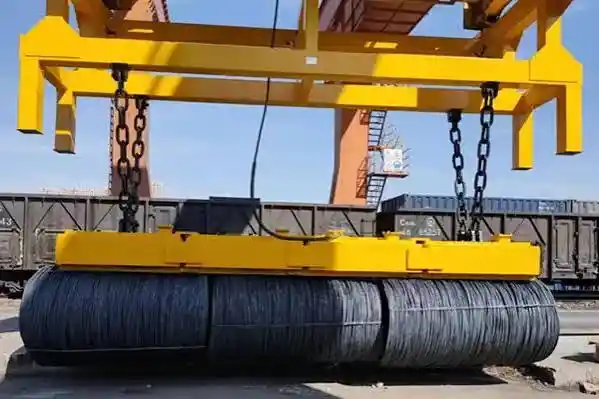
Circular or rectangular. Circular magnets are the standard for scrap and irregular pieces — they grip evenly no matter how the part lies. Rectangular magnets suit long flat stock, holding plate and long sections along their full length so nothing sags or swings.
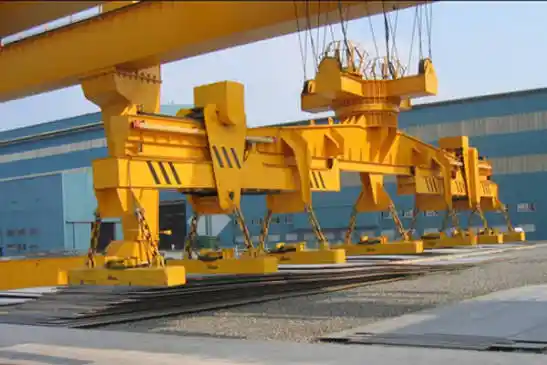
One magnet or a beam. A single magnet under the hook covers scrap and billet handling. Long plate, pipe and sections need several magnets spaced along a spreader beam so the load is supported at more than one point. If your work is mainly long stock, this changes the trolley, the beam and the controls — decide it early.
Rotating or fixed. The QC series is available with top-rotating and bottom-rotating beam arrangements for turning a load before it is set down, worth choosing up front if your storage layout depends on it.
Magnet, grab or vacuum: the attachment decides the crane
All three hang from a double-girder bridge, but they solve different problems.
• A lifting magnet is fastest for ferrous scrap and sections: no jaws to wear, no small pieces to drop, and it grips mixed or partly buried material that a grab cannot close around. The cost is a dependable DC supply and a magnetic-only diet.
• A grab bucket handles non-magnetic bulk — coal, ore, ash, clinker — but cycles slower and wears its jaws and ropes.
• A vacuum lifter suits flat, smooth non-magnetic stock such as stainless or aluminium plate.
A ferrous-only yard is usually cheapest to run with a magnet crane. For yards that handle both, Weihua also builds a dual-purpose machine carrying a magnet and a grab.
What separates a QC from a magnet bolted onto a crane?
The bridge girder is a welded box section analysed by finite element method, with Q235-B (or Q345-B) main members and a minimum plate thickness of 6 mm. It carries a built-in camber of (1–1.4)S/1000, with the peak placed inside the middle tenth of the span, so the girder settles level under full load instead of sagging — a detail that matters on a machine that takes frequent, full-weight scrap lifts.
The trolley runs on full-length welded rail joints rather than bolted splices, which keeps magnet travel smooth and quiet. Crane travel is split across two independent drive systems, each a motor driving a reducer at a 1:2 wheel ratio, while the trolley uses a single centralised drive. Welds are made by submerged-arc or gas-shielded process and inspected to GB/T 14405.
Safety carries more weight here than on a hook crane. The margin between a safe machine and a risky one is the backup supply that keeps the magnet energised if site power fails.
Where buyers go wrong?
Buyers often read the crane's rated capacity and assume the magnet will hold that much. The rating covers the hoist and magnet together, but a magnet's real holding force falls with air gap, thin material, rust and scale — and collapses on hot stock. A magnet that holds a cold, clean slab easily may not hold the same weight hot or rusted, so size the magnet to your actual material and temperature, with margin.
Hot steel is a hard stop, not a derating. Steel loses magnetism as it heats and turns non-magnetic near iron's Curie point of about 770 °C, so red-hot or glowing product cannot be magnet-lifted. It must cool first, or be handled with tongs, a C-hook or a grab.
Duty class decides how long the machine lasts. Scrap handling is high-frequency work, and a machine rated below its real cycle wears out motors, brakes and contactors years early. Steel-mill duty typically means A6/A7.
Keeping it in service
Three checks prevent most magnet-crane failures. Dress or replace a grooved magnet face before the widened air gap eats into holding margin. Watch coil temperature — a magnet running continuously or on hot product runs a hot coil, which shortens its life. And inspect the power path each service: the cable reel, magnet cables and connectors for abrasion and loose joints, plus the demagnetising circuit and backup supply on schedule. If small pieces start clinging after release, residual magnetism is the first suspect.
Before you quote
The electrical side carries most of the questions. Confirm the site supply (3-phase AC, 380 V/50 Hz standard, others on request), the space for the excitation controller and any backup supply, and whether the area is classified — an electromagnetic crane is not an explosion-proof crane. On the structural side, confirm whether the crane works indoors or outdoors, the runway and rail, and remember the magnet and cable reel add height below the hook, so check lifting height against the building.
Frequently Asked Questions
Q1: How is an electromagnetic bridge crane different from a normal hook bridge crane?
A: The bridge is much the same; the attachment is not. A hook crane lifts only what can be rigged, whereas an electromagnetic crane picks ferrous material directly by magnetic force, so scrap and sections move without slings or rigging. The magnet is DC-powered, with a demagnetising circuit for clean release and a backup supply for safety.
Q2: Can it lift stainless steel or aluminium?
A: No. Lifting magnets hold only ferromagnetic material. Austenitic stainless steel and non-ferrous metals such as aluminium, copper and brass will not hold reliably; a grab bucket or vacuum lifter is the right tool for those.
Q3: Can it lift hot steel?
A: Only within limits. Holding force falls as temperature rises, and steel turns non-magnetic near iron's Curie point of roughly 770 °C, so red-hot or glowing product cannot be magnet-lifted. State the product temperature at the point of lift and we will confirm the safe range or recommend tongs or a grab.
Q4: What do you need for a quotation?
A: The material type, size and temperature; the heaviest single lift; span and lifting height; the bay and runway condition; daily working hours; and the site power supply and standards. From these we size the magnet, the duty class and the crane and return a customised quotation.
Contact us
Not sure which magnet configuration fits your yard? Send Weihua your material and bay details for a recommendation and a customised price.