


 English
 Español
 Русский
 العربية
 Français
 Deutsch
 Português
 Tiếng Việt
 Thai
Thai
 Bahasa Indonesia
 Türkçe
 Italiano

What Is a Gantry Crane with Electric Hoist?
A gantry crane with electric hoist is a practical lifting solution for workshops, warehouses, construction yards, fabrication plants, storage areas, and outdoor material handling sites.
Unlike an overhead crane that normally relies on building columns and runway beams, a gantry crane is supported by its own legs and travels along rails installed at ground level. An electric hoist travels along the main girder to lift and move materials across the working area.
A gantry crane with electric hoist is a rail-mounted lifting system consisting mainly of:
-Main girder
-Supporting legs
-End carriages
-Crane traveling mechanism
-Electric hoist
-Electrical control system
-Power supply system
The electric hoist performs two main movements: lifting the load vertically and traveling horizontally along the crane girder.
At the same time, the entire gantry crane travels along its runway rails.
These three movements allow the hook to cover a rectangular working area underneath the crane.
WEIHUA's current electric-hoist gantry crane range is intended for small and medium industrial lifting applications and is commonly used in open yards and warehouses.
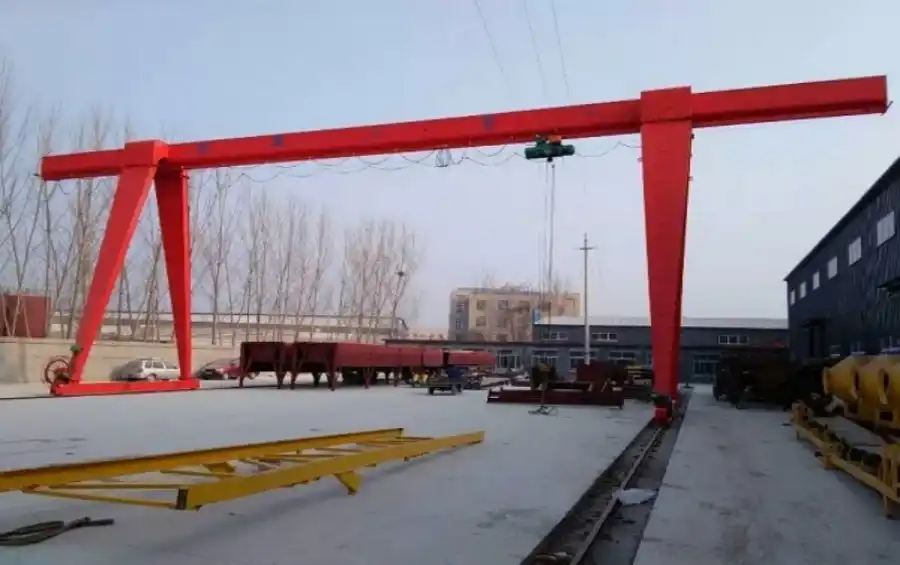
Where Is an Electric Hoist Gantry Crane Used?
This type of crane is suitable for general material handling where extreme lifting capacity or highly specialized equipment is not required.
Manufacturing Workshops
Gantry cranes can move:
-Steel components
-Machinery
-Motors
-Fabricated structures
-Molds
-Production equipment
They are especially useful when the workshop structure is not suitable for supporting an overhead crane.
Outdoor Storage Yards
Steel, concrete products, machinery, pipes, and other materials can be loaded and transferred outdoors.
Because the crane stands on its own supporting legs, it can cover designated storage and loading areas without depending on a building.
Warehouses
A gantry crane can be installed inside or outside a warehouse to transfer materials between storage areas and vehicles.
Fabrication Plants
Steel fabrication and machinery manufacturing facilities often use electric hoist gantry cranes for component assembly and material transfer.
Construction and Maintenance Areas
Temporary or semi-permanent lifting areas can also benefit from a gantry arrangement when installing a traditional overhead crane is inconvenient.
Main Components
Main Girder
The main girder provides the track for the electric hoist.
Depending on the capacity, span, and operating requirements, the girder may use different structural designs.
For general electric-hoist gantry cranes, a relatively simple single-girder arrangement is commonly used because it keeps the structure lighter and reduces equipment complexity.
Supporting Legs
The legs transfer the crane load to the traveling mechanisms and runway rails.
Their design must account for lifting capacity, crane span, wind load, and operating conditions.
Some gantry cranes use two rigid legs, while other structural arrangements may be selected according to the span and application.
Electric Hoist
The electric hoist is the main lifting unit.
It normally contains:
-Lifting motor
-Reduction gearbox
-Brake
-Wire rope or chain
-Drum or load wheel
-Hook block
-Traveling mechanism
Wire rope electric hoists are widely used for industrial gantry cranes where longer lifting heights and moderate-to-heavy loads are required.
Electric hoists can also be configured with different lifting speeds and control systems depending on the working process.
Crane Traveling Mechanism
The complete crane moves along ground rails through powered end carriages.
Travel speed should be selected according to the crane span, runway length, handling frequency, and positioning requirements.
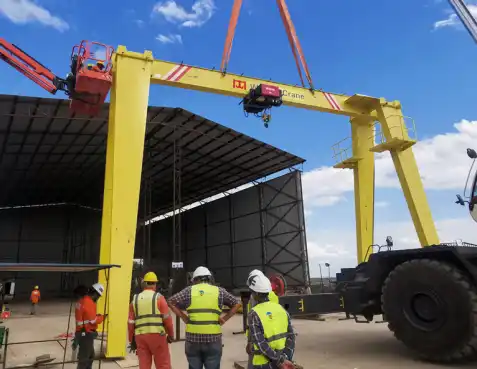
Why Choose a Gantry Crane with Electric Hoist?
Independent Supporting Structure
One of the main advantages is that the crane does not normally require the building to support the lifting load.
This is especially useful for:
-Existing factories
-Outdoor yards
-Workshops without crane runway beams
-Temporary production areas
Simple and Practical Design
Compared with some heavy-duty trolley gantry cranes, an electric-hoist gantry crane has a relatively straightforward lifting system.
This can make installation, inspection, and maintenance easier for general industrial applications.
Flexible Installation
The crane can be designed according to the available yard width, lifting height, and travel distance.
It can also be used indoors or outdoors with appropriate electrical and corrosion protection.
Efficient Use of Working Space
The crane travels above the material handling area, reducing dependence on forklifts or other ground equipment.
This can keep production and storage lanes clearer.
Multiple Control Options
Depending on the application, operation can be performed using:
-Pendant control
-Wireless remote control
-Operator cabin
The manufacturer's published electric-hoist gantry crane configuration also supports ground and cabin operating arrangements.
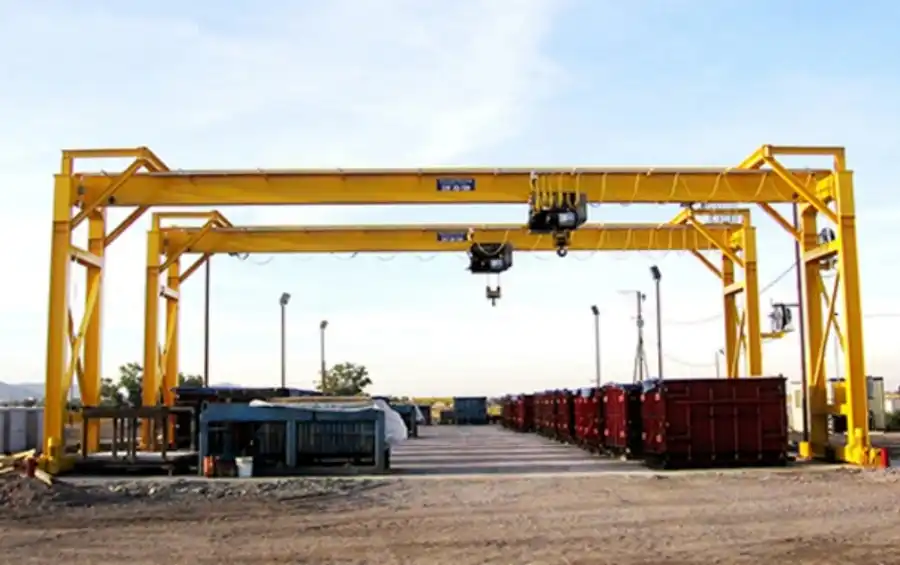
How to Select a Gantry Crane with Electric Hoist?
1. Lifting Capacity
Determine the maximum load the crane will actually lift.
Do not select the crane only according to the average daily load.
2. Crane Span
Span is normally the distance between the centers of the crane rails.
The required span depends on the width of the working area.
3. Lifting Height
Specify the vertical distance the hook needs to travel.
For outdoor yards, consider truck height, stored materials, machinery, and any other obstacles.
4. Crane Travel Length
The runway length determines how far the complete gantry crane must travel.
Providing a site layout drawing helps determine the rail arrangement and power supply system.
5. Working Frequency
A crane used several times a day requires a different duty configuration from one working continuously through multiple shifts.
Provide:
-Operating hours per day
-Approximate lifts per hour
-Average load
-Maximum load
6. Indoor or Outdoor Use
Outdoor cranes need additional consideration for:
-Wind
-Rain
-Temperature
-Corrosion
-Electrical protection
Wind protection and rail anchoring may also be required depending on crane dimensions and local conditions.
7. Power Supply
The electrical system should match the user's local voltage and frequency.
Power can be supplied through systems such as cable reels or other suitable arrangements depending on crane travel distance. The manufacturer's standard product information also lists cable-based power supply options.
Gantry Crane with Electric Hoist FAQ
1.What is a gantry crane with electric hoist?
It is a gantry lifting system in which an electric hoist travels along the main girder to lift and move materials. The complete crane travels on rails supported at ground level.
2.Is it suitable for outdoor use?
Yes. Gantry cranes are widely used in outdoor storage and fabrication yards. Outdoor designs should consider wind, rain, corrosion, and electrical protection.
3.Does a gantry crane need a building runway?
No. A full gantry crane is supported by its own legs and normally travels on ground rails, so it does not require the same elevated building runway as an overhead crane.
4.Can it use wireless remote control?
Yes. Wireless remote control is commonly used for general industrial gantry cranes and allows the operator to observe the load from different positions.
5.What electric hoist can be used?
The hoist should be selected according to capacity, lifting height, working duty, required speed, and environment. Wire rope electric hoists are commonly used for this type of gantry crane.
A Practical Crane Should Match the Site
A gantry crane with electric hoist does not need to be complicated to provide effective material handling.
The key is to match the capacity, span, lifting height, electric hoist, working duty, travel length, and operating environment to the real application.
For workshops, warehouses, fabrication yards, and outdoor storage areas, WEIHUA can configure electric-hoist gantry crane solutions around project conditions instead of relying only on a fixed standard model. Its current product range includes rail-traveling electric-hoist gantry cranes with multiple control arrangements for general industrial handling.
For a preliminary proposal, provide your lifting capacity, span, lifting height, travel length, working hours, control method, power supply, and site drawing.
