



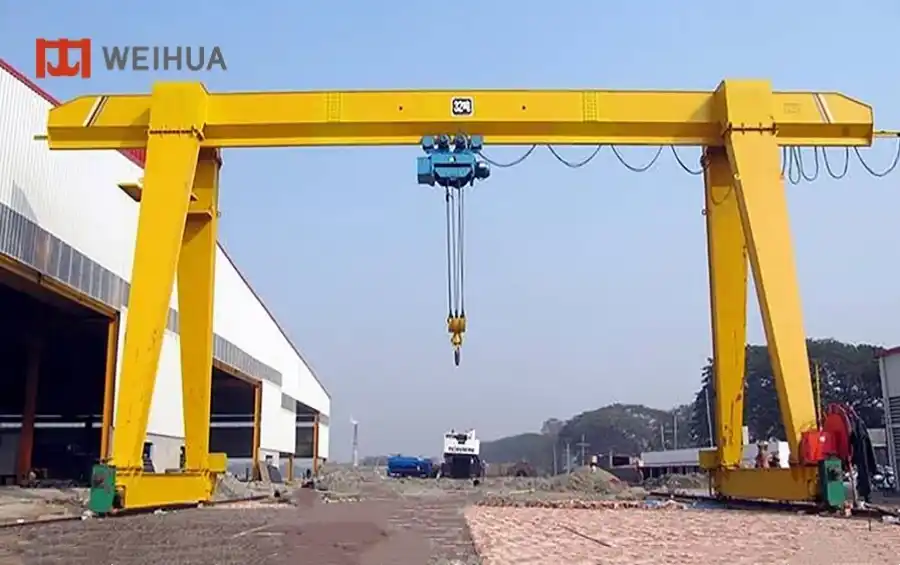
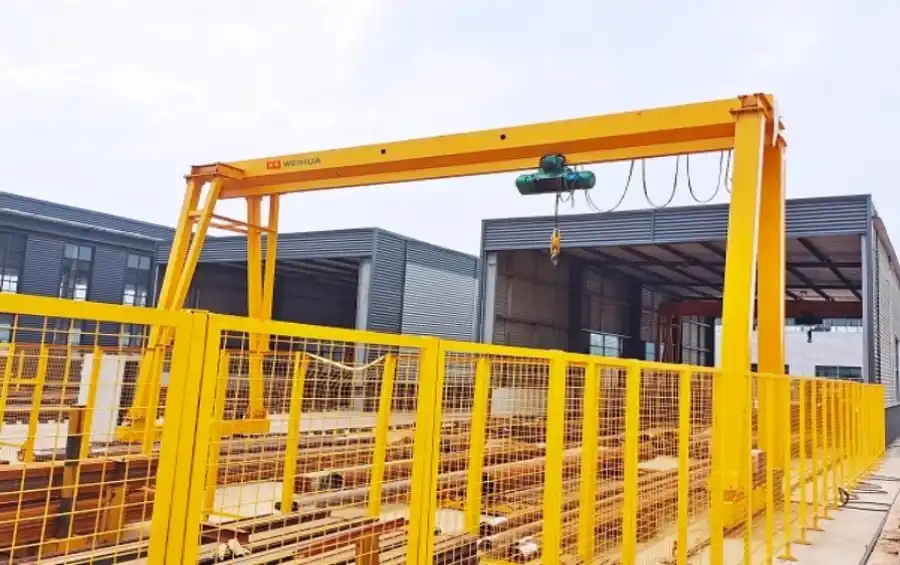
A gantry crane with electric hoist supports itself on its own legs and travels on ground rails, requiring no building structure. For a buyer with an open yard and no existing factory building, this eliminates the cost of constructing a crane-supporting framework.
The MH type is the most common configuration: a single girder — box-type or truss-type — with a CD1 or MD1 wire rope electric hoist running along the lower flange. The hoist handles lifting and trolley travel; the crane as a whole moves along the ground rails, picking up a load anywhere within the span and delivering it to a truck or processing station without a separate trailer.
A typical application: a steel stockyard receives plates and sections by truck, the MH gantry crane unloads them from the truck bed, moves them across the yard, and stacks them by grade. When a processing order comes in, the same crane picks the material and feeds it to the saw or shear line. One machine handles receiving, yard storage, and production feeding.
Three Decisions That Apply Only to the MH Type
•Control method. Ground push-button pendant, wireless remote, or cabin. Pendant is economical for short travel; remote is preferred when the crane exceeds 50 m of travel distance; cabin is specified when the operator needs a direct view of the load at height.
•Temperature rating. Standard: -20°C to +40°C. Outside this range, special lubricants and electrical components are required.
•Power supply. Cable reel connected to a yard power outlet, or a sliding contact line along the rail for fixed-yard layouts.
Box-Type vs Truss-Type Main Girder
Box-type girder. Welded steel plates form a closed rectangular section. Better torsional rigidity, less structural inspection needed. Standard modular sections can be built for transport on flat-rack containers — an advantage when the yard is in a region with containerized freight logistics.
Truss-type girder. Angle steel and round bars in an open lattice. Lighter than a box girder of equal strength, reducing wheel load and ground preparation cost. Wind passes through the open structure, which is an advantage for coastal and high-wind regions. The trade-off: higher fabrication labor cost and more surface area to maintain against corrosion.
If the yard is inland with stable soil and low wind, a box girder is the more cost-effective choice. For yards near the coast or in regions with regular typhoons, the truss girder is the safer long-term investment.
CD1 vs MD1 — Which Electric Hoist Fits Your Operation
CD1. Single-speed hoisting at 8 m/min (3.5 m/min for 16 t and above). Simpler construction, lower cost. Suitable for general loading and unloading where the operator does not need precise inching — moving stock between yard positions, loading trucks.
MD1. Two-speed hoisting with a 1:10 ratio — 8 m/min for fast travel and 0.8 m/min for precise positioning. The low speed allows the operator to align the load with a truck bed, stack on a rack, or match bolt holes in an assembly operation. If the yard handles breakable or fragile loads, the MD1 justifies its additional cost with fewer damaged goods.
Three Control Methods
Ground push-button pendant. The operator stands beside the load and controls hoist and travel directly. The simplest arrangement for short travel distances.
Wireless remote. A handheld transmitter within line of sight. Preferred when the crane travel distance exceeds 50 m or when the load blocks the pendant operator’s view.
Cabin control. An enclosed or open cabin mounted on the crane end. Specified when the operator needs an elevated perspective — unloading trucks from above, stacking loads at height.
Information Needed for a Quotation
1.Rated capacity (t) — including any spreader or lifting beam weight.
2.Span (m) — distance between ground rail centers.
3.Lifting height (m) — floor to hook at highest position.
4.Working duty — A4 (light), A5 (medium), or A6 (heavy). MH cranes default to A4–A5.
5.Girder type — box or truss.
6.Hoist type — CD1 (single speed) or MD1 (dual speed).
7.Control method — pendant, remote, or cabin.
8.Cantilever requirement — if the hook needs to extend beyond the ground rail on one or both sides, specify the cantilever length (not exceeding 1/3 of the span).
Frequently Asked Questions
Q1: What is the difference between a gantry crane with electric hoist and an overhead bridge crane?
A gantry crane with electric hoist travels on ground rails supported by its own legs. An overhead bridge crane runs on elevated rails mounted on the building columns. The gantry crane is used outdoors or where no building exists. The bridge crane is used inside factory buildings.
Q2: What is the temperature range for a standard MH gantry crane?
-20°C to +40°C. For extreme environments, the supplier can specify low-temperature steel, cold-resistant lubricants, and appropriately rated electrical components.
Q3: Can the crane operate outdoors in rain and wind?
Yes. Standard electrical enclosures are weatherproof. In high-wind areas, the truss-type girder reduces wind load, and rail clamps or anchor devices can be added to secure the crane when not in use.
Q4: Does the lifting capacity include the hoist weight?
No — unlike magnet or clamp cranes where the attachment weight is included, the MH crane’s lifting capacity is the net hook capacity. The electric hoist weight is part of the crane dead load.
Q5: How is the crane powered when traveling outdoors?
Standard power supply is via a cable reel mounted on the trolley or end carriage, connected to a yard power outlet. For fixed-yard layouts, a sliding contact line along the rail is an alternative.
