


 English
 Español
 Русский
 العربية
 Français
 Deutsch
 Português
 Tiếng Việt
 Thai
Thai
 Bahasa Indonesia
 Türkçe
 Italiano

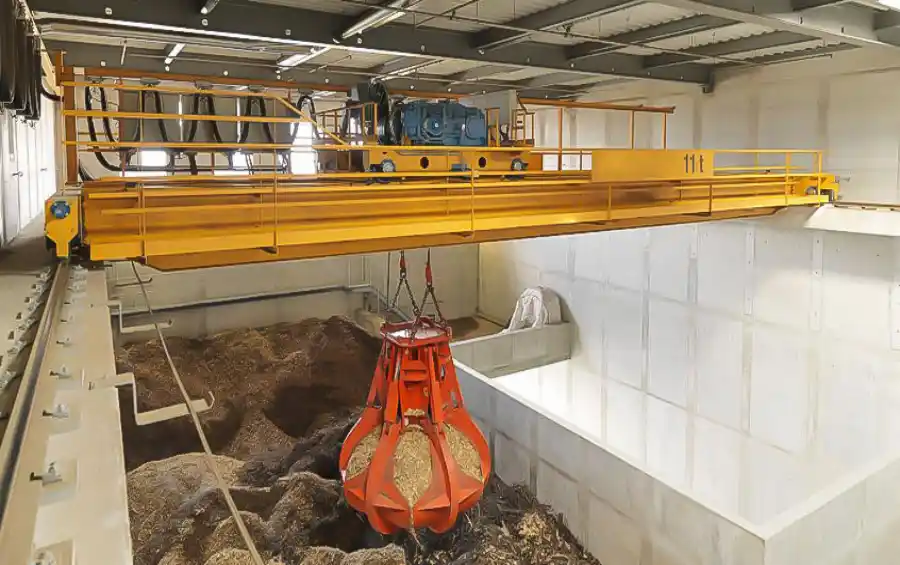
What Is a Grab Bucket Overhead Crane?
A grab bucket overhead crane is a bridge crane equipped with a grab instead of a conventional hook as its main material-handling device.
The crane normally consists of:
lBridge structure
lCrane traveling mechanism
lTrolley
lHoisting mechanism
lGrab bucket
lElectrical and control system
lOperator cabin or remote control system
The bridge travels along runway rails installed on both sides of the building. The trolley moves across the bridge, and the grab is lowered into the bulk material.
After the bucket closes and captures the material, the crane lifts it, transports it to the discharge position, and opens the bucket.
This working cycle makes the crane especially suitable for loose materials that would otherwise require loaders, conveyors, or manual handling.
What Materials Can a Grab Crane Handle?
The correct grab design depends heavily on the material.
Typical materials include:
l Coal
l Ore
l Limestone
l Sand
l Gravel
l Grain
l Fertilizer
l Biomass
l Wood chips
l Industrial waste
l Slag
WEIHUA's current grab crane information also lists coal, ore, grain, and limestone among typical handled materials.
Bulk density, particle size, moisture content, abrasiveness, and flow characteristics all influence the grab selection.
A bucket suitable for grain, for example, may not be appropriate for heavy ore.
Main Components of a Grab Bucket Crane
Bridge Structure
The bridge carries the trolley and spans the working area.
Double-girder structures are commonly used for demanding grab applications because grab cranes often operate at relatively high frequency.
The crane structure should be designed according to capacity, span, duty cycle, and operating environment.
Hoisting Trolley
The trolley moves the grab across the crane span.
In many grab crane systems, the lifting arrangement controls both vertical movement and bucket opening or closing.
The hoisting system must therefore withstand frequent acceleration, braking, and repeated handling cycles.
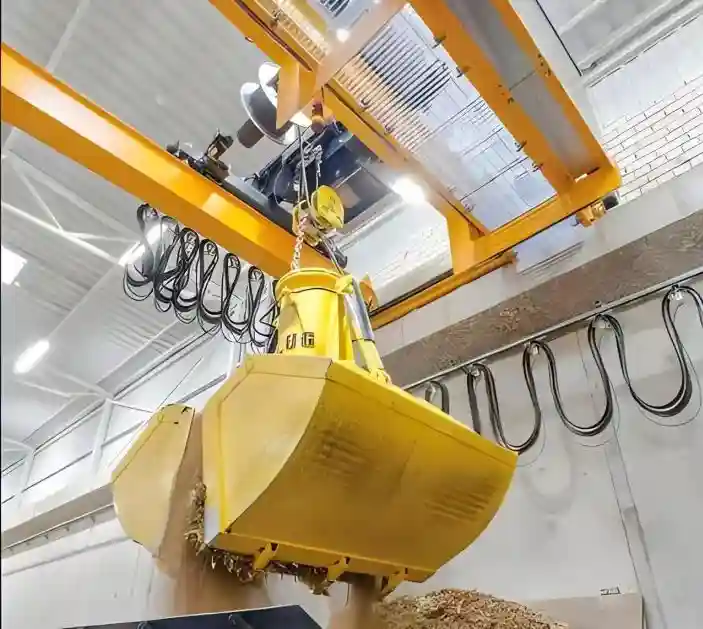
Grab Bucket
The grab is the key working component.
Its size and shape should be selected according to:
Material density
Required handling capacity
Material particle size
Storage conditions
Crane capacity
The objective is not simply to use the largest possible grab.
If the bucket is too large for a dense material, the crane can become overloaded before the bucket is completely filled.
Where Are Grab Bucket Overhead Cranes Used?
Power Plants
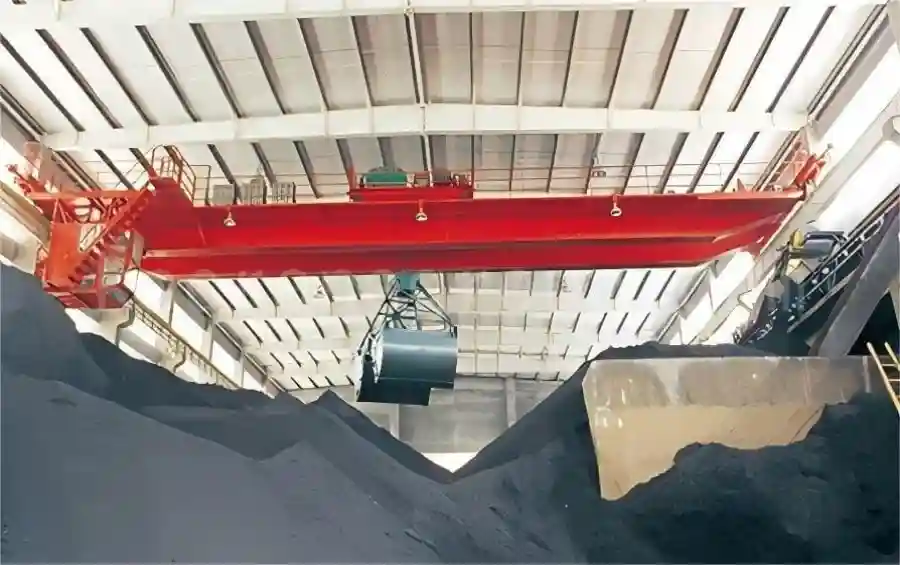
Coal-fired power plants may use grab cranes in coal storage areas or fuel handling systems.
The crane can transfer coal between storage pits, hoppers, and processing equipment.
Cement Plants
Cement production requires continuous handling of materials such as limestone, additives, and fuel.
Grab cranes can serve indoor storage halls and material feeding areas.
Mining and Mineral Processing
Ore and mineral materials are often abrasive and heavy.
For these applications, the crane structure, grab bucket, wire ropes, and drive system require suitable heavy-duty design.
Waste Handling
Grab cranes are commonly used in waste storage pits.
The crane can mix, stack, and feed waste into processing or combustion systems.
Automation can also be introduced when repetitive handling cycles are required.
Grain and Bulk Storage
Special grab buckets can handle grain and other relatively light bulk commodities.
The bucket volume should be selected according to the lower material density.
How to Select a Grab Bucket Overhead Crane?
Correct selection should begin with the material rather than only the crane tonnage.
1. Material Type
Provide the name of the material and its characteristics.
The most important factor is usually bulk density, normally expressed in t/m³ or kg/m³.
2. Required Handling Capacity
If production requires a certain number of tons per hour, provide the target throughput.
This helps determine the required grab volume and crane operating speeds.
3. Crane Capacity
The crane must support the combined lifted load, including the grab itself and the material inside it.
This is an important distinction from ordinary hook cranes.
4. Span
Span is normally based on the distance between the crane runway rails.
A workshop drawing is recommended.
5. Lifting Height
Consider both the depth of the material pit and the highest discharge point.
6. Working Duty
Grab cranes often operate much more frequently than maintenance cranes.
For continuous bulk handling, working duty is therefore a major design consideration. WEIHUA's published standard grab crane configuration, for example, lists an A6 working class for its current range.
7. Control Method
Depending on the application, operation may be from:
-Crane cabin
-Remote control
-Central control room
-Automated control system
For dusty or harsh environments, keeping operators away from the material area can improve working conditions.
Maintenance of a Grab Bucket Crane
Frequent operation makes preventive maintenance especially important.
Regular inspection should include:
Wire Ropes
Check for broken wires, abrasion, deformation, and corrosion.
Grab Bucket
Inspect:
-Bucket lips
-Hinges
-Pins
-Pulleys
-Rope connections
-Hydraulic components where applicable
Wear can be particularly rapid when handling abrasive minerals.
Brakes and Drives
Frequent working cycles can increase brake and transmission wear.
Any unusual noise, vibration, or stopping behavior should be investigated.
Crane Wheels and Rails
Check wheel wear, rail condition, and crane alignment.
Electrical System
Inspect motors, limit switches, control devices, cables, frequency drives, and emergency systems.
Grab Bucket Overhead Crane FAQ
1.What is a grab bucket overhead crane used for?
It is mainly used to lift and transfer loose bulk materials such as coal, ore, sand, limestone, grain, biomass, and industrial waste.
2.How is a grab crane different from a normal overhead crane?
A normal overhead crane usually lifts loads using a hook.
A grab crane uses a bucket that can open and close, allowing it to pick up loose material directly.
3.How do I choose the correct grab size?
Grab volume should be selected according to material density, crane capacity, particle size, and required throughput.
A larger bucket is not always better.
4.Can a grab crane operate automatically?
Yes.
Automatic positioning, anti-sway control, grab control, PLC systems, and remote monitoring can be incorporated depending on the project.
5.Is a grab crane suitable for continuous operation?
Yes, provided that the crane structure, drives, brakes, ropes, and grab are selected for the required duty cycle.
Match the Crane to the Material
A grab bucket overhead crane should not be selected simply by choosing a crane tonnage and adding a bucket.
The material itself determines much of the final design.
Bulk density, handling capacity, grab volume, duty cycle, storage layout, and discharge method must work together.
For bulk material projects, WEIHUA can configure grab crane solutions around the actual handling process rather than relying only on a fixed standard model. Its current grab crane range is intended for applications including ports, mines, power plants, cement facilities, warehouses, and other bulk-material operations.
