



What Is a Rail Mounted Container Gantry Crane?
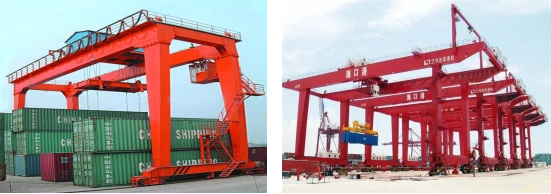
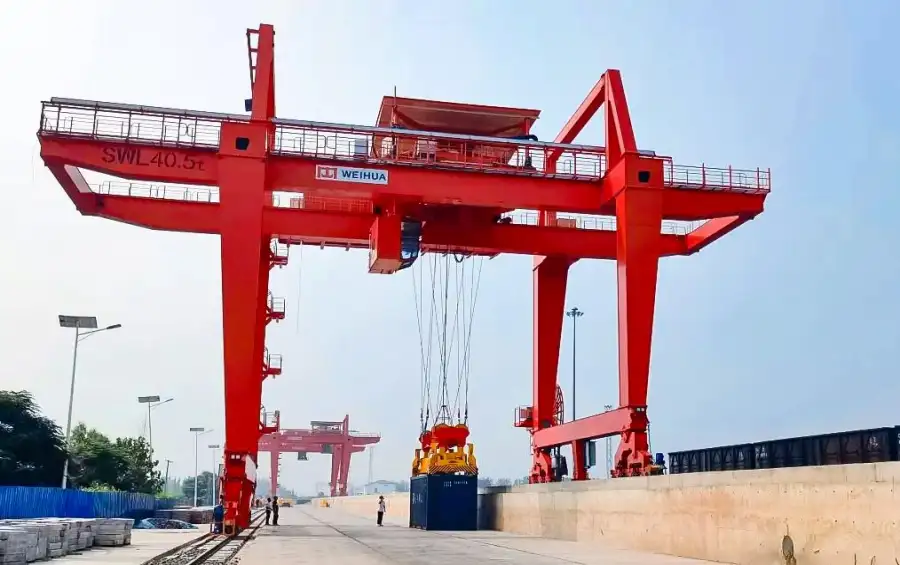
A rail mounted container gantry crane is a large gantry crane designed to move along rails installed on both sides of a container storage block.
The crane spans several container rows and normally lifts containers using a dedicated telescopic spreader.
During operation, three main movements work together:
-The gantry travels along the yard rails.
-The trolley moves across the crane span.
-The hoisting mechanism raises and lowers the spreader and container.
This combination allows the crane to reach containers throughout a defined storage block.
RMG cranes are especially suitable for handling standard 20 ft, 40 ft, and 45 ft containers, depending on the selected spreader and terminal requirements.
Where Are RMG Cranes Used?
Rail mounted container gantry cranes are most commonly used in facilities with high container throughput and relatively fixed yard layouts.
Container Terminals
At marine and inland container terminals, RMG cranes can transfer containers between storage stacks and trucks.
Their long spans allow one crane to cover several rows of containers and vehicle lanes.
Railway Intermodal Terminals
Rail terminals use RMG cranes to transfer containers between railway wagons, trucks, and storage areas.
A large span can cover multiple rail tracks and container stacking lanes, allowing different transport modes to operate within the same crane working area.
Inland Container Depots
Large inland logistics centers often need to store containers densely while maintaining efficient truck access.
Because the crane travels on rails rather than using wide maneuvering areas, more ground space can be dedicated to container storage.
Automated Container Yards
RMG cranes are particularly suitable for automated terminals because their travel routes are fixed and predictable.
Positioning systems, PLC controls, anti-sway functions, remote operation, and terminal management systems can be integrated to reduce manual intervention.
Main Structure of an RMG Crane
Although the exact design varies from project to project, a typical RMG crane contains several major systems.
Main Girder
The main girder spans the container yard and carries the trolley.
Box-type steel structures are commonly used because they provide the strength and rigidity required for repeated container handling.
Rigid and Flexible Legs
The gantry structure is supported by legs on both sides.
On large-span cranes, the design must account for structural deformation, rail alignment, wind loads, and differences in travel resistance between both sides.
Trolley
The trolley travels across the main girder and carries the hoisting equipment.
By combining trolley movement with crane travel, the spreader can reach different container positions inside the yard block.
Hoisting Mechanism
The lifting system raises and lowers the loaded or empty container.
Its capacity, speed, acceleration, braking, and duty classification should be selected according to terminal productivity requirements rather than simply maximum container weight.
Container Spreader
The spreader connects the crane to the container corner castings.
Depending on the project, telescopic spreaders can be configured for different ISO container lengths.
Optional functions may include:
l Container rotation
l Anti-sway control
l Automatic positioning
l Twist-lock monitoring
l Height detection
Crane Traveling System
Steel wheels move the entire crane along fixed rails.
For long-span or high-speed RMG cranes, synchronization between both sides of the gantry is important to prevent excessive skewing.
WEIHUA's published RMG information, for example, notes that large-span systems can use synchronization control to keep both traveling sides coordinated.
Why Use an RMG Crane for Container Handling?
The main advantages come from combining large yard coverage with a fixed rail system.
High Container Storage Density
Because the crane does not require wide tire travel lanes inside the storage block, containers can often be arranged more densely.
This is particularly important where terminal land is expensive or limited.
Large Span
An RMG can cover multiple container rows, truck lanes, or railway lines with one crane.
This makes it suitable for high-volume intermodal operations.
Stable Rail Travel
Rail guidance provides a predictable travel path.
This can support accurate positioning and reduce the variability associated with free-steering mobile equipment.
Electrically Powered Operation
RMG cranes generally use electric power, making them well suited to fixed container yard infrastructure.
Modern systems can use variable-frequency drives and PLC-based control for smooth acceleration, deceleration, and positioning.
Automation Potential
Because both crane travel and trolley travel follow defined axes, RMG cranes are well suited to automation.
A modern system may incorporate:
-Automatic container positioning
-Anti-sway control
-Remote operation
-OCR or identification systems
-Position sensors
-Collision avoidance
-Yard management system integration
The exact automation level should match the terminal's operating process.
Automation and Remote Operation
Container terminals are increasingly reducing the need for operators to remain inside high-mounted crane cabins.
An automated or semi-automated RMG can perform repetitive travel and positioning tasks while operators supervise operations from a remote control room.
Useful technologies may include:
Anti-Sway Control
Container sway can increase cycle times because the operator must wait for the load to stabilize before final placement.
Anti-sway systems help control suspended container movement during trolley travel.
Automatic Positioning
Position sensors can help the crane move toward predefined container bays, truck lanes, or railway positions.
Container Identification
Optical identification and terminal software can help confirm that the correct container is being moved.
Collision Protection
Sensors can detect cranes, vehicles, containers, and other obstacles within critical operating areas.
Remote Monitoring
Operating data can be recorded for maintenance and production analysis.
This can include:
-Operating hours
-Motor conditions
-Fault records
-Crane position
-Container movements
Automation should be designed together with the terminal infrastructure rather than added as an isolated crane feature.
How to Select a Rail Mounted Container Gantry Crane?
RMG selection starts with the container yard.
1. Container Type
Confirm whether the terminal handles:
-20 ft containers
-40 ft containers
-45 ft containers
-Other special container formats
The spreader must match the required container standards.
2. Required Lifting Capacity
Capacity depends on the maximum gross container weight and spreader arrangement.
The specification should be based on actual terminal operating conditions.
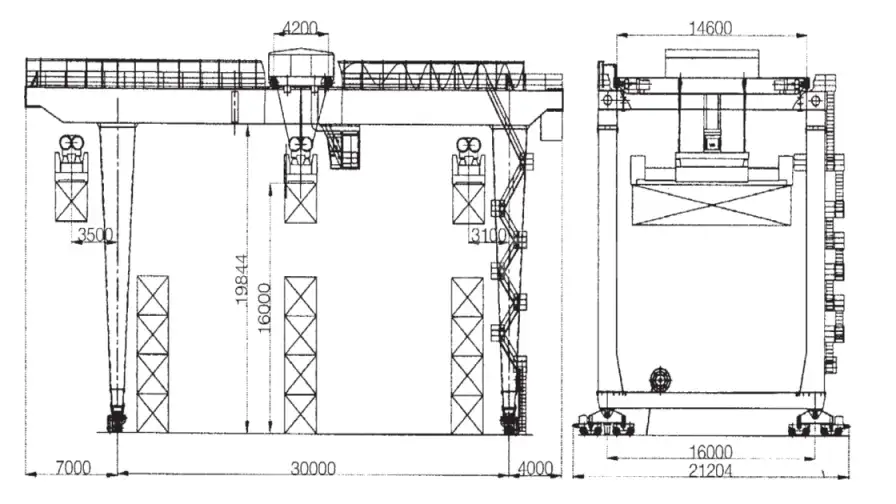
3. Crane Span
Span is determined by the number of container rows, rail tracks, truck lanes, and working clearances below the crane.
A terminal layout drawing is therefore extremely important.
4. Stacking Height
Specify how many containers will be stacked vertically.
The crane must have sufficient lifting height for the spreader to clear the highest stack safely.
5. Cantilever Length
If trucks or railway wagons will operate outside the crane legs, cantilevers may be required.
Their lengths should be designed according to traffic lanes and transfer points.
6. Required Productivity
Provide the expected container moves per hour.
This helps determine appropriate hoisting, trolley, and crane traveling speeds.
7. Working Duty
Container cranes often operate intensively.
The structural, mechanical, and electrical systems therefore need to match the actual working duty.
8. Wind Conditions
Outdoor cranes are exposed to significant wind loads.
The design should consider local wind conditions and include suitable storm protection devices.
9. Automation Level
Decide whether the crane will use:
-Cabin operation
-Remote control
-Remote operator station
-Semi-automatic control
-Full automation
It is better to consider future automation during the original design stage.
Rail Mounted Container Gantry Crane FAQ
1.What does RMG crane mean?
RMG stands for Rail Mounted Gantry crane.
In container terminals, it refers to a gantry crane that travels on fixed rails and uses a container spreader to load, unload, transfer, and stack containers.
2.What containers can an RMG crane handle?
With a suitable telescopic spreader, an RMG can commonly handle standard 20 ft, 40 ft, and 45 ft ISO containers.
3.What is the difference between RMG and RTG cranes?
An RMG runs on fixed steel rails, while an RTG travels on rubber tires.
RMG cranes are particularly suitable for permanent, high-density container blocks, while RTGs offer more flexibility to move between different yard areas.
4.Can an RMG crane handle railway containers?
Yes.
Rail mounted container cranes are widely used in railway transshipment terminals and can be designed to span railway tracks, container stacks, and truck lanes.
