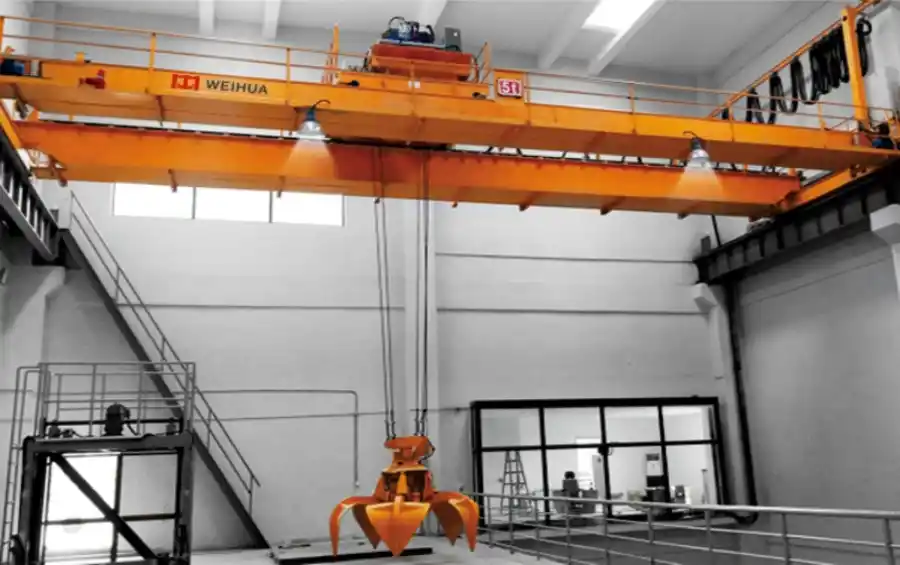
A grab bucket overhead crane is a double-girder bridge crane that carries a grab instead of a hook, built for one job: moving loose bulk material — coal, ore, coke, sand, clinker, grain, ash — through a fixed bay at a high cycle rate. The difference from a hook crane is not the bucket hanging on the end of a rope. It is the trolley underneath.
A QZ grab bucket overhead crane (Q for the bridge, Z for the grab, in the model codes used on Chinese quotations) carries two separate hoisting winches with double-grooved drums arranged symmetrically: one pays out the holding ropes that carry the grab, the other works the closing ropes that shut the jaws.
The grab opens, drops onto the pile under its own weight, the closing ropes pull the jaws shut, and both winches lift together. Weihua builds the QZ series to this architecture, with the structure designed and manufactured under GB/T 3811 and GB/T 14405. Everything that follows — capacity, bucket volume, duty class, rail selection — comes out of that two-winch arrangement.
The QZ range at a glance
Lifting capacity: 5–20 t (grab weight included)
Span: 10.5–31.5 m
Max. lifting height: Up to 28 m
Working class:A6 (heavy duty)
Hoisting speed: 39.2–45.7 m/min
Trolley travelling speed: 43.2–45.9 m/min
Crane travelling speed: 87.3–113.6 m/min
Steel track recommended: 43 kg/m (P43) or QU70
Power supply: 3-phase AC 380 V 50 Hz
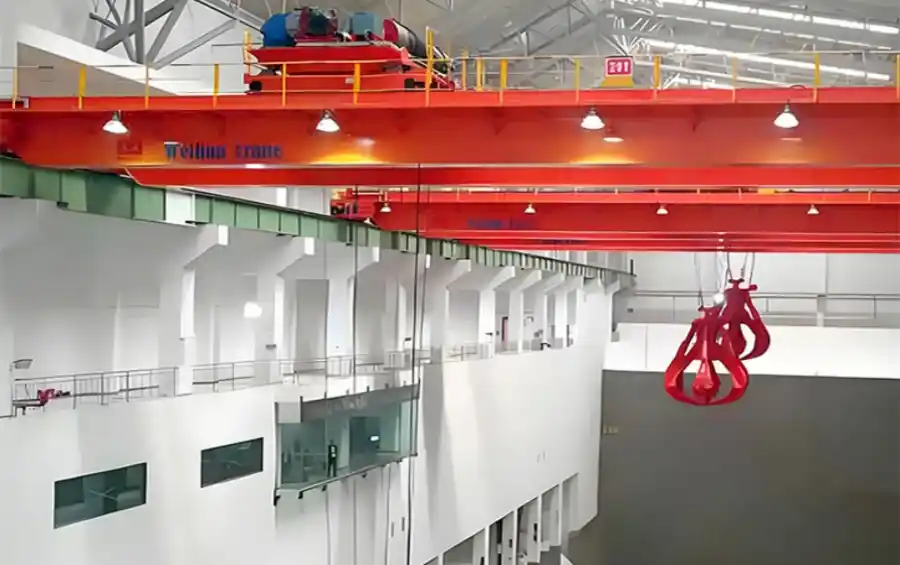
Rated capacity includes the grab, so you buy payload rather than tonnage
The lifting capacity above covers the grab and the material together. A 10 t grab bucket overhead crane does not lift 10 t of coal; it lifts a grab of several tonnes holding whatever is left under the rating. Two practical consequences follow. Price the machine against the net payload you need per bite, not against the tonnage in the model name — that is the figure your throughput calculation actually uses. And because the grab's dead weight is paid for on every single cycle, ask for its weight to be stated separately in the quotation instead of buried in the capacity line.
Bucket volume follows bulk density, not crane capacity
What physically limits one bite is bucket volume in cubic metres, and volume is matched to the material. The same 5 t machine can carry a large bucket of coal or a small one of iron ore; both reach the same rated load, and neither is the wrong grab. This is why a request for "a 10 ton grab crane" cannot be quoted accurately, and why a misjudged grab only shows up after delivery — as a crane that never gets near its rating, or as a grab that cannot bite deep enough to fill.
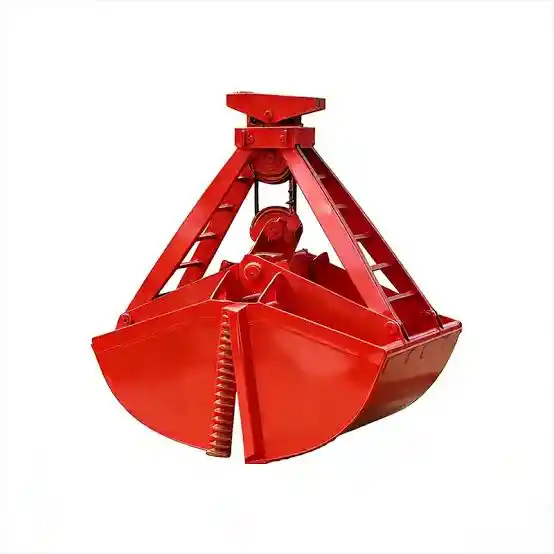
Bucket shape follows the material as well. Clamshell grabs with two jaws suit free-flowing fine material: coal, sand, clinker, grain. Multi-tine orange-peel grabs suit lumpy loads such as ore, large slag and scrap, which a two-jaw bucket would only roll around. Wet ash, clay and corrosive slag need jaw geometry and wearing liners adapted to the material, and that has to be raised at enquiry stage, because the remedy is a different grab rather than a field adjustment.
Four-rope or hydraulic: choose by how the jaws have to open
A four-rope grab is the default. Two holding ropes and two closing ropes run off the two winches, and there is nothing inside the bucket but steel and linkage — which is why it survives A6 duty on routine rope and brake maintenance. The operator sets how deep the jaws dig by paying closing rope in or out.
A hydraulic (motor) grab is a self-contained bucket with its own pump and motor, hung from a single hoisting rope. It opens to a controlled, repeatable degree, which matters when material has to be fed into a hopper or receiving bin at a steady rate rather than dumped. The trade-offs are real: the grab itself is heavier, so less of the rated capacity is left for material, and a hydraulic maintenance scope is added on top of the normal rope-and-brake routine.
Duty class: A6 comes from the load spectrum, not from the shift pattern
A6 is not shorthand for "runs a lot of hours". Under GB/T 3811 the class is set by two factors — the total number of working cycles over the crane's life, and how heavy the typical load is. A6 is reached at combinations as far apart as a heavy load spectrum at roughly a quarter of a million cycles or a light one over several times that count. For a grab machine the deciding question is therefore not shifts per day but whether the bucket comes up full each time.
On grab duty it usually does: a full bucket of dense material is close to rated load on every cycle, and that load spectrum is what pushes the class up. If your site genuinely runs a few hours a day with part loads, say so and the configuration can be discussed. If you cannot state a duty class, give the lifts per day and say whether the load is normally near full. And do not copy a duty class across from a hook crane of the same tonnage — the two machines do not see the same load history.
The two winches have to stay in step
Jaws held on closing ropes and carried on holding ropes only close cleanly if both winches move together. Let them drift and the grab hangs skewed: jaws bite unevenly, one rope wears faster than the other, and material spills on the way across the bay. Weihua's grab trolleys brake each hoisting mechanism with a supporting brake on the motor's high-speed shaft combined with electrical control braking, so the two drums stop as one rather than one running on after the other. When you compare suppliers, the useful question is not drum diameter but how the two mechanisms are kept synchronised — and what the works test proves.
Runway: wheel load does not follow the tonnage
The recommended rail for this class is 43 kg/m (P43) or QU70. Size the runway on wheel load rather than on the figure in the model name: a grab trolley carries two winches, two rope systems and a heavy bucket, and nearly every lift is at full rating with dense material, so rail, rail clamps and the supporting steel work harder than on a hook crane of the same capacity. Where a runway already exists, have the supplier assess it against the new machine rather than assume the profile will take it, and send any local code requirement on rail profile, material or gauge in with the enquiry.
What the RFQ has to carry?
Material name and bulk density in t/m³ — "coal" is not enough
Net payload per bite, excluding the grab
Lifts per hour, or the target handling rate in t/h
Span between rail centres, and lifting height — the height must clear the stockpile under the crane as well as the receiving hopper or vehicle
Grab preference: four-rope or hydraulic, and whether a spare grab is wanted
Runway: existing rail profile and condition, or a new build
Power supply: 3-phase AC 380 V 50 Hz is standard; other voltages can be built
Control method: cab is normal on grab duty because the operator has to place the bucket on the pile; radio remote is available
Destination port, and any standard the machine has to satisfy on import
Frequently Asked Questions
Q1: Does the rated capacity include the grab bucket?
A: Yes. The nameplate figure covers the grab plus the material, so the number that matters in a quotation is the net payload per cycle, with the grab weight stated separately.
Q2: Four-rope or hydraulic grab — which one do I need?
A: Default to four-rope for straight bulk handling on A6 duty: fewer components, simpler maintenance. Choose hydraulic when the jaws have to open to a controlled degree, for example when feeding a hopper, and accept the heavier grab and the extra hydraulic service scope.
Q3: Can an existing hook crane be converted to grab duty?
A: Not economically. A grab trolley needs a second hoisting winch, different rope reeving and a structure re-rated for the changed load case — which means rebuilding the trolley and re-certifying the machine. Where hook work is still needed, a combined grab-and-hook trolley is the practical route.
Q4: Can the crane work outdoors, and can it use an existing runway?
A: Outdoor duty is routine — coal yards and stockpiles are common installations — but say so at enquiry stage so the enclosures and paint system are specified for weather. Re-using a runway depends on the rail profile and the condition of the supporting steel; send the rail type and the span and the wheel loads can be checked against it.