



What counts as a heavy duty gantry crane?
A heavy duty gantry crane is a rail-mounted, double girder gantry crane that works in the open air — freight yards, steel stockyards, precast concrete plants and heavy fabrication shops — where single lifts run from tens of tonnes into the hundreds. In the Weihua product line this class is covered by the A-type double girder gantry crane with hook, a series whose standard capacities run from 5/10 t, 20/5 t, 32/5 t, 50/10 t, 75/20 t and 100/20 t up through 160/50 t, 320/80 t, 500/80 t and 800 t. Unlike a warehouse gantry fitted with an electric hoist, these cranes carry a machined hoist crab that travels along the main girders, and they run on rails fixed to a prepared foundation — so the rail and the civil works are part of the purchase decision from day one.
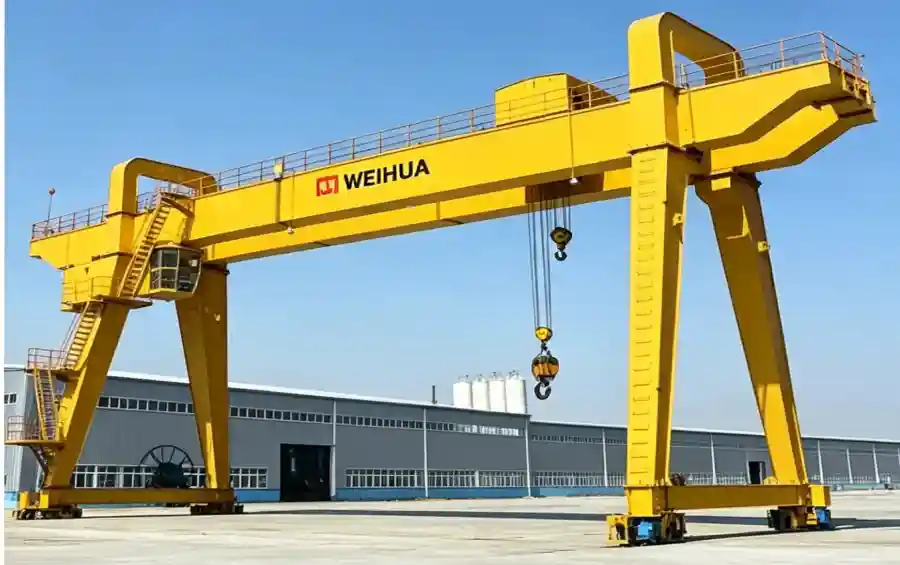
Two hooks, not one: how the main and auxiliary hoists divide the work
Every capacity in this series is configured as a main/auxiliary pair: 32 t with a 5 t auxiliary, 50/10 t, 75/20 t and 100/20 t. The pairing sets the crane's real productivity. On the 50/10 t model the main hoist travels at 5.9 m/min while the auxiliary hook runs at 13.2 m/min; on the 100/20 t model the figures are 3.1 and 7.2 m/min. Full-capacity lifts happen a few times a day; slings and part-loaded loads move far more often, on the fast auxiliary hook. When you estimate daily cycle times, the auxiliary hoist speed usually matters more than the headline capacity.
Long travel speed is quoted the same way on the larger models: the 75/20 t crane travels at 4.1–41 m/min and the 100/20 t at 3.4–34 m/min, a low end for slow positioning on the rail and a high end for covering the yard. Smaller models in the tables quote a single travel figure instead.
A-type or U-type: the leg shape decides what your loads can be
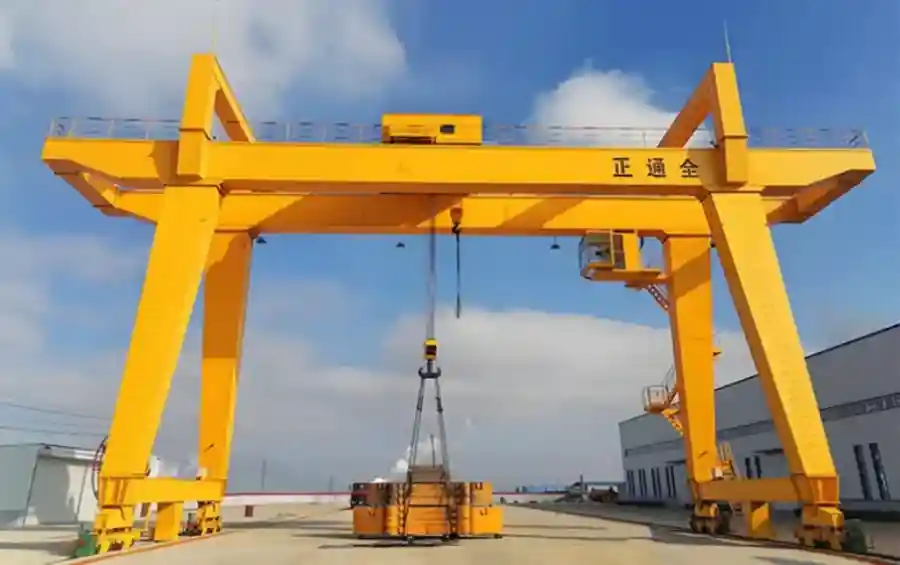
Within the same double girder family, the frame type is a selection decision, not a styling choice. The U-type gantry crane keeps the legs vertical, which leaves more clearance between them — the catalogue's stated reason why U-type models suit bulky loads that must pass between the legs. The U-type also drops the saddle support at the top of the legs, so for a given lifting height the overall crane height is lower; on sites with overhead obstructions or height limits, that difference alone can settle the choice. The U-type tables apply the same outdoor logic to railway-line yards, and its motors are all YZR crane-duty type. The rail class differs too: the 32/5 t U-type runs on QU70 rail, while the equivalent A-type is tabled for 43 kg/m rail or QU80.
Choose A-type when the load path is general yard handling at high tonnage; choose U-type when bulky loads have to travel through the portal or the site height is constrained.
Duty class A5 and what it assumes
The standard tables for the 32/5–50/10 t and 75/20–100/20 t models are rated at duty class A5 under the GB/T 3811 classification, which matches a yard working regular shifts with moderate cycle counts. A yard expecting near-continuous operation should state its actual lifts per hour and working hours per day before ordering, so the hoisting mechanism can be checked against a higher duty class instead of being assumed. Duty class changes motor sizing, braking and gear selection — it is a design input, not an option to add later.
Wind is the risk that warehouse cranes never face
Because this crane stands outdoors, its safety package is built around wind and stability: a wind siren warns of dangerous wind conditions, backed by break-proof shaft and anti-overturning measures. Large-tonnage models use three-in-one gear motors on the long travel and cross travel mechanisms, keeping the drive units compact and easy to replace in the field. The alarm supports the operating procedure but does not replace it: when the siren sounds, the crane must be parked and secured, and high-wind stops belong in your site's crane operation plan.
Construction and project work: the 40–60 t and 80–100 t versions
The same hook-gantry family includes project models rated 40–60 t and 80–100 t for highway, bridge and power station sites. These use a truss frame rather than a box girder, and what matters at the procurement stage is what lands on the ground: lower deadweight and lower wheel loads, which suit a runway built for a temporary project instead of a permanent yard. If your site is a construction job that will be dismantled at the end, say so in the enquiry — that is what separates a project crane from a yard crane with the same hook rating.
Wheel loads decide the foundation — capacity alone does not
The tables make one point buyers routinely miss: maximum wheel load does not rise with rated capacity. Across spans of 18–35 m, the 32/5 t model peaks at 240–295 kN per wheel and the 50/10 t model at 335–395 kN, while the 100/20 t model peaks at only 305–340 kN because its running gear spreads the load over more wheels. The recommended rail is 43 kg/m rail or QU80. The foundation slab and rail must therefore be designed against the wheel-load table of the specific model and span, not against tonnage intuition — assuming a "heavier" crane always needs heavier foundations can waste money in one direction or under-build in the other.
Power supply for export projects
These models are built for a three-phase, 380 V, 50 Hz supply. Yards in regions with 400 V, 415 V or 440 V networks should confirm voltage and frequency at enquiry stage, so motors and control gear are matched to the local supply.
Quotation inputs and what changes the price
Five technical inputs decide both the specification and the price: rated capacity with its auxiliary pairing, span, lifting height, duty class, and frame type — box girder, U-type or truss project. A 35 m span at the same tonnage needs deeper girders and heavier running gear than an 18 m span, and a higher duty class raises motor, brake and gear sizing across three mechanisms.
Two commercial items come up as often as the technical ones. First, rail supply scope: clarify whether your supplier provides the rails, joint bars and clamps or whether you buy them locally, since the crane quotation and the civil package have to meet at the same rail. Second, shipping and erection: ask how the girders and legs will be shipped and assembled on site, and what lifting capacity your site will need for erection, because girder length set against road transport limits shapes the whole delivery plan.
Request the dimension sheet for the model you are quoted, too — it lists the limit dimensions and main dimensions for that span, so your civil contractor can check overall height, clearance and hook reach against your actual layout instead of an assumption.
Send your span, lifting height, capacity pairing, lifts per hour, site conditions and power supply, and you will get the matching specification table and quotation.
Frequently Asked Questions
Why is the main hoist slower than the auxiliary hoist on a heavy duty gantry crane?
The main hoist is geared for torque at full rated load, so it trades speed for force — 5.9 m/min at 50 t, 3.1 m/min at 100 t. The auxiliary hook handles lighter loads many times a day, so it runs nearly twice as fast. Plan your yard's cycle time around the auxiliary hook unless most lifts are at full capacity.
A-type or U-type double girder gantry crane — which one do I need?
Work backwards from the site, not the load chart. If the crane has to fit under an existing height limit, or bulky loads must pass between the legs, price the U-type first — it sits lower for the same lifting height and leaves more room between the legs. Otherwise the A-type covers general yard duty. Whichever you choose, take the rail class from that model's table before you design the runway.
Is duty class A5 enough for a two-shift freight yard?
A5 covers the standard working schedule assumed in these specification tables. Whether it is enough depends on your real lifts per hour and total running hours, so send those figures with your enquiry. If your operation points to a higher duty class, the hoisting mechanism is sized accordingly at design stage — not retrofitted.
Do I have to build a QU80 rail foundation?
The tables recommend 43 kg/m rail or QU80 depending on capacity and span — the U-type 32/5 t is tabled for QU70 — so the answer follows the model, not a general rule. The rail is only part of the cost: the concrete foundation takes the wheel loads, up to 395 kN per wheel on the 50/10 t model, so the slab should be engineered against the wheel-load table of the exact model and span, together with your ground conditions.
