



A warehouse gantry crane is a rail-mounted lifting machine that carries its own girder on two legs and runs on rails fixed to the floor, so none of the load passes into the building's columns or roof trusses.
Where the building steel cannot take a runway beam, or the lifting area sits partly outdoors, the gantry still works. Weihua builds this class as the MH electric hoist gantry crane, used with CD1 or MD1 electric hoists in capacities of 3–16 t and spans of 12–30 m for service between −20 °C and +40 °C, to GB/T 14406-2011 for general purpose gantry cranes. Two structural versions cover most warehouse jobs: a box-girder type and a truss type.
MH electric hoist gantry crane (box type / truss type)
Lifting capacity: 3–16 t
Span: 12–30 m
Lifting height: 6 / 9 m (catalogue)
Hoist: CD1 (single speed) / MD1 (two-speed)
Working duty: A4
Power source: 380 V / 50 Hz / three-phase
Working temperature: −20 °C to +40 °C
Max wheel load: 37–140 kN, by capacity and span
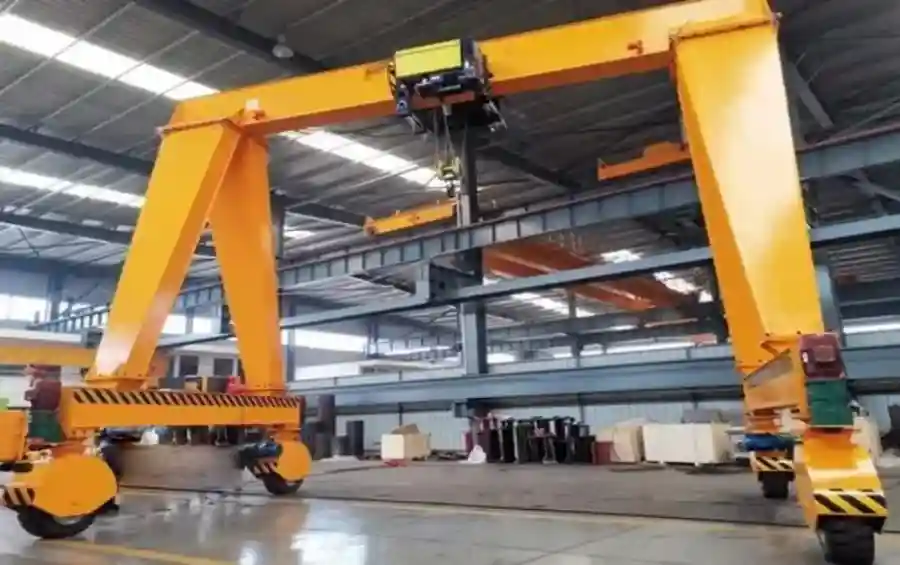
Box girder or truss — and the wheel loads each puts on your floor
Buyers compare tonnage; the floor feels wheel load. The catalogue publishes maximum wheel loads for each span, worth reading before any civil work is priced. The 3 t box-type MH runs from 37–42 kN at a 12 m span to 48–54 kN at 24 m; the 10 t truss-type reaches 93–102 kN at 12 m and 140 kN at 30 m. Those are the point loads at four wheels — what the slab and rail beam must carry, and the number that decides whether an existing floor can take the crane.
The box type is the indoor warehouse machine: a closed, rigid girder with the hoist travelling on the lower flange. The truss type is the outdoor version — lighter, open to the wind, and the right call in semi-open storage yards. Both are catalogued at working duty A4 and take the same CD1 or MD1 hoists; the choice is mostly about environment, not capability.
The rails and the foundation are the project
A warehouse gantry crane is only as good as what it rolls on. The catalogue pairs each capacity with a recommended rail section — P38 and P43 for the 10 t truss type — and the first quotation question is who supplies the track. If you buy it locally, we specify the section; if we supply it, the scope covers the rail, the fishplates and the rail clamps. The standard foundation drawing is conventional civil work: a compacted lime-soil base, a reinforced concrete layer above it, and cast-in anchor bolts on roughly 600 mm centres along the track, extended into a T-shape at both ends. Cheaper to design in than to repair after the first wheel passes.
Power, control and the hoist decision
Power to the long travel normally comes from a cable reel and cable rather than an overhead conductor bar, keeping the feed at grade; confirm your local supply early, since the catalogue standard is 380 V / 50 Hz / three-phase. Ground control is pendant or radio, and a cabin is available on both versions. The hoist choice separates CD1 from MD1: CD1 is single speed and the default for routine storage and truck loading, while MD1 is two-speed and earns its cost wherever loads are set down or aligned precisely — installing machine parts, mating components, positioning stock. Where the hook must reach past the legs, a cantilever on one or both girder ends extends the working area, with the practical limit at one third of the span.
One cost-saving substitution: for capacities around 5 t and below — in practice 2 t and under — some buyers fit a travelling electric chain hoist to the MH single girder instead of a wire-rope hoist. It works at the light end, provided the hoist and girder are matched as one system.
What to send for a quotation?
Power voltage; capacity, span, lifting height and working duty; cantilever length if any; control method; and who supplies the rail. If you want them stated on the quote, also name the hoist lifting and travel motor brands, the limit switch brand, and the main electrical components. With those details, the model selection and the rail recommendation come back together.
To have the wheel loads checked against your floor before you commit to a civil budget, send the site drawing and your load list.
Frequently Asked Questions
Q: Can a warehouse gantry crane be installed without modifying the building?
A: Yes. The legs carry every load down to the floor rails, so nothing bears on the roof or columns. What you must verify is the slab: the crane's maximum wheel load — 37–54 kN for the 3 t box type, up to 140 kN for the 10 t truss type — has to be within what the floor and its rail beam were built to take.
Q: Which hoist should I choose, CD1 or MD1?
A: CD1, single speed, for routine storage moves and truck loading. MD1, two-speed, when loads are placed or aligned precisely, such as machine installation or on-site component mating.
Q: Can a warehouse gantry crane work outdoors?
A: Yes. The truss type is rated for −20 °C to +40 °C, and its open structure is why it, not the box girder, serves open and semi-open yards.
