



Efficient container handling requires equipment that can combine lifting capacity, mobility and reliable operation. A Rubber Tyred Container Gantry Crane, commonly known as an RTG crane, is designed to move, stack and transfer containers in ports, logistics terminals, railway yards and container storage areas.
Unlike rail-mounted gantry cranes, an RTG travels on rubber tyres and does not require fixed rails. This gives the crane greater flexibility when moving between container rows or operating areas, making it particularly suitable for terminals where yard layouts or handling requirements may change.
WEIHUA provides rubber tyred container gantry crane solutions that can be configured according to container dimensions, lifting requirements and operating conditions.
What Is a Rubber Tyred Container Gantry Crane?
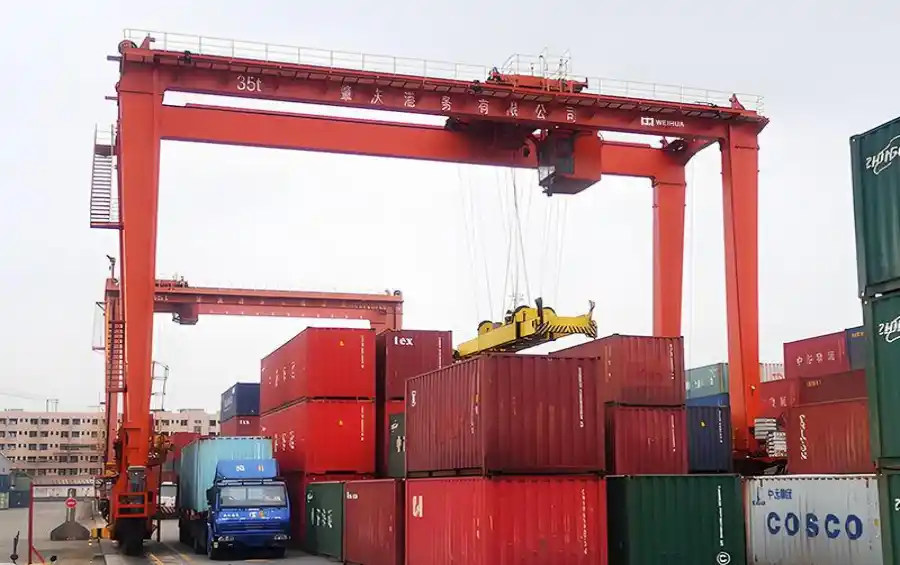
A rubber tyred container gantry crane is a mobile gantry crane equipped with rubber tyres and a container spreader. It travels across the container yard while the trolley and lifting mechanism position containers between stacks and transport vehicles.
Typical RTG cranes are used for handling standard 20 ft, 40 ft and 45 ft containers. Depending on the selected configuration, the crane can serve different stacking heights, spans and container rows.
Its main operating movements normally include:
-crane travelling along the container yard;
-trolley travelling across the gantry;
-container lifting and lowering;
-container positioning and stacking;
-steering or directional movement for yard transfer.
Because the machine moves on tyres rather than rails, the operating area can be adjusted more easily without building a complete rail foundation.
Why Are RTG Cranes Widely Used in Container Yards?
One of the biggest advantages of an RTG crane is the balance between container stacking density and yard mobility.
In a busy container terminal, operators need to store as many containers as possible while keeping truck lanes and transfer routes accessible. The gantry structure allows containers to be stacked beneath the crane, while the rubber tyre travelling system enables the equipment to move within the yard.
This makes RTGs suitable for:
Container terminals and ports. RTGs can handle container transfer between yard stacks and terminal tractors or trucks.
Inland logistics centers. They can be used where containers arrive by road or rail and need temporary storage or redistribution.
Railway freight yards. The crane can assist with transferring containers between storage areas and transport vehicles.
Industrial container yards. Manufacturers and large logistics operators can use an RTG where flexible container movement is required.
Weihua's available RTG configurations include dedicated container spreaders and tyre steering arrangements intended to improve manoeuvrability within the yard.
Main Advantages of a Rubber Tyred Container Gantry Crane
Flexible Yard Movement
The rubber tyre travelling system eliminates the restriction of fixed crane rails. The machine can therefore serve different operating areas and adapt more easily to changes in yard organization.
Certain RTG configurations allow tyre steering and directional movement to assist with repositioning the crane between working lanes.
Efficient Container Stacking
An RTG can span several container rows together with a truck lane, allowing containers to be stacked vertically while maintaining vehicle access.
For terminals where land utilization is important, this provides a practical way to improve storage capacity without relying entirely on large horizontal storage areas.
Container-Specific Spreader
Instead of using a conventional crane hook for routine container handling, the crane can be equipped with a dedicated container spreader designed for standard ISO containers.
This improves positioning efficiency during repetitive loading, unloading and stacking operations.
Stable Handling and Control
Modern RTG cranes can integrate variable-speed drives, monitoring systems, safety devices and centralized control functions.
Depending on project requirements, operating parameters can be configured around lifting speed, trolley travelling speed, crane travelling speed and the required duty level.
Monitoring and management functions can also be incorporated for equipment status monitoring, data collection and fault diagnosis.
Customized for Different Terminal Conditions
Container yards vary considerably in layout and workload, so an RTG should normally be selected according to the actual project rather than treated as a completely standardized machine.
Important parameters include:
Rated lifting capacity — determined according to the maximum loaded container and spreader arrangement.
Span — selected according to the number of container rows and vehicle lanes covered by the crane.
Lifting height — determined by the required stacking level.
Container size — typically 20 ft, 40 ft or 45 ft.
Working duty — selected according to daily handling cycles and operating intensity.
Power supply — selected according to terminal infrastructure and operating requirements.
Environmental conditions — including ambient temperature, humidity, wind conditions and yard surface conditions.
For this reason, providing the actual container yard layout before quotation makes it much easier for the crane manufacturer to determine an appropriate configuration.
RTG Crane vs. Rail Mounted Gantry Crane
The main difference between an RTG crane and an RMG crane is the travelling system.
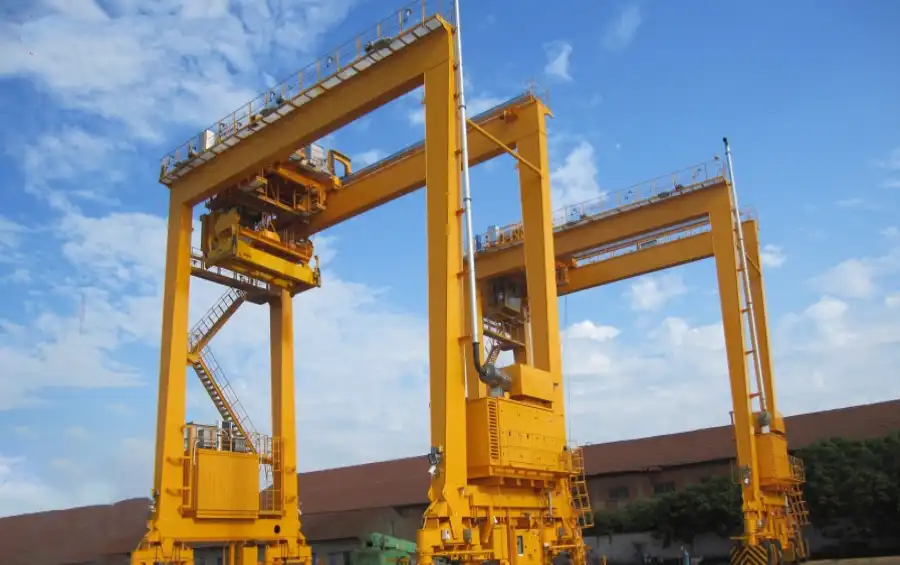
An RTG moves on rubber tyres and offers better mobility around a container terminal. An RMG travels along fixed rails and is generally more suitable for highly standardized operating areas where the crane remains within a defined track.
If a terminal requires the crane to change operating lanes or move between different yard sections, an RTG can provide greater flexibility.
If the operating route is fixed and the container yard is designed around permanent rails, an RMG may be another suitable option.
The final choice should therefore depend on yard layout, container throughput, stacking requirements, infrastructure and operating strategy rather than lifting capacity alone.
What Information Is Needed Before Ordering an RTG Crane?
For a more accurate technical proposal, customers should normally provide the following information:
-Required lifting capacity under the spreader
-Container sizes to be handled
-Number of container rows to be covered
-Required stacking height
-Required truck or trailer lane arrangement
-Daily or annual container handling volume
-Yard dimensions and travelling distance
-Available power supply
-Local ambient temperature and wind conditions
-Any special automation or control requirements
With these parameters, the crane structure, spreader, mechanisms, electrical system and travelling configuration can be designed around the actual terminal.
Frequently Asked Questions
1.What does RTG mean in container handling?
RTG stands for Rubber Tyred Gantry Crane. In container terminals, it normally refers to a rubber-tyred gantry crane equipped with a container spreader for stacking and transferring shipping containers.
2.What container sizes can an RTG crane handle?
Depending on the spreader configuration, an RTG can be designed to handle common 20 ft, 40 ft and 45 ft containers.
3.Does an RTG crane require rails?
No. The crane travels on rubber tyres, which is one of the main differences between an RTG and a rail-mounted container gantry crane.
4.Can the lifting capacity and span be customized?
Yes. RTG cranes are normally engineered according to the required container weight, yard span, stacking height and duty cycle. Final parameters should be confirmed after reviewing the customer's container yard layout.
5.Where are rubber tyred container gantry cranes commonly used?
They are commonly used in ports, container terminals, railway freight yards, inland logistics centers and industrial container storage areas.
6.How do I choose the right RTG crane?
Start with the container size, maximum container weight, required stacking height and number of rows to be covered. The yard layout, operating frequency, power supply and local environmental conditions should then be considered before finalizing the crane configuration.
A Flexible Solution for Container Yard Operations
For terminals that require both high-density container stacking and flexible yard movement, a Rubber Tyred Container Gantry Crane provides a practical container handling solution.
The most suitable RTG is not simply the crane with the largest capacity. A properly designed system should match the yard layout, container throughput, stacking arrangement and operating environment.
By providing the basic container dimensions, required lifting capacity, stacking height and yard layout, buyers can obtain a more accurate RTG configuration and technical proposal for their project.
