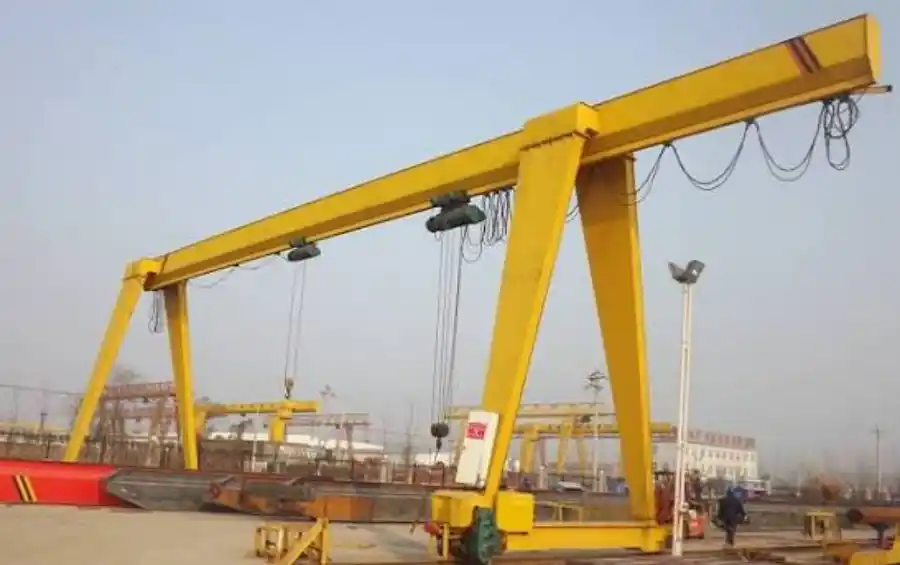
What is a single beam gantry crane?
A single beam gantry crane, also referred to as a single girder gantry crane, is a type of gantry crane that uses a single main girder to support the lifting mechanism. It is typically equipped with a CD1 or MD1 electric wire rope hoist that travels along the underside of the main girder. Compared to a double girder gantry crane, the single beam gantry crane has a lighter structure, lower cost, and simpler installation. It is classified under the ISO 4301 standard and is widely adopted in workshops, warehouses, freight yards, and outdoor material handling sites. When your lifting requirements are moderate and your budget is constrained, the single beam gantry crane is often the most cost-effective solution.
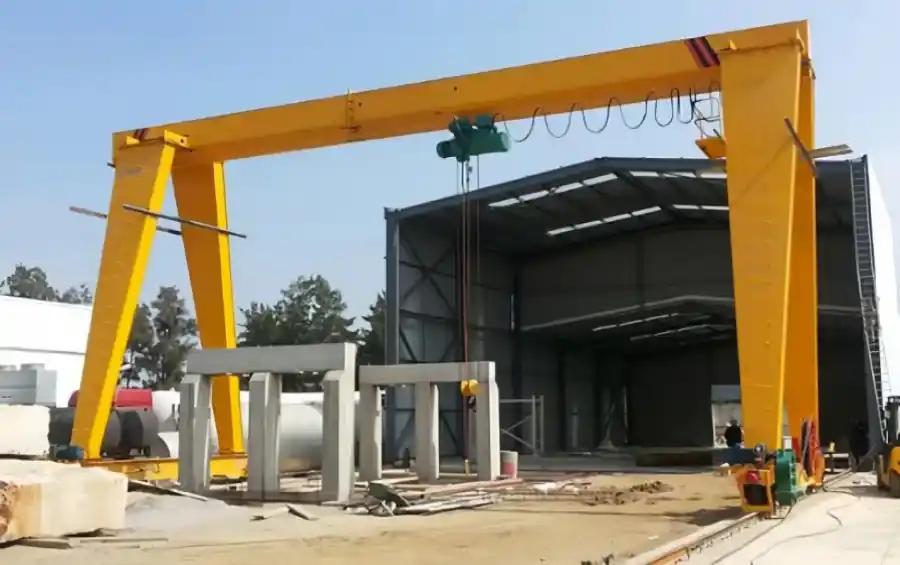
Single Beam Gantry Crane vs Double Girder Gantry Crane: Which One Fits Your Site?
Single beam gantry crane: the single main girder structure means lower self-weight and less impact on the foundation. It is typically used for lifting capacities under 20 tons. The CD/MD hoist runs on the lower flange of the girder, which means the hook height is limited by the girder position. If your daily lifting tasks do not exceed 20 tons and you want to keep your civil works and equipment costs down, the single beam gantry crane is the right choice.
Double girder gantry crane: with two main girders, the trolley runs on top of the girders rather than underneath. This provides a higher hook height and supports heavier loads (typically 16 tons and above, up to 300 tons or more). If your site requires heavy-duty lifting, higher duty class (A6-A8), or a grab bucket, magnet, or other specialized lifting attachments, you should consider the double girder gantry crane instead.
So, the key decision factors are: lifting capacity, hook height requirement, duty class, and budget. If your lifting capacity is under 20 tons and you do not need a trolley running on top of the girders, the single beam gantry crane will save you money without sacrificing performance.
Types of Single Beam Gantry Crane: Truss Type vs Box Type vs European Type
There are three common types of single beam gantry crane available on the market. You should select the right type based on your site environment, wind conditions, and budget:
Truss type single beam gantry crane (MH): the main girder is built with welded steel trusses, which makes it lighter and more wind-resistant. Wind can pass through the truss structure, reducing wind load on the crane. This type is ideal for outdoor sites with moderate wind conditions and lifting capacities under 16 tons.
Box type single beam gantry crane (MH-box): the main girder is a welded box structure, which is stronger and more rigid than the truss type. It is suitable for heavier loads and more demanding working conditions. The box structure also provides better protection for the internal components.
European type single beam gantry crane (BMH): designed according to FEM/DIN standards, with a compact structure and low headroom design. The European-style hoist runs on the lower flange of the girder, providing a higher hook height and smoother operation. It is more expensive than the standard MH type but offers better performance and a longer service life.
How to Select the Right Single Beam Gantry Crane?
Choosing the right single beam gantry crane requires you to evaluate several factors before placing an order. Here is a practical checklist to guide you through the decision-making process:
1. Confirm your maximum lifting weight: know the heaviest single item you will lift. Add a 15-20% safety margin to ensure the crane can handle occasional overload situations.
2. Measure your site dimensions: measure the wall-to-wall clear width, the clear height from the rail surface to the ceiling or any obstacle above, and the available length of the runway. These dimensions determine the span and lifting height you can accommodate.
3. Determine the duty class: if you use the crane occasionally (2-3 times per day), A3 is sufficient. For moderate usage (several hours per day), choose A4. For frequent and continuous lifting, A5 is recommended. Selecting the wrong duty class can lead to premature component failure and safety risks.
4. Consider the outdoor environment: if the crane will be installed outdoors, you need to consider wind conditions. The truss type is more wind-resistant due to its open structure. Wind locks and rail clamps should be installed if your site is in a typhoon-prone area. Also, you may need a rain cover for the electric hoist and other components.
5. Verify the supplier certifications: check whether the supplier has ISO 4301, CE, or other relevant certificates. This is not only about quality assurance but also a requirement for importing cranes into many countries.
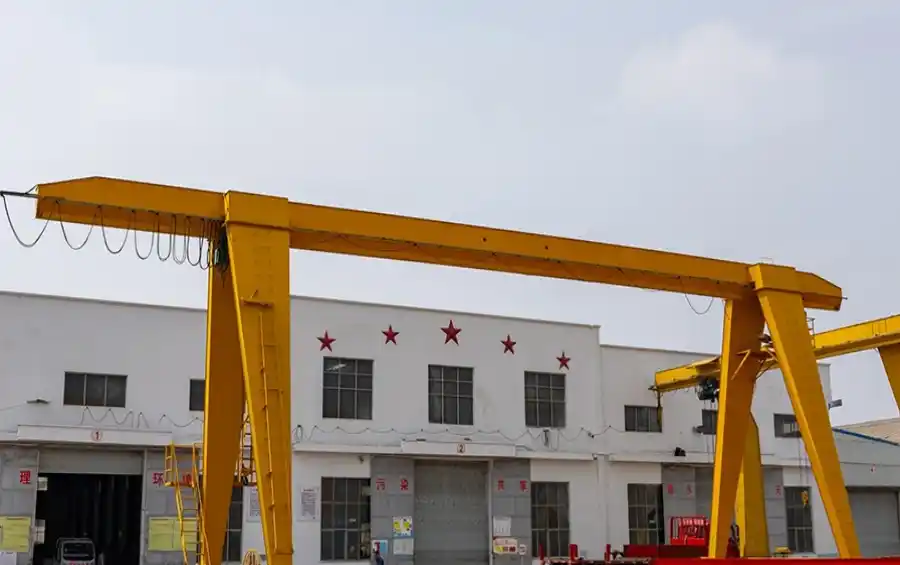
Application Scenarios
The single beam gantry crane is versatile and can be found in a wide range of industries and working environments. Common application scenarios include: outdoor material yards, warehouses and storage facilities, steel fabrication workshops, concrete precast plants, ports and harbor auxiliary operations, railway freight stations, and construction material handling sites.
We had a customer from Indonesia who purchased a 10-ton MH type single beam gantry crane with an 18-meter span for their outdoor steel pipe yard. They were initially considering a double girder gantry crane, but after reviewing their actual lifting requirements, we recommended the single beam type to save on equipment cost and foundation work. The crane has been running for over 2 years without any major issues, and the customer is satisfied with both the performance and the cost savings.
Cost Considerations: Why TCO Matters More Than Price
Most buyers focus on the purchase price, but the Total Cost of Ownership (TCO) is what you should really care about. A cheaper crane with substandard components may cost you more in the long run through frequent breakdowns, higher maintenance costs, and production downtime. Here is what you should factor into your TCO calculation:
Equipment purchase price
Civil works (rail foundation, ground leveling, electrical supply)
Installation and commissioning costs
Annual maintenance and spare parts
Downtime cost (lost production during crane failure)
When you choose a Weihua single beam gantry crane, you are investing in a product that is manufactured with high-quality steel, core components from reputable brands, and a proven track record of reliability. The slightly higher upfront cost pays off through lower maintenance and fewer breakdowns over the crane 15-20 year service life.
Why Choose Weihua Crane for Your Single Beam Gantry Crane?
Weihua Crane is one of the leading crane manufacturers in China, with over 30 years of experience in the lifting equipment industry. We have delivered crane products to customers in over 130 countries. Here is why buyers choose Weihua:
Manufacturing capability: our production facilities cover a large manufacturing base with in-house fabrication, welding, machining, and testing capabilities. Every single beam gantry crane is manufactured according to ISO 9001 quality management standards.
Certifications: our cranes are certified with ISO 4301, CE, SGS, and BV certificates, ensuring compliance with international standards.
Customization: we can customize the span, lifting height, lifting speed, control method, and voltage to match your specific site requirements. You can also choose between CD1 (single speed) and MD1 (double speed) hoists, and between pendant, remote, or cabin control.
After-sales support: we provide a 2-year spare parts kit with every crane, including brake pads, limit switches, contactors, and wire ropes. For most faults, your maintenance team can replace the parts before our engineer arrives. We also offer remote support with a 24-hour response time.
Frequently Asked Questions
What is the maximum lifting capacity of a single beam gantry crane?
The standard MH type single beam gantry crane is designed for lifting capacities from 1 ton to 20 tons. For capacities above 20 tons, a customized single beam gantry crane can be manufactured up to 32 tons, but we generally recommend switching to a double girder gantry crane for loads above 20 tons to ensure better stability and safety.
Can a single beam gantry crane be used outdoors?
Yes. The single beam gantry crane is commonly used in outdoor material yards, freight stations, and construction sites. For outdoor installations, we recommend the truss type (MH) for better wind resistance, and you should install wind locks and rail clamps if the site is in a typhoon-prone or high-wind area. A rain cover for the electric hoist and electrical components is also available as an option.
How long does it take to manufacture and deliver a single beam gantry crane?
The standard production lead time is 20-30 working days after the deposit is received and the technical drawings are confirmed. For customized models with special span, height, or control requirements, the lead time may extend to 35-45 working days. Shipping time depends on your destination port. We will provide you with an estimated delivery schedule in the quotation.