


 English
 Español
 Русский
 العربية
 Français
 Deutsch
 Português
 Tiếng Việt
 Thai
Thai
 Bahasa Indonesia
 Türkçe
 Italiano

A clamps overhead crane lifts by gripping, not by hooking. The hoist block carries a clamping attachment — motorized coil tongs, a C-hook, or plate lifters — and the jaws close around the material and squeeze. Because no sling, chain, or lifting eye is involved, the crane moves bare steel that offers nothing to attach to, which is why it is the standard choice in steel service centers, coil warehouses, and plate and aluminum processing lines. Weihua engineers these machines as one system, matching the crane, trolley, and clamp to the same capacity, duty, and load geometry before anything is built.
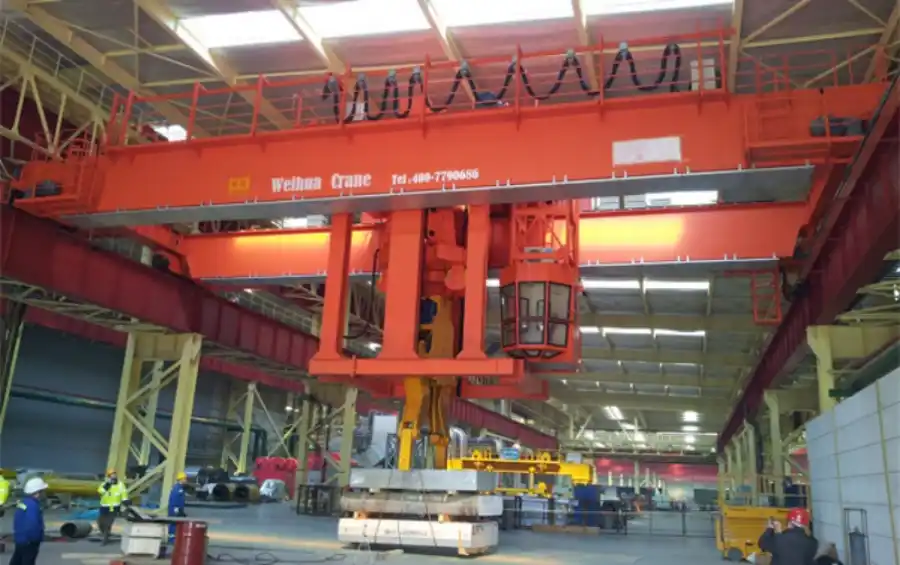
How a Clamp Holds the Load?
The clamp is the load-bearing part; the crane only positions it. Three mechanisms are common, and they fail differently:
-Self-locking wedge. The load's own weight drives the jaws tighter. If power is lost, the load stays put — the safest option, and the one to ask for first.
-Motor-driven tongs. A motor opens and closes the jaws, giving precise travel across a wide coil ID range. Tongs that turn a coil from eye-to-sky to eye-to-horizontal add a second motorized axis.
-Hydraulic clamping. Cylinders produce high, adjustable grip force for heavy or thick-wall coils. The power unit rides on the trolley and needs its own pressure monitoring.
Whatever the mechanism, the clamp must also control its grip force. Squeeze too hard and a thin-wall coil deforms; squeeze too little and it slips. Motor-driven and hydraulic tongs set this force to the coil weight, which is why the load's weight still matters even when the crane is oversized.
Match the Clamp to the Load, Not Just the Tonnage
Jaw travel, not rated capacity, is what usually decides whether a clamp crane works. A 10-ton hoist cannot pick up a coil whose bore falls outside the tongs' gripping range.
-Coils. Give the supplier ID, OD, and width. Tongs grip the outer diameter and turn a coil from eye-to-sky to eye-to-horizontal, so coils stack flat in storage and arrive at the uncoiler in the right orientation. C-hooks slip through the bore and cover only one ID range. Thin-wall coils need a clamp that grips without crushing the bore.
-Plates. Give thickness and length. Vertical edge clamps feed shears and presses; horizontal lifters move stacks. The jaw opening must cover the thickest plate, not the average one.
-Billets and slabs. Forge tongs grip hot stock where no hook can engage.
Surface Contact and Temperature
A hook never touches the product; a clamp does. The jaw pads are the interface, and they decide whether the material arrives unmarked.
-Polished, coated, or galvanized coil and plate — and any stainless or aluminum stock — need non-marking rubber or polyurethane pads. Pads are wear parts; order a spare set with the crane.
-Hot-rolled coils and hot billets need heat-rated pads and shielded cylinders. Standard pads glaze and lose grip.
Safety: What Happens When Power Fails
With a hook and sling, gravity holds the load. With a clamp, the machine holds it — so grip retention on power loss is the first question to put to any supplier.
-A self-locking clamp keeps the load if the motor or hydraulics lose power.
-Overload protection belongs on both the hoist and the clamp, and open/closed limit switches must stop the hoist from lifting a half-closed clamp.
-Do not accept a clamp that depends on continuous power to stay shut.
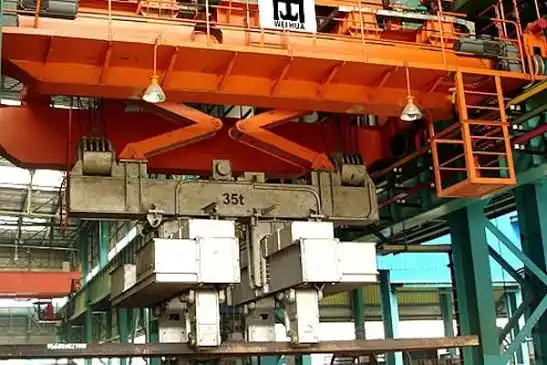
Specifying and Buying
-Size the crane above the clamp. The clamp and its turning mechanism add dead weight below the hook, which cuts net capacity. A crane rated to the coil weight alone may not lift it.
-Confirm the jaw travel covers your full coil or plate range. “Adjustable” does not mean it fits every size.
-Ask about the clamp's own duty. The jaws, screws, and gears inside the clamp wear faster than the crane structure, so a clamp sized to a lighter work group fails before the crane does.
-Request a creep speed. Aligning tongs with a coil bore or a plate edge is fine-positioning work, so a two-speed or variable-frequency hoist beats a single-speed hoist for this job.
-Check headroom. Coil-turning tongs add height below the hook, so verify building clearance before ordering.
If the shop runs mixed products, ask about a quick-change head so one crane can swap between tongs and plate lifters instead of buying a second machine. If a suitable bridge crane is already on the floor, ask whether a clamp can be retrofitted in place of the hook — it usually costs far less than a new crane, but the clamp's added dead weight must be re-rated against the existing capacity before the retrofit is put to work.
Send the manufacturer your coil ID/OD/width and weight, plate thickness and length, material temperature, and daily lift count, and have the crane and clamp quoted together.
Frequently Asked Questions
Q: What is the difference between a clamps overhead crane and a normal overhead crane?
A: A normal overhead crane lifts through a hook, so every load needs a sling, chain, or lifting eye. A clamps overhead crane replaces the hook with tongs, a C-hook, or plate lifters that grip the material directly. The practical difference is that the clamp crane handles bare steel coils and plates with no rigging, but it must be matched to the load's dimensions — bore size, plate thickness — not just its weight.
Q: Can one clamp crane handle both coils and plates?
A: Rarely well. Coil tongs and plate lifters grip different geometries, and a single clamp cannot do both jobs properly. Shops that handle both typically order two clamps with a quick-change connection, or two cranes. Give the manufacturer your full load mix before ordering.
Q: How do I know a clamp crane is safe if power fails?
A: Ask whether the clamp is self-locking. A mechanical wedge or spring-loaded jaw holds the load when the motor or hydraulics lose power. Also check for overload protection on both the hoist and the clamp, and limit switches that stop the hoist from lifting a half-closed clamp.
Q: Can a clamp be fitted to an existing overhead crane?
A: Often, yes. If the existing bridge and hoist have enough capacity and headroom, coil tongs, a C-hook, or plate lifters can be retrofitted in place of the hook. The main constraint is the clamp's own dead weight, which reduces the crane's net capacity, so the crane must be re-rated before the retrofit is used.
