



What Is a Marine Boat Hoist?
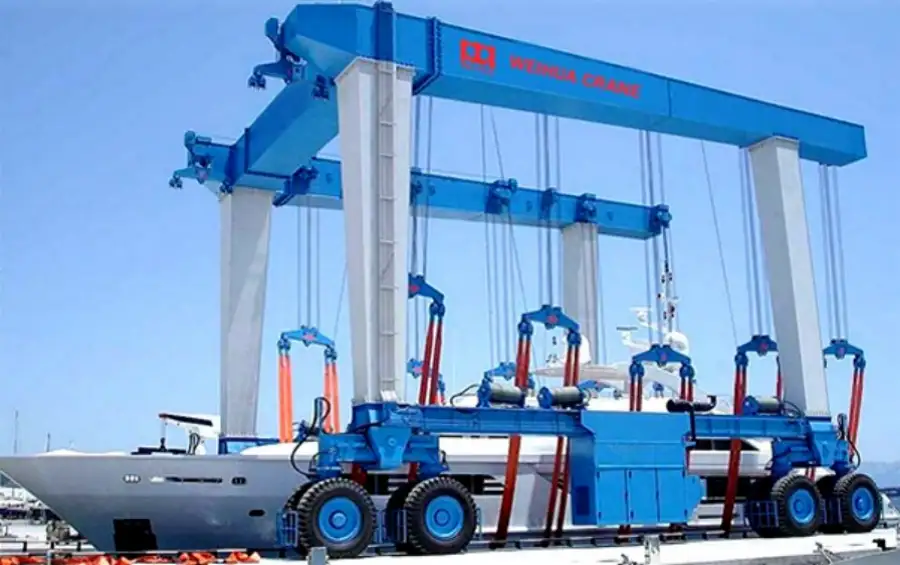
A marine boat hoist is a rubber-tired mobile lifting machine designed to straddle a vessel and lift it with multiple slings.
Unlike a conventional gantry crane that usually travels along fixed rails, a mobile boat hoist can move around the yard after lifting the vessel.
This allows one machine to perform several operations:
-Lift a boat from the water
-Launch a vessel into the water
-Transfer boats around a shipyard
-Move vessels to maintenance areas
-Position boats on support stands
-Arrange boats in dry storage areas
The combination of lifting and mobile transport makes the equipment particularly useful for marinas and shipyards with frequent vessel-handling requirements.
Where Is a Marine Boat Hoist Used?
The most common applications are facilities where boats need to be moved regularly between the water and land.
Marinas and Yacht Clubs
Marinas often need to launch and retrieve vessels for owners, maintenance contractors, and seasonal storage.
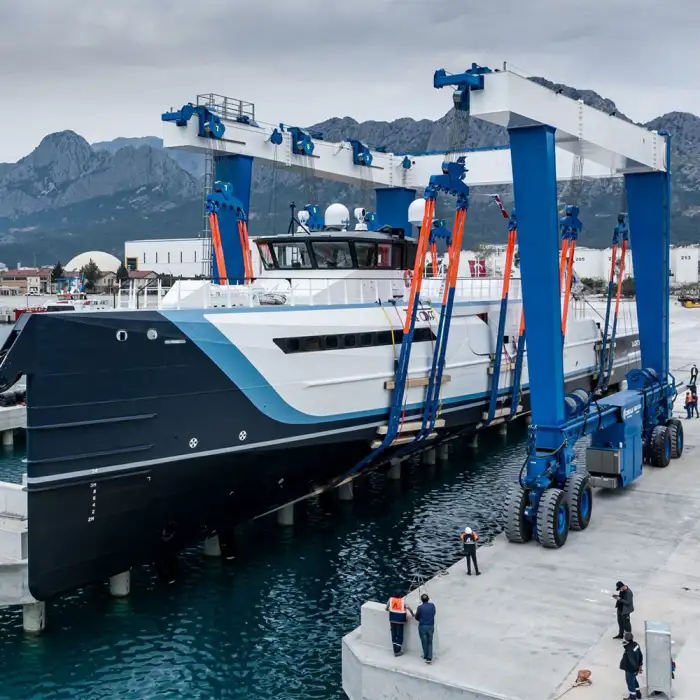
A marine boat hoist allows yachts and leisure boats to be lifted directly from a launching basin and transported to a parking or maintenance location.
Because the machine is mobile, one hoist can serve several areas of the marina.
Shipyards and Boat Repair Facilities
Repair yards use boat hoists to move vessels into workshops or dry maintenance areas.
Typical operations include:
-Hull inspection
-Painting
-Propeller maintenance
-Engine repair
-Electrical maintenance
-Structural repair
The vessel can be lifted from the water and placed directly on a support frame for maintenance.
Boat Manufacturing Facilities
Boat builders can use marine hoists to move newly manufactured vessels from assembly areas to testing, launching, or storage locations.
The ability to handle boats without requiring a fixed lifting track gives manufacturers greater flexibility when planning the production yard.
How Does a Marine Boat Hoist Work?
The basic operating process is straightforward, although each lift must be planned carefully according to the vessel.
First, the boat enters the designated lifting bay.
The marine hoist moves into position so that its main structure straddles the vessel.
Lifting slings are then placed under appropriate areas of the hull.
Once the vessel is properly supported, the lifting system raises the boat slowly and evenly.
After the boat is clear of the water or launching area, the travel lift can move the vessel to a maintenance, storage, or transportation position.
The typical handling sequence includes:
1.Positioning the vessel
2.Positioning the boat hoist
3.Arranging and adjusting the lifting slings
4.Lifting the vessel slowly
5.Checking balance and stability
6.Transporting the vessel
7.Lowering it onto supports or into the water
Correct sling positioning and balanced lifting are especially important because hull structures differ between sailboats, motor yachts, workboats, and other vessels.
Main Components of a Marine Boat Hoist
Although configurations vary according to lifting capacity and application, most marine boat hoists contain several important systems.
Steel Gantry Structure
The main frame provides the structural strength required to lift and transport the vessel.
It normally consists of vertical legs and upper beams arranged to provide sufficient clearance around the boat.
The width and height must be selected according to the types of vessels being handled.
Lifting Winches
Winches provide the lifting force for raising and lowering the boat.
Multiple lifting points help distribute the load more evenly across the hull.
Independent or synchronized control can help operators adjust the vessel position during lifting.
Lifting Slings
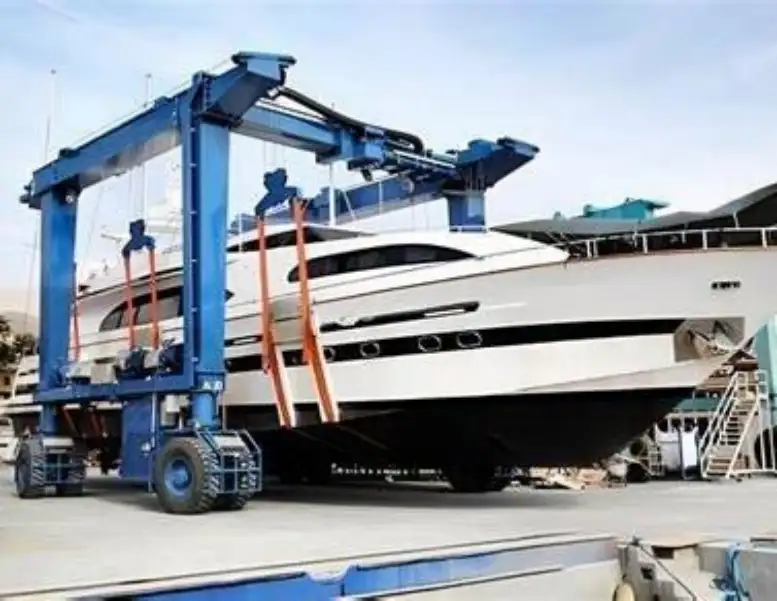
Wide lifting slings support the vessel from underneath.
Compared with rigid lifting attachments, slings can adapt to different hull shapes and help distribute pressure over a larger surface area.
The sling arrangement should always follow the lifting requirements of the vessel.
Rubber Tires
Marine boat hoists generally use multiple rubber tires instead of fixed rail wheels.
This provides mobility across the yard and allows the machine to transport boats between different working areas.
Steering System
Steering capability is one of the most important differences between a mobile boat hoist and a conventional fixed gantry crane.
Depending on the configuration, steering systems can support straight travel, turning, and different steering modes for maneuvering inside limited yard spaces.
Hydraulic and Electrical Systems
Hydraulic systems commonly control lifting, steering, and travel functions.
Electrical control systems coordinate the different mechanisms and provide safety monitoring.
Remote control can also be used to give the operator a better view of the vessel during handling.
Key Factors When Selecting a Marine Boat Hoist
A suitable boat hoist should be selected around the vessels and the shipyard, rather than simply choosing a machine based on rated capacity.
1. Maximum Boat Weight
The first parameter is the maximum vessel weight.
The total lifting load should include the vessel and any equipment or materials remaining onboard during handling.
Adequate safety margin should also be considered according to the applicable design standard.
2. Maximum Boat Width
The inside clear width of the hoist must allow the largest vessel to pass safely between the legs.
Additional clearance should be considered for fenders, rails, stabilizers, and other structures.
3. Boat Height
Vertical clearance is also important, particularly for yachts with cabins, radar equipment, antennas, or superstructures.
4. Hull Type
Different boats require different sling positions.
Important information may include:
-Hull length
-Hull width
-Hull shape
-Keel configuration
-Propeller position
-Shaft arrangement
-Stabilizer location
Providing vessel drawings is helpful when designing the sling layout.
5. Yard Layout
The turning radius and available travel routes affect the steering configuration.
The manufacturer should understand:
-Road width
-Pier dimensions
-Launching basin width
-Storage arrangement
-Turning space
-Ground conditions
6. Ground Bearing Capacity
A loaded boat hoist can impose significant wheel loads on the yard surface.
The pavement or foundation must therefore be suitable for the equipment weight and vessel load.
7. Marine Environment
Saltwater environments can accelerate corrosion.
For this reason, coating systems, electrical protection, hydraulic components, and exposed hardware should be selected with marine conditions in mind.
Marine Boat Hoist FAQ
1.What is the difference between a marine boat hoist and a normal gantry crane?
A conventional gantry crane normally operates on rails or within a fixed travel path.
A marine boat hoist uses rubber tires and is designed specifically to lift and transport vessels around a marina or shipyard.
It also uses multiple wide slings to support the boat hull.
2.Can one boat hoist lift different types of boats?
Yes.
The position of the lifting slings can normally be adjusted for different hull lengths and shapes.
However, every vessel must remain within the rated lifting capacity and dimensional limits of the hoist.
3.Can a marine boat hoist operate near seawater?
Yes.
Marine hoists are designed for marina and shipyard environments, but appropriate corrosion protection and regular maintenance are important for long-term operation.
4.How do I choose the correct lifting capacity?
Start with the maximum fully loaded vessel weight expected at the facility.
The selected capacity should account for the actual operating condition and applicable safety requirements rather than relying only on the empty boat weight.
A Practical Boat Handling Solution for Your Yard
The best marine boat hoist is not necessarily the machine with the highest capacity or the greatest number of functions.
It is the one that matches the boats, launching area, yard dimensions, operating frequency, and future handling requirements of the facility.
For this reason, marine lifting equipment is often engineered around the individual project.
WEIHUA can provide marine boat handling solutions based on vessel dimensions, lifting capacity, site conditions, travel requirements, and operating environment.
If you are planning a marina, shipyard, boat maintenance center, or dry storage facility, send us your maximum boat weight, boat length, boat width, boat height, and yard layout.Our engineering team can recommend a practical marine boat hoist configuration for your project.
