


 English
 Español
 Русский
 العربية
 Français
 Deutsch
 Português
 Tiếng Việt
 Thai
Thai
 Bahasa Indonesia
 Türkçe
 Italiano

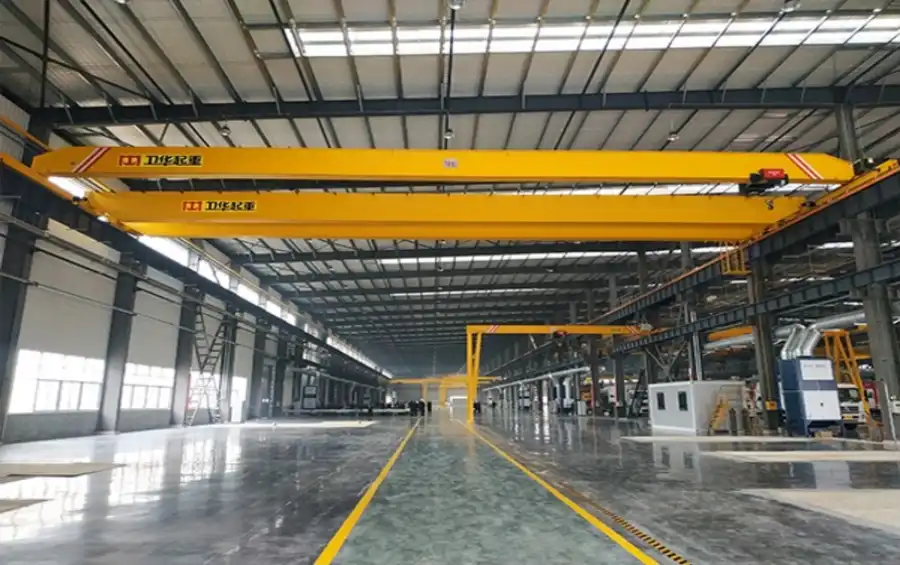
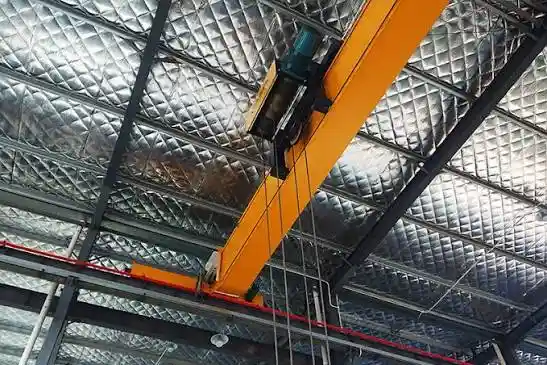
What makes a crane low headroom is not a shorter frame; it is where the hoist lives. On a conventional double-girder overhead crane, the hoist and trolley ride on top of the girders, and that whole stack sits between the runway and the hook, burning clearance that never lifts a load. A low headroom design moves the mechanism: a double-girder machine drops the hoist down between the two girders, while a single-girder machine hangs it beside the beam web. The hook then rises much closer to the girder line, and the crane stops spending the building's height on itself.
Weihua configures these cranes one job at a time from the buyer's building drawings, because a low headroom crane is bought against a constraint, not off a catalogue line. The return shows up in three places: a higher hook position in the same building, a lower and cheaper shed on a greenfield site, or an existing structure that finally fits a crane it was never sized for.
One number decides the outcome
In a low headroom enquiry, a single figure settles whether the machine works: headroom, often labelled the C dimension on the general-arrangement drawing. It is the distance from the top of the girder — or the runway, on an underslung unit — down to the hook at full raise. Two machines can both be sold as low headroom and still differ materially on this number, because "low" is relative to each maker's own standard range. Get it from the drawing, not the brochure.
Where it pays for itself?
Low headroom cranes earn their premium in situations where the ceiling, not the load, is the limit:
-Retrofits into machine shops, fabricating halls and press lines whose roof and columns were never sized for a crane.
-Upper-floor and mezzanine handling, where floor-to-floor height is fixed and small.
-Replacing an older, taller crane on a live runway to gain lifting height without disturbing the roof steel.
-Food, beverage and pharmaceutical lines where overhead services leave little room above the work area.
What these share is a building that cannot move. That is the trigger for a low headroom machine — not a default choice.
Selection runs backwards
Selection here runs in the opposite order from a standard crane. Start from the hook height you must reach, then add the depth of the bottom block, the rope clearances and any spreader beam. What remains is the headroom the crane is allowed to spend. If that exceeds what the building offers, the machine must be low headroom — or the building decision changes. Capacity, span and duty class are then sized normally, but they follow, not lead.
Single girder vs double girder
The two low headroom configurations are mechanically different, so the choice is not only about price.
A side-suspended single-girder hoist is the lighter, cheaper route at lower capacities, but it projects beside the beam and therefore needs horizontal clearance to the nearest column or wall — a penalty an under-running hoist does not carry. A double-girder low headroom crane sits the hoist between the girders, which suits higher capacities and closer hook approaches, at the cost of a heavier bridge. Decide on load, span and side clearance together.
What buyers often miss?
Low headroom quotes mislead when they are read like a standard crane quote. Four points deserve attention:
-The bottom block eats the saving. A deeper hook block, common at higher capacities, consumes headroom directly, so a strong C dimension on paper can shrink on the delivered unit.
-Side clearance, not just headroom. A side-suspended hoist must pass beside columns and walls; check hoist-to-column on the drawing.
-Underslung versus top-running. Hanging the crane beneath the runway beams reclaims more height but changes how the runway is loaded. Settle it with the structural engineer before ordering, not after.
-Compare C dimensions, not labels. Since "low headroom" is not an absolute, the only fair comparison between suppliers is their C dimension at your capacity and span.
The building interface
The building interface decides whether the design advantage survives installation. Rail elevation and tolerance matter more here than on a conventional crane, because there is no spare vertical room to absorb misalignment. On a retrofit, verify the existing runway and columns against the new wheel loads first — reusing old steel is cheaper only if it is strong enough. And inside a compact envelope, plan access to the hoist and gearbox now; a machine that cannot be reached for routine service ages quickly.
Frequently Asked Questions
Q1. What actually makes an overhead crane "low headroom"?
The position of the hoist, not the frame. A double-girder low headroom crane places the hoist between the two girders; a single-girder version side-suspends it beside the beam web. Both cut the vertical stack above the hook so it rises closer to the girder line. The measurable result is the headroom, or C dimension — the distance from girder top (or runway) to the hook at full raise.
Q2. How do I choose between a low headroom single-girder and double-girder crane?
A side-suspended single-girder hoist is lighter and cheaper for lower capacities but needs horizontal clearance past columns and walls. A double-girder low headroom crane keeps the hoist between the girders, fitting higher capacities and closer hook approaches at a higher steel cost. Weigh load, span and side clearance together rather than capacity alone.
Q3. Can a low headroom crane go onto my existing runway?
Often yes — this is a standard retrofit. The existing runway and columns still need checking against the new crane's wheel loads, and the rails must meet the crane's elevation and tolerance, because a low headroom machine leaves no spare vertical room for a misaligned rail.
