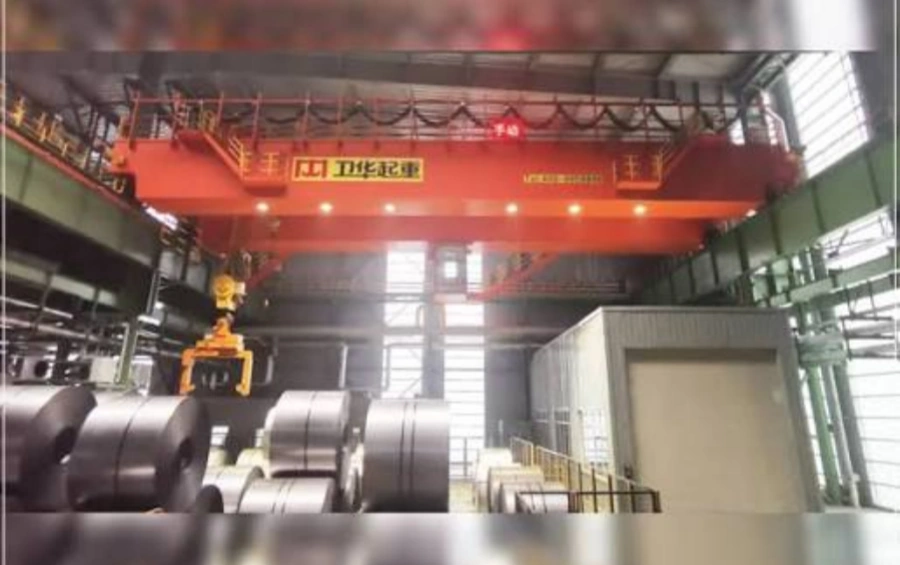
Steel coils are heavy, valuable, and unforgiving when mishandled. A single dropped coil can destroy equipment, halt production for days, and put worker safety at risk. That is why more steel mills, service centers, and port terminals are upgrading from conventional cranes to intelligent steel coil handling cranes — purpose-built lifting systems that combine precision load control, automation, and real-time monitoring.
If you are evaluating an intelligent steel coil handling crane for your facility, this guide walks you through the key features, selection criteria, compliance requirements, and procurement considerations so you can make an informed, risk-aware decision.
Key Selection Factors for Your Intelligent Steel Coil Handling Crane
Choosing the right configuration starts with understanding your coil parameters, required handling attachments, desired automation level, and facility layout. Below are the critical factors to evaluate.
1. Coil Specifications
Match the crane to the heaviest and widest coil you will ever handle:
-Coil weight range: 5 t to 80 t (typical). Specify rated capacity at least 10% above your maximum coil weight.
-Coil width: 600 mm to 2,100 mm. Affects the C-hook or tong arm length.
-Coil inner diameter (ID): 508 mm (20 in) or 610 mm (24 in) are industry standards. The lifting attachment must clear the ID without edge damage.
-Coil outer diameter (OD): Up to 2,000 mm or more. Determines the lifting hook height clearance.
2. Lifting Attachment Type
The attachment defines how the coil is engaged:
-C-hook (coil hook): Most common for eye-vertical coils. Simple, reliable, low maintenance.
-Electromagnetic chuck: For eye-horizontal coils or mixed stock. Requires backup power to prevent coil drop on power failure.
-Mechanical tong / clamp: Grips the OD. Suitable when ID access is limited.
-Vacuum lifter: For thin-gauge or surface-sensitive coils where marks are unacceptable.
For most steel service centers, a C-hook with hydraulic or motorized rotation is the workhorse choice. Port terminals handling mixed cargo often pair the crane with a quick-change system to switch between attachments.
3. Automation Level
-Semi-automatic: Operator initiates moves; crane auto-corrects positioning, sway, and speed. Best for facilities transitioning from manual operations.
-Fully automatic: Crane executes predefined coil-handling sequences (pick, traverse, rotate, place) with minimal human input. Ideal for high-volume, repetitive storage yard operations.
-Remote operation: Operator controls via radio pendant or cabin-based HMI with camera feeds.
4. Structural Configuration
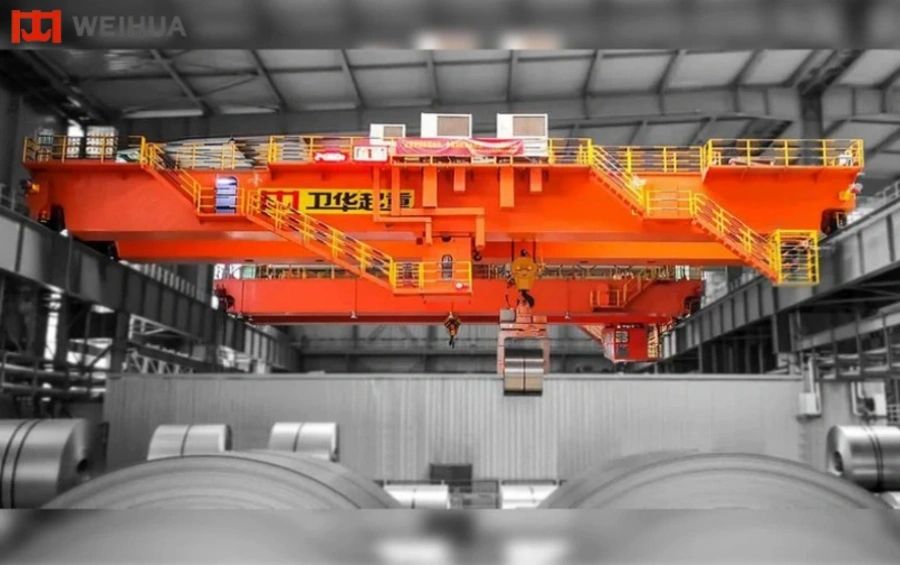
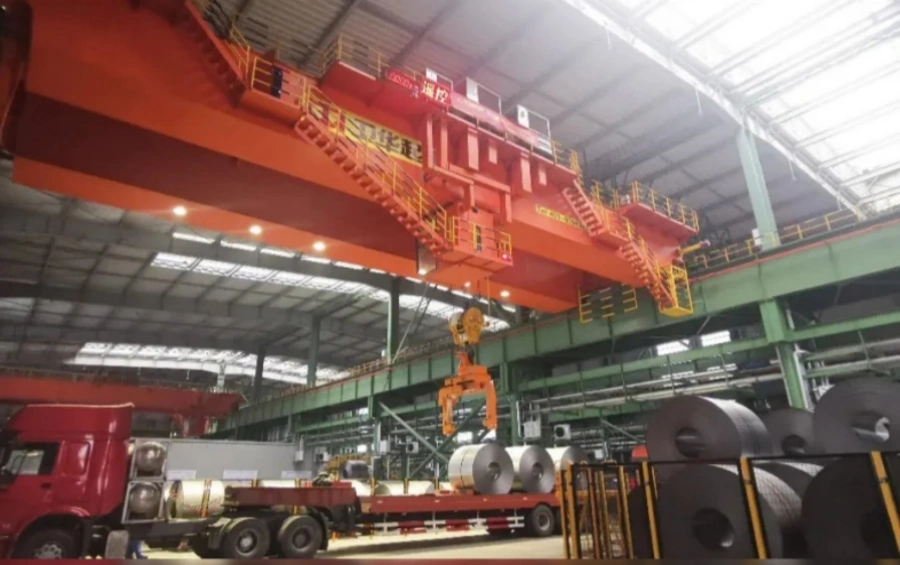
-Double-girder overhead crane: Most common for indoor coil storage bays. High capacity, stable, easy to fit with tongs and rotation devices.
-Gantry crane (rail-mounted): For outdoor coil yards and port terminals. Can span 30 m to 40 m+.
-Semi-gantry or wall-mounted: For facilities with limited runway structure.
Cost Considerations
An intelligent steel coil handling crane is a capital investment. Understand the full cost picture:
1.Equipment cost: Typically ranges from USD 80,000 for a small semi-auto overhead unit to over USD 500,000 for a fully automated rail-mounted gantry with WMS integration.
2.Civil works: Runway beam reinforcement, rail installation, power supply (busbar or festoon), foundation for gantry rail.
3.Commissioning & integration: PLC programming, WMS/MES integration, operator training, on-site acceptance testing.
4.Spare parts & maintenance: Budget 2–3% of equipment cost annually for intelligent systems. Predictive maintenance packages can reduce this.
Total cost of ownership (TCO): A 15- to 25-year service life is typical. Energy-efficient Risk & Compliance: What to Verify Before Signing
International procurement carries regulatory risk. Verify the following standards and risk controls before committing to a supplier.
International Standards to Require
FEM 1.001: European crane design rules (widely adopted globally)
ISO 4301/4306/4309: Classification, dimensions, wire rope inspection
EN 15011 (CE): European crane safety directive — mandatory for EU market
Critical Risk Areas
1.Coil drop risk: Electromagnetic attachments must have a backup power supply (battery or diesel generator) that holds the load for a safe lowering period. Mechanical tongs should have a fail-safe locking mechanism.
2.Overload protection: A verified load cell system must trigger automatic cutoff at 100–110% rated capacity. Do not accept "alarm-only" systems without hard cutoff.
3.Anti-collision: In multi-crane bays, laser or radar anti-collision systems are mandatory, not optional.
4.Seismic & wind loads: For outdoor gantry cranes in seismic zones or high-wind regions, demand site-specific structural calculations stamped by a licensed engineer.
5.Certification & third-party verification: Require mill test certificates for all critical structural steel, wire ropes, and load-bearing components. For EU-bound equipment, insist on a Notified Body CE certificate (Module G or H).
Why Choose Weihua Crane for Your Steel Coil Handling Project
Weihua Crane, a brand of Weihua Group, is one of China's largest and most established crane manufacturers. Founded in 1988 and headquartered in Xinxiang, Henan Province, Weihua has delivered over 10,000 crane units annually to customers in 100+ countries.
Here is why buyers choose Weihua for intelligent steel coil handling cranes:
1.Deep experience in steel industry applications. Weihua has supplied coil handling cranes to major steel mills, service centers, and port terminals worldwide. The product line covers C-hook overhead cranes, electromagnetic coil cranes, tong-grab gantry cranes, and automated storage yard systems.
2.Intelligent crane capabilities. Weihua's intelligent crane systems integrate PLC control, frequency variable speed drives, laser-guided auto-centering, electronic anti-sway, load monitoring with data logging, and WMS/MES connectivity. Remote diagnostics and predictive maintenance are available as standard options.
3.International standards compliance. Weihua cranes are engineered to FEM, ISO, and CMAA standards. CE certification (EN 15011) is available for EU-bound equipment, and ATEX-rated models can be supplied for hazardous-zone facilities.
4.Factory-scale production and quality control. With a production base exceeding 2 million square metres and in-house machining, welding, assembly, and testing facilities, Weihua controls the entire manufacturing chain. Every crane undergoes full-load testing before shipment.
5.Global service network. Weihua maintains overseas service centers and partners across Southeast Asia, the Middle East, Africa, South America, and Europe. Installation supervision, operator training, and spare parts support are available in-region.
6.Custom engineering. Weihua's engineering team provides site-specific structural calculations, seismic and wind load analysis, and tailored attachment design for non-standard coil dimensions or facility layouts.
Frequently Asked Questions
Here are answers to the most common questions buyers ask when evaluating an intelligent steel coil handling crane.
Q1: What capacity range is available for an intelligent steel coil handling crane?
Weihua offers intelligent steel coil handling cranes from 5 t to 80 t rated capacity. For coils exceeding 80 t, custom-engineered twin-girder or tandem crane configurations are available. Always specify your maximum coil weight plus a 10% margin when requesting a quote — under-capacity is the most common cause of premature crane failure.
Q2: Can the crane be retrofitted with intelligent features on an existing runway?
Yes, in many cases. If your existing runway structure has sufficient load-bearing capacity, Weihua can supply a new intelligent crane trolley and lifting attachment that fits the existing girders. A structural assessment of the runway beams is required first. For outdated control systems, a control-panel and drive upgrade can add anti-sway, load monitoring, and remote diagnostics without replacing the entire crane.
Q3: How long does delivery and commissioning typically take?
For a standard intelligent steel coil handling crane, the typical timeline is:
-Design & engineering: 2–4 weeks
-Manufacturing: 8–12 weeks
-Shipping: 2–6 weeks (depending on destination)
-Installation & commissioning: 2–4 weeks on-site
Fully automated systems with WMS integration may add 2–4 weeks for software configuration and site acceptance testing. Weihua provides a detailed project schedule with milestone-based delivery in the contract.