



Core Structural Difference: The Presence or Absence of Ground Legs Is the Fundamental Distinction
The biggest gap lies in load-bearing support structures, which leads to all subsequent differences in application.
1. Overhead Crane
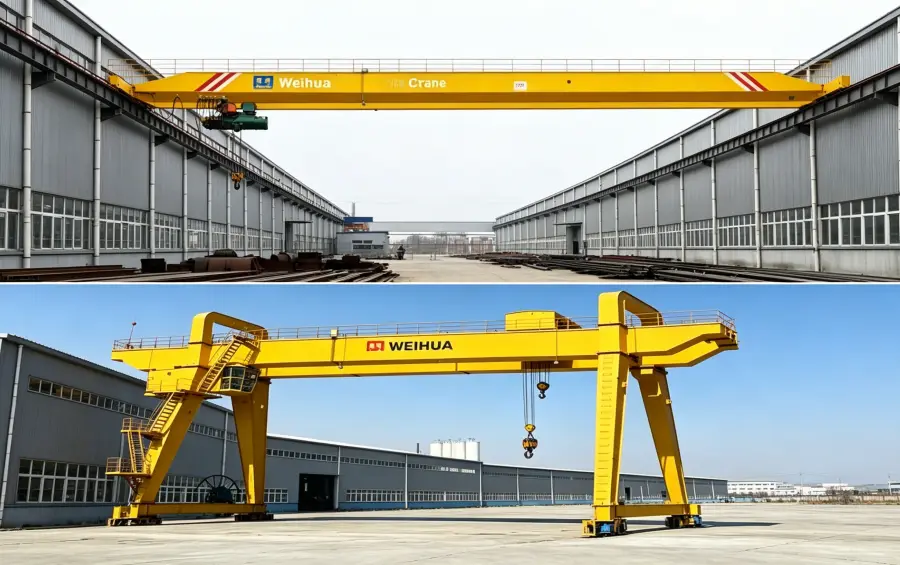
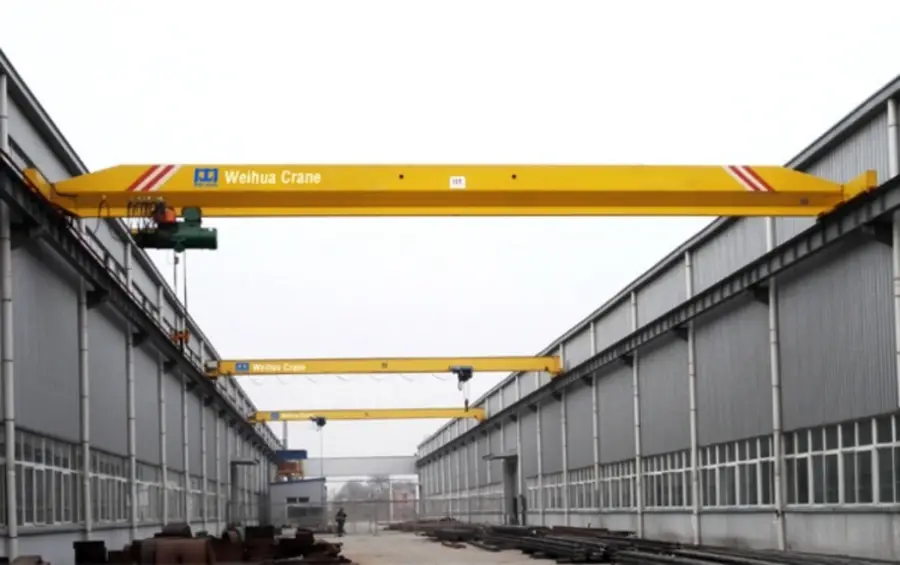
It is a building-dependent lifting device without ground support legs. Its main beam is mounted on load-bearing girders and columns on both sides of the workshop, suspended entirely in the air. All loads are borne by the factory’s steel structure or concrete columns. The crane travels back and forth on elevated indoor rails without occupying any ground space, and is exclusively designed for indoor use.
2. Gantry Crane
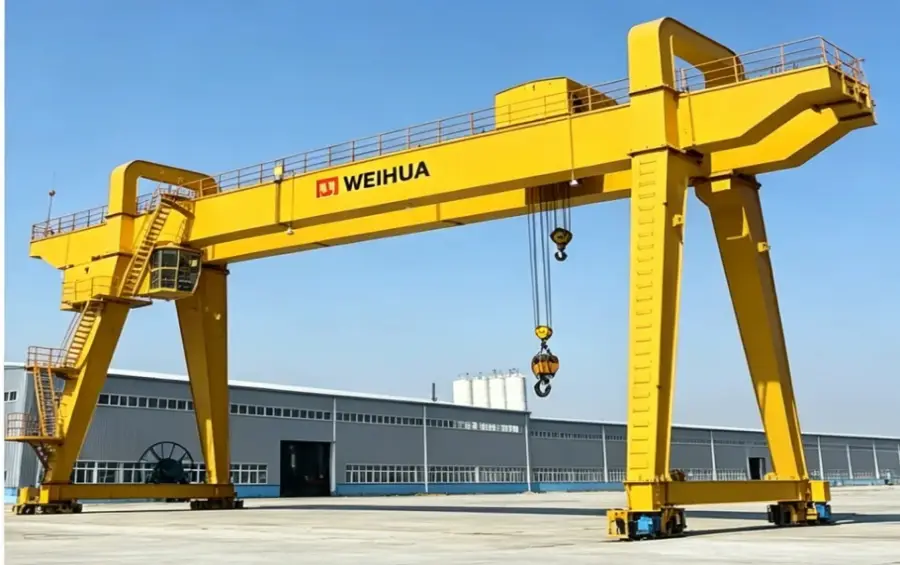
It can be regarded as a derivative of the overhead crane, equipped with vertical steel legs on both sides to form a stable gate-shaped frame. Supported by legs standing on the ground, it runs on rails laid on the ground. It requires no support from factory buildings and can operate independently with excellent site flexibility.
Differences in Applicable Scenarios: Precision Indoor Lifting vs. Wide-Range Heavy-Duty Outdoor Lifting
Structural disparities directly separate their application fields, serving as the core reference for purchasing decisions.
1. Overhead Crane: High-Frequency Precision Indoor Lifting
It fits enclosed workshops, production plants, finished goods warehouses and assembly lines. The suspended layout maximizes vertical space utilization, leaving the ground fully available for machine tools, raw materials and production lines without operation obstructions.
Boating stable operation, high positioning accuracy and low failure rates, it is ideal for long-term, frequent indoor tasks including equipment assembly, mold lifting, workpiece transfer and warehouse stacking. It is widely applied in mechanical processing, metallurgy, hardware manufacturing and other indoor production lines.
2. Gantry Crane: Long-Span Heavy-Duty Outdoor Lifting
Unrestricted by factory buildings, it is mainly deployed at open yards, port terminals, construction sites, shipyards, water conservancy infrastructure and other outdoor locations. It features a larger span and wider coverage, capable of bulk cargo loading/unloading, large steel component hoisting, hull section transfer and heavy construction material lifting.
Semi-gantry models are also available to suit special sites such as workshop gateways and semi-open workshops, delivering broader scene compatibility.
Environmental Adaptability: Mild Indoor Working Conditions vs. All-Weather Outdoor Resilient Equipment
Overseas buyers pay close attention to outdoor weather resistance, and the two cranes show obvious gaps in environmental performance.
1. Overhead Crane
Designed exclusively for stable indoor environments, it does not need to withstand harsh weather including rain, sand, salt mist and strong winds. It only adopts basic dustproof protection. Long-term outdoor exposure will cause rust, motor water intrusion and accelerated component aging, so it is not recommended for outdoor operation.
2. Gantry Crane
It comes standard with full outdoor protection against rain, dust, wind and corrosion. For coastal projects, anti-salt-spray anti-corrosion coatings can be upgraded; wind clamps and wind anchoring devices can be added for windy sites. It can steadily operate under complex outdoor conditions such as rain, sand, extreme temperatures and high humidity, suitable for all kinds of open-air engineering projects worldwide.
Comparison of Procurement and Maintenance Costs
Most buyers only compare equipment prices while ignoring comprehensive expenses including civil engineering, installation and after-sales maintenance, resulting in significant overall cost gaps between the two products.
1. Overhead Crane
It features a lower unit price with a simple structure, standardized spare parts and fast installation. However, the workshop must be pre-built with load-bearing girders and rails, bringing higher upfront civil engineering costs. Its later maintenance is simple with universal spare parts and low failure rates, offering superior long-term cost performance for fixed indoor workshops.
2. Gantry Crane
It has an integrated supporting frame with more steel consumption, leading to a higher unit price. Nevertheless, it needs no factory building support, eliminating costs for factory reconstruction and load-bearing beam construction. The crane can be disassembled, relocated and reused for great site flexibility. Regular anti-corrosion and wind-resistant component inspections are required for outdoor operation, so its maintenance frequency is higher than that of indoor overhead cranes.
Quick Selection Guidelines
Based on years of export experience in lifting equipment, we have sorted out simple selection rules applicable to most industrial projects at home and abroad.
1. Choose an Overhead Crane if you meet any of the following requirements:
- You have a standard enclosed workshop and all operations are carried out on indoor production lines
- You demand high positioning accuracy and smooth running performance during lifting
- Your working site is permanent, and you prioritize low long-term maintenance costs
2. Choose a Gantry Crane if you meet any of the following requirements:
- No supporting factory building, and your working site is an open yard, port or construction site
- You need long-span, wide-area heavy material lifting
- The working site needs flexible adjustments and the crane requires relocation and reuse
- Operations take place outdoors with harsh conditions such as rain, salt mist and strong winds
Conclusion
Overhead cranes are the top choice for precision indoor lifting, while gantry cranes are essential equipment for heavy-duty outdoor engineering. Neither is absolutely superior to the other; suitability depends entirely on your project conditions.
If you cannot confirm which model matches your site and working conditions, feel free to contact us. We boast years of practical experience in customized crane exports. We will provide one-on-one exclusive lifting solutions free of charge according to your lifting capacity, span, site environment and service frequency, avoiding improper selection waste and ensuring stable, efficient long-term operation of your equipment.
