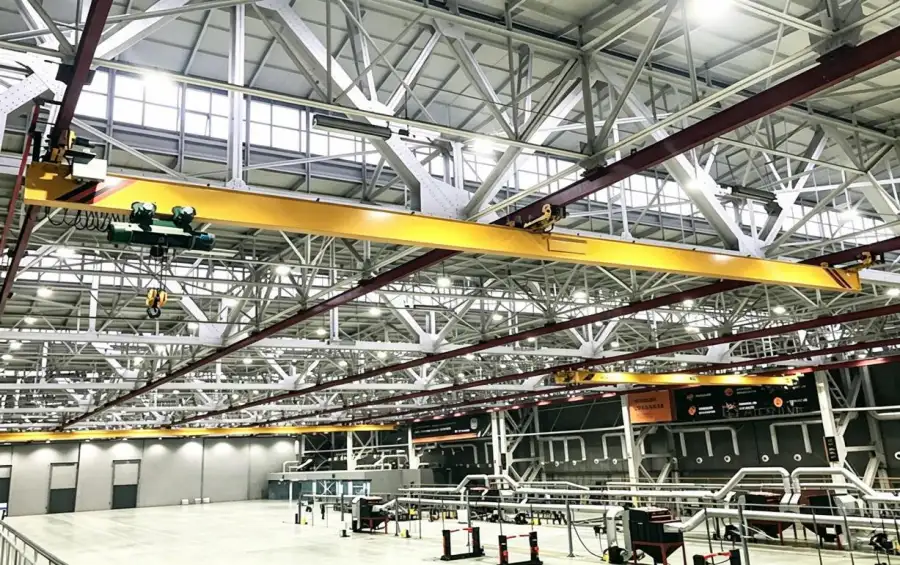
In many workshops, production areas, warehouses, and assembly facilities, installing a conventional top-running overhead crane is not always practical. Limited building height, restricted floor space, or an existing roof structure may make a standard crane runway difficult to install.
A suspension overhead crane, also known as an underhung overhead crane, offers a compact alternative. Instead of traveling on rails installed on top of runway beams, the crane is suspended from the building structure and travels along tracks mounted underneath the supporting beams.
This design can make better use of available workshop space and is especially suitable for light- and medium-duty material handling applications.
What Is a Suspension Overhead Crane?
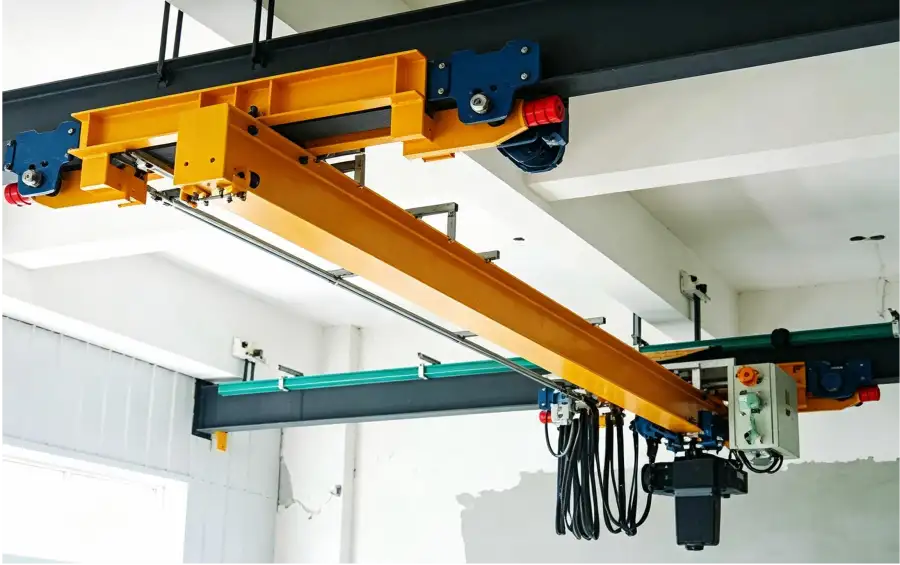
A suspension overhead crane is an overhead lifting system in which the bridge runs underneath the crane runway.
The runway is usually fixed to the roof structure, ceiling beams, or specially designed steel support system. The crane bridge travels below these tracks, while the hoist moves along the bridge girder to lift and position materials.
A typical suspension overhead crane includes:
-suspension runway;
-bridge girder;
-end trucks;
-electric hoist;
-traveling mechanism;
-electrical control system.
Because the crane is supported from above, it normally does not require floor-mounted columns along the working area.
This makes it suitable for workshops where keeping the floor clear is important for machinery, production lines, forklifts, and operators.
How Does a Suspension Overhead Crane Work?
The operating principle is similar to other overhead crane systems.
The bridge travels along the suspended runway, the hoist moves horizontally across the bridge, and the lifting mechanism raises or lowers the load.
These three motions allow the crane to cover a defined rectangular working area.
The basic movements include:
1.Crane traveling – movement along the workshop length.
2.Hoist traveling – movement across the bridge.
3.Vertical lifting – raising and lowering the load.
This combination allows materials to be transferred between machines, workstations, assembly areas, and storage locations without occupying production floor space.
Why Choose a Suspension Overhead Crane?
The main advantage of a suspension overhead crane is its ability to provide overhead material handling where conventional runway systems may not be suitable.
Better Use of Workshop Floor Space
Because the crane runway is supported from above, additional floor columns may not be necessary.
This helps keep the workshop floor open for:
-production machines;
-assembly stations;
-forklifts;
-storage racks;
-operator movement.
For factories with limited usable floor area, this can significantly improve layout flexibility.
Suitable for Buildings with Limited Headroom
In some workshops, the distance between the working floor and roof is limited.
A properly designed suspension crane can make effective use of the existing roof structure and reduce the need for large supporting structures below the crane.
This can be particularly useful in older workshops or facilities that were not originally designed for heavy crane systems.
Flexible Coverage for Workstations
Suspension overhead cranes are commonly used to cover machining areas, assembly lines, maintenance zones, and production cells.
The crane can move loads across a larger rectangular area than a jib crane while remaining more compact than many heavy-duty bridge crane systems.
Reduced Floor-Level Obstructions
A traditional independent crane runway may require supporting columns installed along both sides of the workshop.
A suspension crane can reduce these obstructions when the building structure is suitable for supporting the crane loads.
Typical Applications of Suspension Overhead Cranes
Suspension overhead cranes are commonly used in facilities where loads need to be handled repeatedly within a defined production area.
Manufacturing Workshops
The crane can move raw materials, components, tools, and finished products between different production stages.
It is especially useful in factories with multiple machines installed close together.
Assembly Lines
Suspension cranes can support component positioning during equipment assembly, automotive production, machinery manufacturing, and general industrial assembly.
Operators can move components between adjacent workstations without relying on forklifts or manual handling.
Maintenance Areas
In maintenance workshops, suspension cranes can be used to remove and position motors, gearboxes, pumps, machine parts, and other equipment.
Warehouses
For warehouses handling relatively compact loads, the crane can support loading, unloading, sorting, and internal material transfer.
Light Industrial Facilities
Suspension crane systems are also suitable for light manufacturing, component production, fabrication workshops, and technical service facilities.
Main Components of a Suspension Overhead Crane
Suspended Runway
The runway carries the bridge crane and transfers the operating loads to the building structure.
It must be designed according to:
-crane capacity;
-span;
-runway length;
-working duty;
-structural conditions.
The supporting roof or steel structure must be checked before installation.
Bridge Girder
The bridge girder connects the two end carriages and provides the traveling path for the hoist.
Its design depends on the crane span, capacity, and operating requirements.
End Carriages
The end carriages allow the crane bridge to travel along the suspended runway.
Reliable wheel alignment and proper installation are important for smooth operation and reduced wear.
Electric Hoist
The hoist provides vertical lifting and horizontal trolley movement.
Depending on the application, an electric chain hoist or wire rope hoist may be selected.
Electrical Control System
Suspension cranes can use different control methods, including:
-pendant control;
-wireless remote control;
-centralized control.
The control method should be selected according to the workshop layout and operator requirements.
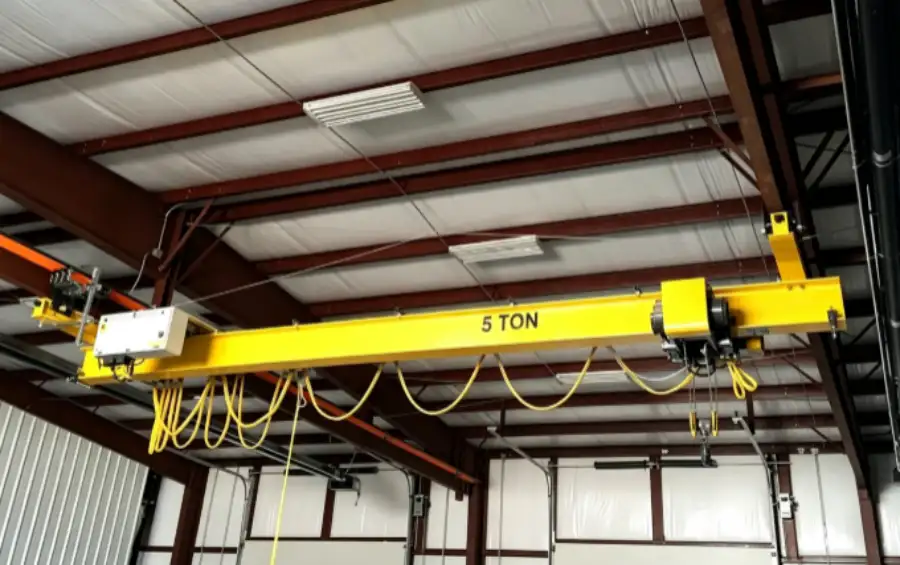
How to Select the Right Suspension Overhead Crane?
Choosing a suspension overhead crane requires more than selecting a lifting capacity.
The building structure, working area, operating frequency, and load characteristics should all be considered.
1. Lifting Capacity
Determine the maximum weight that needs to be lifted.
The crane should be selected according to the actual maximum working load rather than the average load.
2. Crane Span
The span is the distance between the two crane runway tracks.
Accurate workshop measurements are important because the crane structure must match the existing building layout.
3. Lifting Height
Measure the required distance between floor level and the highest hook position.
Roof height, crane structure, hoist dimensions, and required clearance should all be considered.
4. Runway Length
The runway length determines how far the crane can travel through the workshop.
This should be based on the actual material handling area rather than the total building length.
5. Working Duty
Operating frequency directly affects crane design.
A crane used occasionally for maintenance has different requirements from a crane operating continuously on a production line.
Information such as lifting cycles per hour and working hours per day can help determine the correct configuration.
6. Building Structure
This is one of the most important factors.
Because the crane is suspended from above, the roof beams or supporting steel structure must be capable of carrying:
-crane dead weight;
-lifted load;
-dynamic forces;
-traveling forces;
-horizontal loads.
Structural verification should be completed before installation.
7. Power Supply
Provide the required voltage, frequency, and phase according to the installation country and factory electrical system.
Frequently Asked Questions
What is a suspension overhead crane?
A suspension overhead crane is an overhead lifting system whose bridge travels underneath suspended runway beams. The crane is normally supported by the building roof structure or a specially designed overhead steel structure.
What is the difference between a suspension crane and an underhung crane?
In most industrial applications, the two terms refer to the same general crane configuration. Both describe a crane bridge that travels underneath the runway.
Can a suspension overhead crane be installed in an existing workshop?
Yes, provided that the existing building structure has sufficient load-bearing capacity. The roof beams and supporting structure should be checked before installation.
Does a suspension crane require floor columns?
Not always. One of its main advantages is that the crane can often be supported from the existing overhead structure, which reduces floor-level columns. However, additional structural supports may be required if the building cannot carry the crane loads.
Is a suspension crane suitable for heavy loads?
Suspension cranes are generally more suitable for light- and medium-duty material handling. For very large capacities or demanding heavy-duty operations, a top-running overhead crane is often more appropriate.
Can a suspension overhead crane use an electric chain hoist?
Yes. Electric chain hoists are commonly used for compact suspension crane systems. Wire rope hoists may also be selected depending on capacity, lifting height, duty, and operating requirements.